



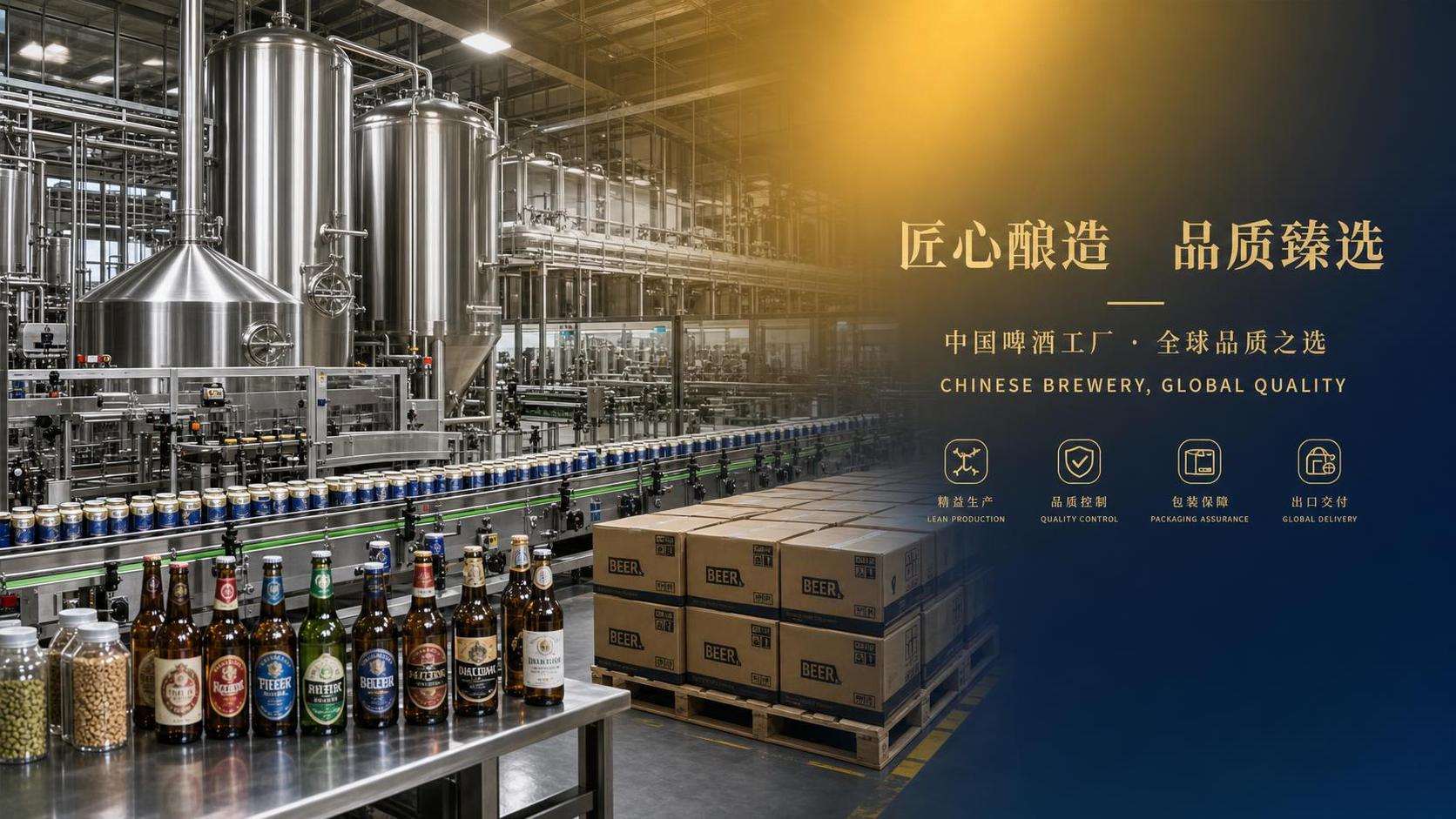
China Beer Factory Audit Checklist for First-Time Sourcing
For first-time buyers, auditing a China beer factory is usually the point where a promising supplier either becomes a realistic option or quietly drops off the list. A good sample can open the conversation, but it does not tell you how stable the brewing process is, whether packaging quality holds up at scale, or how well the factory handles export documentation, label control, and product customization.
That matters even more in beer, where product quality is tied to process discipline. Two factories may both offer lager, wheat beer, fruit beer, or private-label craft lines, yet their consistency, formulation flexibility, and delivery reliability can be very different. If you are sourcing for retail, bars, restaurants, or regional distribution, the audit is not a formality. It is how you test whether the supplier can support your market after the first shipment, not just win the inquiry.
Start with the factory’s actual business model
Before walking the production floor, clarify what kind of manufacturer you are looking at. Some suppliers are genuine breweries with in-house R&D, brewing, filling, and export coordination. Others are closer to trading operators or rely heavily on outsourced production. That difference affects lead time control, recipe development, MOQ flexibility, and problem solving when the product needs adjustment.
Ask directly how much of the process is managed in-house: recipe design, pilot testing, fermentation, filtration if applicable, canning or bottling, packaging sourcing, and final quality release. If you need OEM or ODM support, this question becomes even more important. A supplier that truly develops and produces beer products internally is usually better positioned to support classic lager, German wheat, sugar-free low-calorie styles, fruit-flavored lines, and more niche functional specialty beers without turning every change into a long back-and-forth between multiple parties.
This is also where portfolio breadth tells you something useful. A company engaged in R&D, production, and distribution across several categories is often more familiar with formulation adjustments for different channels, whether the destination is a supermarket shelf, a bar menu, or a private-label e-commerce launch.
Check brewing capability, not just finished products
When auditing a China beer factory, buyers sometimes focus too much on the packaged product and too little on how the beer is made. The brewing side is where many long-term quality issues begin.
Look at brewhouse condition, fermentation tank management, cleaning procedures, and whether process records are maintained in a way that can be reviewed. You are not necessarily looking for a perfect showroom. You are looking for evidence of control: raw material intake standards, batch tracking, sanitation routines, temperature monitoring, and handling of deviations.
If the supplier claims recipe customization, ask how new products are developed and validated. For example, fruit-flavored beer and low-calorie formulations usually introduce extra complexity in flavor balance, sweetness control, stability, and packaging compatibility. Functional specialty beers may raise additional questions around ingredients, claims, and destination-market restrictions. A competent factory should be able to explain where customization is straightforward and where it needs lab testing, pilot runs, or label review.
A simple but useful audit question is this: what changes from batch to batch, and what must never change? The answer often reveals whether the operation is process-driven or just sales-driven.
Review quality management in practical terms
Quality discussions in supplier meetings can become vague very quickly. During the audit, pull them back to operational details.
Ask what is tested at raw material stage, during brewing, before filling, and before shipment. You do not need the factory to drown you in technical language. You need to understand whether there is a routine, documented release process and whether nonconforming product is clearly isolated. If there is a lab, check whether it supports day-to-day production control or exists mainly for presentation.
Consistency matters more than grand claims. One clean sample is not enough. Ask to see how the factory handles repeat orders: retained samples, production records, complaint handling, and corrective actions. If you expect long-term cooperation, this discipline will matter more than any single tasting session.
Packaging lines deserve a full audit of their own
In export beer business, packaging is not a minor detail. It affects shelf presentation, leakage risk, transit loss, barcode readability, and importer compliance. A factory that brews well but packs poorly will still create claims and market headaches.
Check what packaging formats the supplier can run reliably: cans, bottles, multipacks, retail cartons, and display-ready outer cases if needed. Then go deeper. Are changeovers between SKUs controlled? How is date coding managed? What is the inspection process for fill level, seam or cap condition, label placement, and carton integrity?
For OEM projects, label approval flow is another common risk point. Errors in alcohol statements, ingredient declarations, language requirements, or importer details can delay customs clearance or force relabeling after arrival. A capable supplier should not act as your legal advisor, but it should understand that export label control is part of execution, not an afterthought.
Evaluate export readiness early
Many first-time buyers focus on product and price, then discover later that the supplier is less prepared for destination-market requirements than expected. Export readiness should be audited before commercial terms are finalized.
This includes document handling, product specifications, shelf-life communication, shipping mark control, and responsiveness when importers ask for technical files or compliance materials. Requirements vary by market, so this part usually needs confirmation against your local rules, but the factory should at least be used to preparing organized product data rather than assembling documents at the last minute.
Pay attention to how the team answers compliance questions. If every answer depends on one salesperson “checking later,” that is a warning sign. Export projects run more smoothly when operations, QA, and sales are aligned instead of working in silos.
OEM and ODM capability should be tested against your use case
Many suppliers offer private label services. Fewer can manage them well once the project moves beyond standard packaging. During the audit, ask how the factory handles custom formulations, alcohol level adjustments, sweetness changes, flavor development, and packaging redesign. Then match the answers to your channel strategy.
If you are building a branded retail line, you may need repeatability, marketing-friendly taste profiles, and packaging flexibility across several SKUs. If you are supplying bars or restaurant chains, keg or on-premise format support, stable lead time, and menu-specific customization may matter more. If your market is experimenting with sugar-free or functional concepts, formulation support and claim review will need closer scrutiny.
This is where a broader operating model can help. A manufacturer that already works across online and offline channels, and serves different retail and foodservice environments, often has a better feel for how product decisions affect packaging, freight, shelf life, and reorder planning.
Do not ignore supply chain basics
Some audits spend hours on brewing details and almost no time on production planning. That is a mistake. Reliable sourcing depends on the unglamorous part of operations: raw material availability, packaging material lead times, order scheduling, and warehouse discipline.
Ask what typically drives lead time in this factory. Is it brewing capacity, fermentation cycle, printed can or label procurement, or shipment scheduling? For customized products, packaging often becomes the bottleneck before the beer itself does. If the factory is vague about planning constraints, your launch calendar may be built on guesswork.
It is also worth checking how the supplier handles peak season. You are not looking for promises that everything is always smooth. You are looking for realism, transparency, and a planning method that can support reorder visibility.
A short audit table for decision meetings
What usually separates a workable supplier from a risky one
In practice, first-time sourcing decisions are rarely won by the lowest quote alone. A workable China beer factory tends to show the same pattern across departments: the product team understands formulation limits, the production team can explain process control, the packaging team manages execution details, and the sales team does not overpromise what operations cannot deliver.
That kind of alignment matters if you plan to build a long-term portfolio rather than place one opportunistic order. It is especially relevant when the supplier offers a broad beer range and custom development support. The more varied the product mix, the more important internal coordination becomes.
On the other hand, if your audit reveals nice samples, polished presentations, but weak traceability, unclear ownership of custom projects, or inconsistent answers between departments, proceed carefully. Those issues tend to surface again during relabeling requests, urgent replenishment, or quality complaints.
A first audit does not need to answer every technical question on the spot. It should help you decide whether the supplier is worth moving into sample refinement, commercial negotiation, and compliance review. If that next step involves custom beer styles, private label packaging, or multi-channel distribution, confirm the exact specification, lead time assumptions, and destination-market requirements before locking the first production run.
Thank you very much for writing to us. Please leave your message and contact information, we will reply to you within 24 hours.