



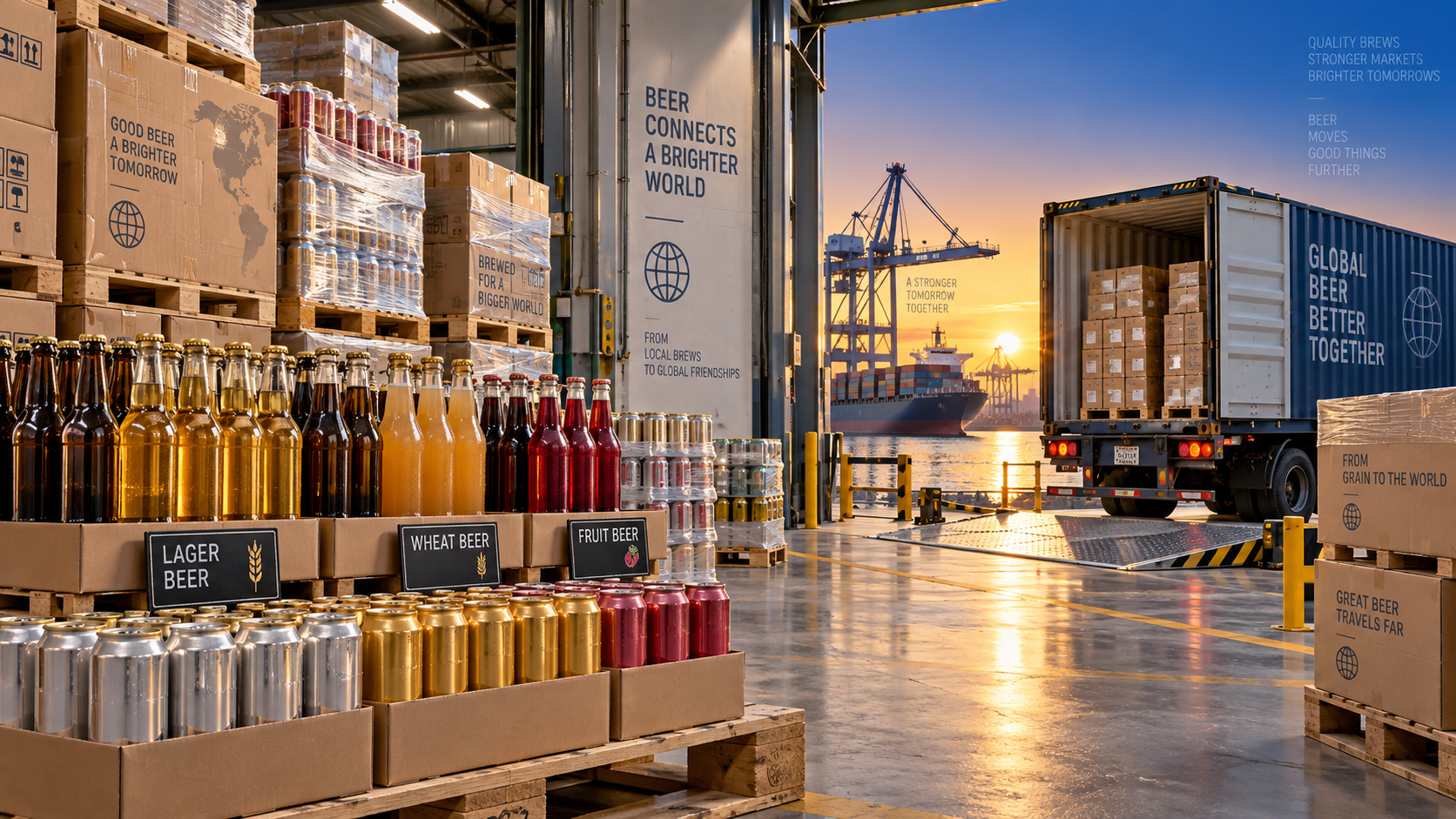
A distributor preparing to introduce beer into a new market is rarely concerned with taste alone. The questions arrive quickly: Which styles will fit local drinking habits? Can the supplier support private-label requests? How will mixed product lines move from brewery to warehouse without creating gaps on the shelf? What happens when a restaurant group wants wheat beer in summer, while an online retailer is asking for low-calorie cans and a bar chain is testing fruit-flavored seasonal releases?
These are not separate problems. They are parts of one export launch plan. Working with a brewery with global logistics gives distributors, agents and import partners a way to connect product selection, production planning, documentation and delivery into a practical route to market. For Jinpai Beer partners, that route can include classic lager, German wheat beer, sugar-free low-calorie beer, fruit-flavored beer and functional specialty beer, supported by wholesale supply as well as OEM/ODM customization.
The goal is not simply to send beer abroad. It is to create an assortment and supply rhythm that a local market can absorb, reorder and grow with confidence.
Begin with the destination market, not the brewery catalogue
A broad beer range is valuable only when it is translated into a local commercial opportunity. A distributor may be tempted to launch every available SKU at once, hoping variety will create attention. In practice, an oversized opening assortment can complicate customs clearance, warehouse management, sales training and stock rotation. It also makes it harder to understand what customers actually want.
A more grounded launch plan starts by dividing the destination market into sales occasions. Supermarkets often require approachable, repeat-purchase styles and clear shelf logic. Restaurants may want food-friendly wheat beer or a reliable lager that works across different menus. Bars are more likely to trial distinctive fruit beers or functional specialty beers that give customers something new to discuss. Online stores can present more product detail and may perform well with targeted options such as sugar-free, low-calorie or limited-flavor products.
For many first-stage export programs, a distributor can build a compact assortment around three roles:
- The anchor product: a familiar, accessible beer such as classic lager, intended to establish steady volume and recognizable value.
- The point-of-difference product: German wheat beer or a fruit-flavored line that gives sales teams a story beyond the standard lager shelf.
- The audience-specific product: sugar-free low-calorie beer or functional specialty beer for consumers making more deliberate lifestyle choices.
This structure is not a rule; it is a way to avoid launching blindly. In a market driven by casual on-trade consumption, the anchor and point-of-difference products may deserve greater emphasis. In a health-oriented retail environment, a low-calorie option may need to appear from day one. The right mix comes from local channel knowledge, not from copying another importer’s range.
Turn a product list into a channel-by-channel launch map
Beer travels through very different commercial worlds. A restaurant buyer thinks about menu fit, serving experience and reliable replenishment. A supermarket buyer looks at packaging, price architecture, shelf movement and promotional windows. An agent supplying neighborhood stores may care most about carton efficiency and the simplicity of selling the first order. A digital retailer needs clear product descriptions, compliant imagery and an assortment that can be discovered through search or social content.
For this reason, export planning should assign each beer style a job before the first shipment is booked. Classic lager can be positioned as the everyday option for supermarkets, casual dining and broad retail. German wheat beer may suit restaurants, independent bars and premium grocery environments where customers are open to style exploration. Fruit-flavored beer can support summer activations, event venues, younger adult consumer segments where permitted, and online discovery packs. Sugar-free low-calorie beer deserves messaging that is accurate, market-compliant and easy for shoppers to understand. Functional specialty beers require even more care: the claims, labeling language and positioning should be reviewed against destination-market rules before any promotional campaign begins.
A useful distributor exercise is to ask sales teams to complete one sentence for every SKU: “This beer is for this customer, in this channel, because it solves this buying occasion.” If the sentence is vague, the product may not yet have a clear place in the launch.
What global logistics should mean in an export plan
The phrase “global logistics” can sound broad, but distributors need to reduce it to operational details. A brewery with global logistics should be able to support coordination across the stages that most often affect a beer launch: order planning, production scheduling, packing configuration, export documents, shipping arrangements and communication around delivery timing.
Beer is not an abstract commodity. It has packaging formats, handling needs, shelf-life considerations and market-specific label requirements. A well-designed logistics process helps the importer avoid discovering these issues after goods have already been produced. Before confirming an order, partners should align on product specifications, carton dimensions, palletization where relevant, loading preferences, destination port or delivery point, and the documents required by the importing country.
It is equally important to discuss the handoff between parties. Who is responsible for freight booking? Who prepares commercial invoices and packing lists? What information is needed for customs declaration? Which party checks label text and local language requirements? The answer will vary by trade term, destination and partner capability, but uncertainty should never be left to the final days before loading.
Jinpai Beer can work with international partners on wholesale supply and customized beer projects while helping align supply arrangements with the commercial launch calendar. For an importer, this makes it easier to plan around real selling moments rather than treating shipping as an afterthought. A summer fruit beer program, for example, needs to be in-market before the season—not sitting in transit when the campaign window has already passed.
Build the launch in phases so demand can guide the next order
Export success is often less about getting the first shipment perfect than about learning quickly without creating unnecessary stock pressure. Instead of treating the opening order as a final statement, distributors can structure it as the first phase of a longer market-entry program.
Phase one: establish availability. Choose a manageable number of products, prepare local sales materials, train the sales team on the range, and secure initial listings in the channels most likely to generate useful feedback. This stage should confirm basic questions: Which package format receives the strongest response? Are consumers choosing lager for familiarity or moving toward wheat and fruit styles? Does the retailer need a different mix than the bar channel?
Phase two: refine the assortment. Once reorder patterns become visible, expand selectively. A fast-moving lager might justify deeper inventory planning. A fruit-flavored product may perform better as a seasonal feature rather than a year-round core line. If low-calorie beer draws interest online but not in physical retail, the distributor can adjust channel allocation rather than abandoning the product altogether.
Phase three: localize the offer. This is often the point at which OEM/ODM conversations become meaningful. A partner may want packaging tailored to a regional retail identity, a private-label range for a supermarket program, a flavor profile suited to local preferences, or a promotional pack created for a holiday period. Customization works best when it follows evidence from the market, not when it is used as decoration at the beginning.
OEM/ODM is a commercial tool, not just a packaging request
For distributors and agents, OEM/ODM services can open doors that a standard catalogue alone may not. A retailer may be interested in building an exclusive beer line. A hospitality group may want a branded product for its venues. An established beverage importer may need a range that complements existing spirits, soft drinks or food brands without competing directly with them.
However, customization introduces more decisions. Partners should define the target customer, intended price tier, package format, artwork ownership, language requirements, product style and order rhythm before moving too far into development. It is also wise to consider whether the custom product can be supported by a realistic forecast. A visually attractive private-label beer becomes a burden if it is designed without a clear replenishment plan.
When discussing an OEM or ODM project with Jinpai Beer, distributors can approach the conversation from the market backward: explain the channel, consumer profile, expected positioning and desired launch timing. From there, product options can be evaluated across lager, wheat, fruit-flavored, low-calorie and specialty categories. That approach produces a more coherent result than simply asking for a custom label on an unsuitable base product.
Protect the launch from the common export mistakes
Many avoidable problems come from decisions made too late. One of the most frequent mistakes is confirming labels without checking destination-market requirements. Alcohol labeling can involve language, ingredient, allergen, deposit, recycling, responsible-consumption or other local obligations. Requirements vary, and distributors should work with qualified local regulatory or customs advisers where necessary. A brewery can provide product information and export documentation support, but the importer must ensure that goods are appropriate for its market.
Another mistake is treating lead time as only a shipping issue. Production capacity, packaging procurement, artwork approval and port scheduling can all affect the date goods are ready to leave. A realistic launch calendar includes time for these steps, as well as customs clearance, warehouse intake and sales activation after arrival.
There is also the issue of portfolio imbalance. A shipment containing only niche styles may excite a small group of enthusiasts but leave the distributor without a dependable volume product. On the other hand, a range made entirely of familiar lager may be easy to sell but difficult to differentiate. The most resilient export assortment often combines everyday accessibility with a controlled amount of discovery.
Finally, avoid measuring the program only by the first purchase order. Reorders, sales velocity by channel, seasonal performance, consumer feedback and sales-team confidence are more meaningful indicators of whether the plan can scale.
A practical planning conversation before placing an order
Distributors evaluating a brewery with global logistics should enter the first planning meeting with a few clear inputs: target countries or regions, intended channels, estimated opening volume, preferred beer categories, required packaging formats, target launch period and any private-label ambitions. This does not mean every detail must be fixed. It means the brewery and importer can begin with the same commercial picture.
From there, the discussion can cover product recommendations, sample evaluation where appropriate, customization possibilities, production timing, export documentation, shipment configuration and future reorder expectations. The most productive partnerships are transparent about what is known and what is still uncertain. A new distributor may not yet know which fruit flavor will lead the category, but it can still identify whether the opportunity lies in premium bars, convenience retail, online bundles or restaurant menus.
Jinpai Beer supports partners looking to develop beer programs across international online and offline channels. Its portfolio provides room for both broad-market and differentiated positioning, while wholesale supply and OEM/ODM capabilities give distributors options as their local strategy matures. For restaurants, supermarkets, bars, specialist retailers and digital sales platforms, the emphasis remains the same: match the beer to the occasion, match the supply plan to demand, and make logistics part of the commercial design from the start.
From shipment to sustained market presence
A beer export launch becomes durable when the brewery, distributor and local sales channels are working from one connected plan. The beer needs a reason to be chosen. The packaging needs to make sense in its channel. The order needs to arrive in time for the selling season. And the first shipment should create enough insight to improve the next one.
That is the practical value of partnering with a brewery with global logistics: not merely access to international delivery, but a framework for bringing lager, wheat beer, low-calorie options, fruit flavors and specialty products into a market with greater clarity. For distributors and agents, that clarity can turn an initial import order into a repeatable, adaptable export business.
Thank you very much for writing to us. Please leave your message and contact information, we will reply to you within 24 hours.