



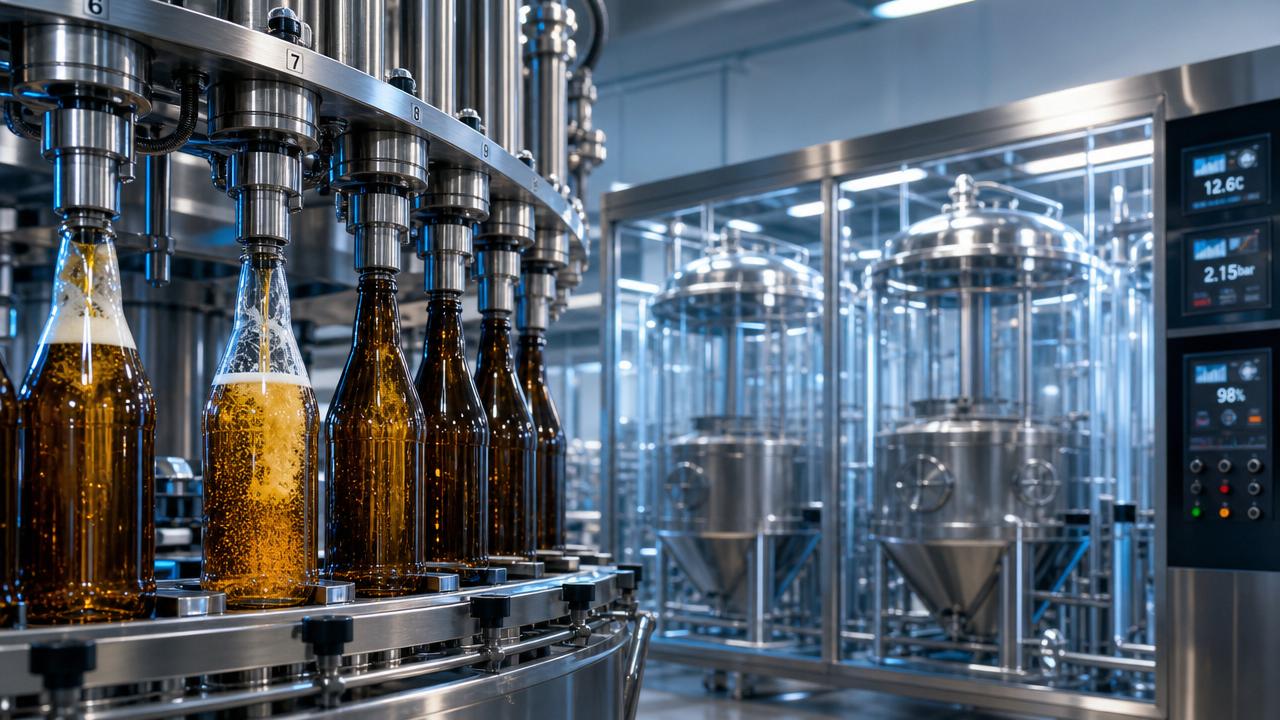
When scaling craft beer production, quality consistency becomes the make-or-break factor—especially for food safety and QA managers overseeing compliance across markets. A trusted Beer OEM manufacturer like Jinpai Beer offers rigorous HACCP-certified brewing, batch traceability, and regulatory-aligned documentation—without compromising on flavor integrity or functional innovation. Unlike in-house expansion, which strains resources and risks variability, partnering with an experienced OEM ensures scalable output while maintaining strict sensory, microbiological, and labeling standards. Let’s explore when outsourcing isn’t a compromise—but the strategic threshold for sustainable growth.
Why Scenario-Based Evaluation Matters for QA & Food Safety Teams
For quality control and food safety professionals, “scaling” isn’t just about volume—it’s about preserving analytical rigor, audit readiness, and cross-market compliance under pressure. In-house brewing capacity upgrades often introduce uncontrolled variables: new equipment validation gaps, staff training lag, inconsistent raw material sourcing, and delayed response to microbial deviations. Meanwhile, a qualified Beer OEM manufacturer operates within a locked-down quality ecosystem—designed not for flexibility alone, but for reproducibility, documentation fidelity, and third-party verifiability. The decision isn’t “OEM vs. brewer”—it’s “which scenario demands which quality assurance architecture?”
Four High-Stakes Scenarios Where OEM Partnership Becomes a Quality Threshold
Not all scaling moments are equal. Below are real-world scenarios where QA and safety leaders at restaurants, importers, specialty retailers, and emerging brands encounter critical inflection points—and where engaging a certified Beer OEM manufacturer shifts from option to operational necessity.
Scenario 1: Launching Multi-Market Distribution (EU + US + ASEAN)
Each region imposes distinct labeling rules (alcohol-by-volume rounding, allergen declarations, nutrition claims), packaging safety standards (glass fragmentation testing, child-resistant caps), and microbiological limits (e.g., Saccharomyces diastaticus thresholds differ in Germany vs. Singapore). An in-house team must build parallel SOPs, validate multiple label versions, and maintain separate QC logs per jurisdiction. A Beer OEM manufacturer like Jinpai Beer embeds regional compliance into its core workflow—providing pre-audited labels, country-specific CoAs, and ISO 22000–aligned batch records ready for customs clearance or retailer onboarding.
Scenario 2: Introducing Functional or Low-Calorie Formulations
Sugar-free lagers, probiotic wheat beers, or CBD-infused variants demand precise stabilization, preservative efficacy testing, and shelf-life validation under real-time stress conditions (light, temperature cycling, oxygen ingress). In-house labs rarely possess validated methods for functional ingredient interaction studies—or the throughput to run accelerated stability trials across 12+ SKUs. Jinpai Beer’s R&D lab conducts full functional claim substantiation per EFSA/FDA/Health Canada guidance, with documented challenge testing and real-time monitoring of live cultures or enzymatic activity—ensuring claims withstand regulatory scrutiny and consumer expectation alike.
Scenario 3: Responding to Sudden Retailer Demand (e.g., National Supermarket Chain Onboarding)
A Tier-1 retailer may require 20,000 units/month within 90 days—including full traceability down to malt lot, yeast strain passage number, and centrifuge run ID. In-house facilities face bottlenecks in fermentation scheduling, filtration capacity, and packaging line calibration—leading to rushed validations and compromised sterility assurance. A seasoned Beer OEM manufacturer maintains buffer capacity, pre-qualified suppliers, and digital batch records synced to blockchain-enabled traceability platforms—delivering full audit trails without compromising sensory benchmarks or microbial safety.
Scenario 4: Managing Seasonal or Limited-Edition Line Extensions
Fruit-flavored sours or barrel-aged stouts involve high-risk variables: post-fermentation fruit additions (yeast reactivation risk), wood-derived contaminants (e.g., chlorophenols), and extended aging timelines that amplify spoilage vulnerability. QA teams must verify each small-batch iteration against historical baselines—not just alcohol content, but ester profiles, pH drift, and Lactobacillus load. Jinpai Beer applies sensory panel benchmarking + rapid qPCR pathogen screening per batch, ensuring seasonal releases meet both brand promise and food safety thresholds—no guesswork, no batch recalls.
Key Decision Criteria: Matching Your Scenario to OEM Readiness
Selecting a Beer OEM manufacturer isn’t about cost—it’s about alignment with your quality infrastructure. Use this table to assess fit:
What QA Managers Often Overlook (But Should Verify First)
Before finalizing a Beer OEM manufacturer partnership, confirm these often-overlooked operational realities:
- Microbiological release criteria: Does the OEM test for S. diastaticus, wild Brettanomyces, and Pediococcus using culture-independent methods (e.g., ddPCR), not just plating?
- Sensory continuity protocol: Is there a trained internal panel conducting blind triangle tests against master reference batches every 3rd production run?
- Raw material provenance tracking: Can they provide malt origin maps, hop oil chromatograms, and yeast strain authentication reports—not just supplier invoices?
- Audit readiness: Are HACCP plans, SSOPs, and corrective action logs available for remote review within 48 hours?
Next Steps: Aligning Your Quality Framework with Scalable Execution
If your current scaling path is triggering any of the four scenarios above—or if your QA team spends >30% of bandwidth managing variability instead of advancing standards—you’ve likely crossed the quality threshold. Jinpai Beer supports global partners through three actionable entry points:
- Compliance Gap Audit: Free 2-hour remote assessment of your labeling, documentation, and microbiological controls against target markets.
- Batch Benchmarking Pilot: Produce 500L of your recipe under Jinpai’s HACCP system—with full CoA, sensory report, and traceability map.
- QA Integration Workshop: Joint session mapping your existing SOPs to Jinpai’s digital quality management platform (validated for FDA 21 CFR Part 11).
Quality isn’t sacrificed at scale—it’s re-engineered. When consistency, compliance, and consumer trust converge, the right Beer OEM manufacturer isn’t a vendor. It’s your quality extension.
Thank you very much for writing to us. Please leave your message and contact information, we will reply to you within 24 hours.