



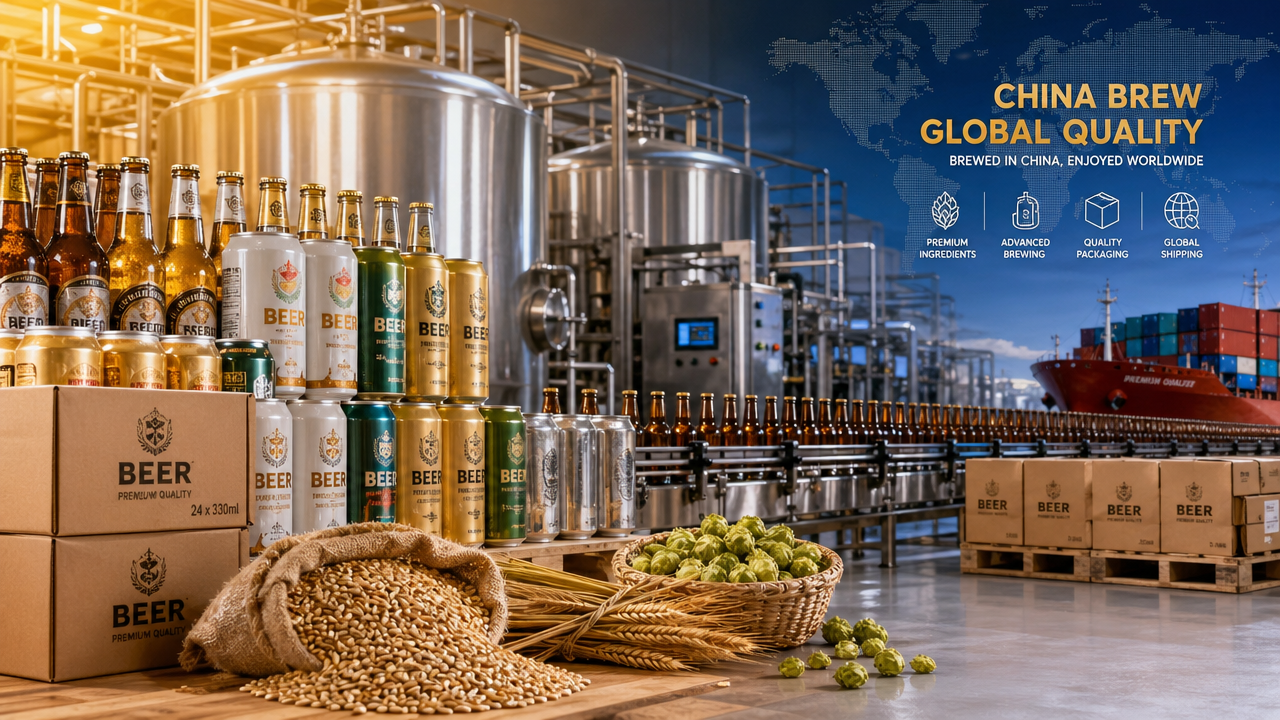
Choosing the right beer manufacturer China is about more than price alone. For buyers comparing a Chinese beer factory, bulk beer supplier, or private label beer manufacturer, total cost depends on recipe complexity, packaging, order volume, OEM/ODM flexibility, and export capability. Whether you need craft beer OEM China, contract brewing, or custom beer manufacturing for supermarkets, bars, or retail channels, understanding these key cost drivers helps you source smarter and build a more competitive beer brand.
What really drives the cost of a beer manufacturer in China?
When buyers ask for a price from a beer manufacturer China, they often receive very different quotations for products that seem similar at first glance. The reason is simple: beer cost is built from multiple layers, not only liquid production. Recipe design, malt and hop grade, alcohol content, fermentation cycle, filtration method, packaging format, and export preparation all influence the final number. For procurement teams, the lowest unit price can easily become the highest total cost if the product does not match the target market.
In the beverage industry, cost changes are especially sensitive when the project includes craft beer OEM China or private label beer manufacturer services. A standard lager produced in large volume normally has a different cost structure from German wheat beer, sugar-free low-calorie beer, fruit-flavored beer, or functional specialty beer. The difference is not only ingredient price. It also includes brewing time, stability control, flavor consistency, and packaging compatibility across online and offline channels.
For distributors, restaurant groups, supermarket buyers, and brand owners, the most practical way to evaluate a Chinese beer factory is to separate cost into 5 core areas: liquid formula, packaging system, order scale, customization depth, and export service. This framework helps decision-makers compare suppliers on the same basis within 7–15 working days instead of relying on headline pricing alone.
Jinpai Beer focuses on R&D, production, and distribution across classic lager, German wheat, sugar-free low-calorie beer, fruit-flavored beer, and functional specialty beers. That matters because broad category capability gives buyers more room to balance target flavor, market positioning, and budget instead of forcing one formula into every channel.
Five cost layers buyers should separate before comparing quotes
- Liquid cost: malt ratio, hop usage, yeast choice, adjuncts, fruit materials, and process intensity all shape the brewing cost per batch.
- Packaging cost: cans, bottles, keg options, carton structure, tray packing, and label method can change unit cost quickly.
- Volume efficiency: small test runs and mixed SKU orders usually carry a higher per-unit cost than stable production runs.
- OEM/ODM cost: custom formulation, design adaptation, sample rounds, and flavor tuning increase front-end development work.
- Export support cost: documents, compliance coordination, palletization, container loading plans, and destination-specific requirements add operational work.
Once these layers are visible, buyers can judge whether a quotation is genuinely competitive or simply incomplete. This is especially important in cross-border beverage sourcing, where a low ex-factory price may exclude packaging adjustments, documentation support, or channel-ready labeling.
How do recipe, ingredients, and brewing process change total cost?
The first major variable is the beer itself. In a Chinese beer factory, classic lager is often the most cost-efficient style because the process is standardized and raw material planning is more predictable. By contrast, wheat beer, low-calorie beer, fruit beer, and functional variants often require different ingredient systems, tighter flavor balancing, or additional process controls. Even a small formula change can affect production yield and shelf stability.
A buyer should ask at least 4 technical questions before comparing offers: what is the target taste profile, what is the expected alcohol range, what is the intended shelf-life, and what channel will sell the product first. A bar-focused craft product and a supermarket private label product may both be beer, but their process priorities are different. One may prioritize freshness and aroma; the other may prioritize consistency and transport stability over 6–12 months.
Brewing time is another hidden factor. More complex styles may need a longer fermentation and conditioning cycle, which occupies tank capacity for more days. Capacity occupation has a direct cost effect, especially during peak scheduling periods. For OEM buyers launching multiple SKUs at the same time, tank planning can be as important as ingredient budgeting.
This is why supplier capability matters. A manufacturer with established R&D and broader product lines can usually guide buyers toward formulas that fit both market demand and production efficiency. In some cases, slight adjustments in bitterness, fruit concentration, or calorie positioning can reduce complexity without weakening shelf appeal.
Typical recipe factors that increase or stabilize cost
The table below helps procurement teams compare where cost tends to move when selecting different beer styles or formulation paths from a beer manufacturer China.
For buyers, the key lesson is that cost should be linked to product positioning. If your target customer wants premium differentiation, investing in formula complexity may be justified. If your goal is large retail turnover, a cleaner and more scalable formulation often protects both margin and supply continuity.
A practical example for channel matching
A supermarket buyer may favor a stable, repeatable wheat lager with broad appeal and easier stock rotation. In that case, a product such as Whole wheat lager Beer can fit a balanced strategy between flavor identity and operational simplicity, especially when the goal is steady turnover across multi-store retail networks.
By comparison, a nightlife distributor might prioritize stronger visual packaging and more distinct taste segmentation. The liquid cost may be only one part of the decision, while bar menu positioning and repeat ordering behavior become equally important.
Why do packaging and order volume often change cost more than expected?
In many beer OEM projects, packaging is the second major cost driver and sometimes the most underestimated one. Buyers often focus on beer style first, but can format, bottle weight, cap type, label process, tray or carton structure, and pallet specification can strongly influence the landed cost. A low-cost recipe packed in a premium presentation may end up more expensive than a higher-grade liquid in a simple retail pack.
Order volume also changes the picture. Small-batch custom beer manufacturing usually includes setup loss, artwork coordination, and less efficient production scheduling. Larger repeat orders can improve material planning and reduce cost per unit. This does not mean buyers should always order more. It means they should align volume with sell-through speed, storage conditions, and channel launch strategy.
A useful way to evaluate quotes is to compare them across 3 volume bands: trial launch, growth stage, and mature channel supply. The same beer manufacturer China may provide very different economics at each stage. For many private label beer manufacturer projects, the best path is to start with a controlled batch, validate market response in 1–2 channels, then scale the winning SKU.
Procurement teams should also remember that export packaging is not only a branding issue. It affects breakage risk, pallet loading efficiency, warehouse handling, and container utilization. A slightly higher packaging cost can reduce transit damage and improve on-shelf appearance, which may protect gross margin better than chasing the lowest packaging price.
Packaging and volume comparison for sourcing decisions
The following comparison table is useful when discussing packaging plans and MOQ strategy with a bulk beer supplier or contract brewing partner.
This table shows why procurement should compare total packaging strategy, not only unit carton or bottle price. Good suppliers help buyers simplify where simplification does not hurt shelf impact, and invest where packaging supports premium positioning or safer export delivery.
Three volume strategies that reduce sourcing risk
- Use a pilot order to confirm taste, shelf presentation, and early sell-through before expanding into wider distribution.
- Group similar SKUs under shared packaging materials where possible to reduce procurement fragmentation.
- Build a 2–3 month rolling forecast with the supplier so production planning and packaging purchasing become more efficient.
These steps are especially useful for distributors and agents entering a new region, where demand is real but exact SKU rotation is not yet fully known.
How should buyers evaluate OEM, ODM, and export capability before placing an order?
For many international buyers, the cost question is closely tied to service scope. A contract brewing supplier offering only production is different from a partner that supports OEM/ODM, packaging adaptation, sample refinement, and export coordination. The wider the service package, the more important it becomes to define exactly what is included in the quote. This reduces misunderstandings and helps finance teams estimate the real project cost.
A practical evaluation usually involves 4 stages: demand confirmation, sample or formula alignment, packaging and document review, then production scheduling. Depending on complexity, this process may take 2–6 weeks before mass production begins. Buyers with urgent timelines should confirm not only liquid lead time but also artwork readiness, packaging availability, and destination-market documentation requirements.
Export capability matters because beer is a product where transport, storage, and market compliance all affect performance after shipment. Label language, ingredient declaration, date coding, outer carton marks, and shipping configuration should be checked early. Even if the product quality is acceptable, weak export preparation can delay customs clearance or create relabeling costs in the destination market.
Jinpai Beer supports OEM/ODM services, wholesale supply, and customized solutions for restaurants, supermarkets, bars, and retail channels worldwide. For buyers, this matters because channel-specific customization often determines whether a product becomes commercially viable, not just whether it can be produced.
Supplier review checklist for procurement and management teams
- Can the manufacturer handle multiple beer categories such as lager, wheat beer, low-calorie, fruit-flavored, and specialty functional styles?
- Does the quotation clearly separate liquid, packaging, sampling, design adaptation, and export-related items?
- What is the normal sample cycle, and how many rounds of adjustment are practical before launch?
- Can the supplier support online and offline channel requirements, including supermarket shelf formats, bar presentation, and distributor pack sizes?
- How are lead-time expectations managed during peak periods or mixed-SKU orders?
This checklist helps business decision-makers move beyond marketing claims. A capable beer manufacturer China should be able to discuss not only brewing, but also product-market fit, packaging practicality, and export execution in a structured way.
Common procurement mistake
One frequent mistake is treating OEM and ODM as the same service. OEM often works from an existing formula or a buyer-defined direction, while ODM may include stronger supplier-side development input on taste, style, and market adaptation. The broader the development role, the more important it is to define ownership, revision scope, and launch timeline from the beginning.
What are the most useful cost-control strategies without weakening product value?
The best cost control in beer sourcing is not simple price cutting. It is design alignment. Buyers can often improve cost efficiency by refining the recipe target, reducing unnecessary packaging complexity, limiting early-stage SKU proliferation, and matching volume to demand more carefully. This keeps the beer brand commercially attractive while protecting margin.
For example, if a buyer wants a premium but broadly accessible product, it may be smarter to prioritize one strong hero SKU and one support SKU rather than launching 5 or 6 variants at once. Fewer initial SKUs usually mean cleaner packaging procurement, simpler inventory control, and faster market feedback. After 1 sales cycle or 1 quarter, the product line can expand based on actual performance.
Cost can also be controlled through channel-specific packaging. Bars may accept formats that emphasize service convenience or visual identity, while supermarkets may need stronger focus on shelf efficiency and barcode clarity. A one-packaging-fits-all strategy often creates hidden waste across channels. Better segmentation leads to better economics.
Another good approach is to discuss substitute paths with the supplier. In some projects, slight adjustments to grain composition, flavor intensity, or outer packaging can protect the target retail price while keeping the product profile intact. A collaborative beer manufacturer China should be able to offer alternatives rather than forcing a yes-or-no decision.
Four practical ways to control cost in custom beer manufacturing
- Start with 1–2 priority SKUs, then expand after real market feedback from distributors, bars, or retail stores.
- Use standardized packaging components where shelf differentiation does not depend on custom structures.
- Confirm channel-specific compliance and label needs before artwork finalization to avoid rework and relabeling cost.
- Plan repeat ordering windows in advance so production and material procurement can be aligned more efficiently.
These methods are especially valuable for private label launches, where brand owners must control upfront cost while still presenting a credible, consistent beer offering to the market.
FAQ: what do buyers ask most often about beer manufacturing cost in China?
Before contacting a supplier, buyers usually want fast answers on MOQ, lead time, customization, and export readiness. The questions below reflect common sourcing intent from distributors, procurement teams, and brand owners comparing beer manufacturer China options.
How long does a typical OEM or private label beer project take?
A normal project often moves through 3 stages: requirement confirmation, sample and packaging alignment, then mass production scheduling. Depending on formula complexity and packaging readiness, the pre-production stage may take 2–6 weeks. If artwork, labeling, and destination requirements are confirmed early, the process is usually smoother and more predictable.
Is the cheapest quotation usually the best choice?
Not necessarily. Buyers should compare at least 5 points: liquid specification, packaging scope, MOQ basis, included service items, and export support. A lower quote may exclude sample revisions, document preparation, or channel-specific packaging details. The better decision is usually the supplier with the clearest total-cost structure.
Which products are easier to launch for broad retail channels?
Products with broad taste acceptance and operational simplicity often work well for early retail entry. A balanced wheat or lager profile can be easier for supermarkets and mixed retail outlets than highly niche flavors. In some channel strategies, Whole wheat lager Beer may suit buyers who want craft identity without making the assortment too narrow for mass consumers.
What should distributors ask before committing to a long-term supply relationship?
Distributors should confirm supply continuity, SKU expansion ability, documentation support, and response time for repeat orders. It is also smart to discuss 2–3 growth scenarios in advance, such as pilot region launch, wider supermarket entry, or bar-chain expansion. This reveals whether the manufacturer can support the business after the first shipment, not only at the quotation stage.
Why work with a manufacturer that can support both product range and channel strategy?
A beer project succeeds when product, packaging, and channel execution fit together. That is why many buyers prefer a partner that can support classic lager, wheat beer, sugar-free low-calorie beer, fruit-flavored beer, and functional specialty beers under one manufacturing system. It reduces coordination friction and makes it easier to compare launch options for restaurants, supermarkets, bars, and retail distribution.
Jinpai Beer combines R&D, production, distribution, OEM/ODM service, wholesale supply, and customization support for global markets. For procurement managers, this means faster alignment on product selection, sample direction, packaging planning, and order execution. For decision-makers and agents, it means a stronger base for building differentiated beer programs with practical commercial support.
If you are comparing a Chinese beer factory, contract brewing partner, or private label beer manufacturer, the next step should be specific rather than general. Prepare your target style, packaging format, order quantity range, launch channel, and destination market requirements. With those 5 inputs, supplier discussions become much more accurate and useful.
Contact us to discuss product selection, formula direction, packaging options, sample support, lead-time planning, export preparation, and quotation details. Whether you need a bulk beer supplier for stable wholesale orders or custom beer manufacturing for a new brand launch, we can help you assess cost drivers clearly and build a sourcing plan that fits your market and budget.
Thank you very much for writing to us. Please leave your message and contact information, we will reply to you within 24 hours.