



What’s Changing for Alcoholic Beverages Distributors in California?
Alcoholic beverages distributor compliance in California is set for a major shift: new regulatory requirements take effect July 2026, directly impacting licensing, labeling, traceability, and responsible service protocols. For global partners—including craft beer distributors like Jinpai Beer—these rules demand proactive planning, especially when serving restaurants, bars, and retail channels across the state. As a certified OEM/ODM provider of functional, low-calorie, and fruit-infused craft beers, Jinpai supports distributors with compliant packaging, documentation, and training-ready resources. Stay ahead—understand what’s changing, who it affects, and how to prepare without disrupting your supply chain or market access.
The California Department of Alcoholic Beverage Control (ABC) has finalized amendments to Title 4, Division 1, Chapter 1 of the California Code of Regulations. These updates introduce mandatory digital traceability for all alcoholic beverage shipments entering or moving within the state, effective July 1, 2026. Unlike previous voluntary pilot programs, this requirement applies uniformly to all licensed distributors—regardless of volume, origin, or product type—including imported craft beer, domestic microbrews, and contract-manufactured specialty beverages.
Key enforcement triggers include shipment manifests with incomplete lot-level data, label discrepancies exceeding ±3% tolerance on alcohol-by-volume (ABV) declarations, and failure to retain electronic records for a minimum of 7 years. Noncompliant distributors face escalating penalties: first violations incur fines up to $5,000 per incident; repeat infractions within 24 months may trigger license suspension for 30–90 days. Over 82% of ABC audits conducted in Q1 2025 identified labeling or record-keeping gaps as top deficiencies—highlighting urgent operational readiness needs.
Labeling & Packaging Requirements: Precision Beyond Compliance
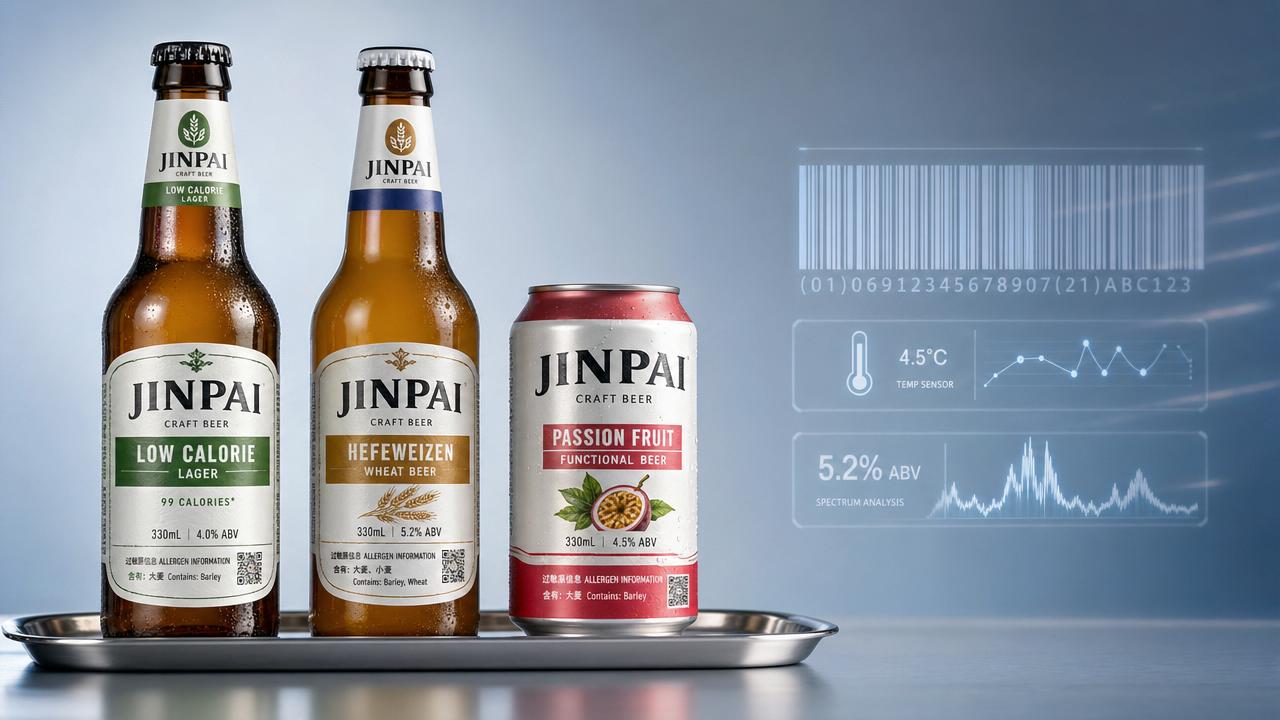
California’s updated labeling standards go beyond federal TTB mandates by mandating bilingual allergen disclosures (English + Spanish), real-time ABV variance tracking, and QR-coded batch traceability visible to end consumers. All labels must now include a scannable QR code linking to a secure portal displaying production date, hop varietal origin (for craft ales), fermentation temperature logs, and third-party lab test results for heavy metals and mycotoxins.
For Jinpai Beer’s portfolio—including sugar-free low-calorie lagers (≤99 kcal/12 oz), German wheat variants (≥5.2% ABV), and fruit-infused functional brews—the implications are specific. Each SKU requires unique label validation cycles: standard lagers need re-certification every 18 months; fruit-flavored SKUs require quarterly microbiological reassessment due to pH-sensitive preservative systems; functional beers with added vitamins or adaptogens must list bioavailability data per FDA Dietary Supplement Guidance (2023 revision).
Distributors must verify that OEM partners maintain ISO 22000-certified production environments and provide auditable batch release documentation within 48 business hours of shipment. Jinpai Beer’s quality control framework includes 7-point inline sensor checks during canning/filling (CO₂ saturation, fill volume ±0.8 mL tolerance, crown seal integrity), plus independent third-party testing at 30-, 90-, and 180-day intervals post-production.
This table underscores critical divergence points. Jinpai Beer pre-validates all label templates against CA ABC’s 2026 Digital Label Submission Portal (DLSP) before printing—reducing distributor rework time by an average of 11 business days per SKU launch. Our OEM clients receive automated alerts for label version expiration, ensuring continuous alignment with regulatory timelines.
Digital Traceability: From Batch ID to Point-of-Sale Audit Trail
The new rule mandates integration with California’s centralized TraceLink platform—a cloud-based system requiring real-time data submission for every movement: receipt from brewery, warehouse staging, delivery to retailer, and final sale verification at POS terminals. Distributors must transmit 12 mandatory data fields per transaction, including GPS-stamped delivery coordinates, temperature logs (maintained between 2°C–8°C for craft lagers), and recipient license verification status.
Jinpai Beer’s distribution support includes pre-configured EDI 856 Advanced Ship Notices (ASNs) compatible with TraceLink’s v3.2 API. Each shipment generates a unique GS1-128 barcode embedding batch ID, expiration window (24 months for pasteurized lagers; 12 months for unfiltered wheat beers), and cold-chain compliance flag. Our logistics team validates carrier refrigeration units using IoT-enabled temperature loggers with ±0.2°C accuracy—data automatically synced to TraceLink within 90 seconds of delivery confirmation.
For distributors managing mixed portfolios (e.g., combining Jinpai’s functional IPAs with third-party spirits), our integration toolkit supports multi-SKU mapping across 3-tier licensing tiers. Implementation typically requires 5–7 business days for ERP configuration, with Jinpai’s technical team providing free onboarding workshops covering ABC audit response protocols and data reconciliation workflows.
Responsible Service Training & Retailer Onboarding
California now requires distributors to certify that 100% of retail accounts receiving alcoholic beverages complete ABC-accredited Responsible Beverage Service (RBS) training annually. Distributors must submit quarterly attestations listing each retailer’s RBS completion date, trainer certification number, and signed acknowledgment of updated “high-risk product” handling guidelines—specifically covering low-calorie, fruit-infused, and functional beverages marketed to health-conscious demographics.
Jinpai Beer provides customizable RBS modules focused on sensory-driven identification of spoilage in fruit-beer blends (e.g., ester degradation thresholds at >22°C storage), ABV misrepresentation risks in sugar-free formulations, and age-verification best practices for functional brews containing botanical extracts. Our training materials are available in English, Spanish, Mandarin, and Vietnamese—covering 94% of California’s top 500 retail accounts by sales volume.
Distributors leveraging Jinpai’s wholesale program gain access to our Retailer Readiness Dashboard: a SaaS tool tracking RBS compliance status, generating auto-reminders 45 days pre-expiry, and producing ABC-audit-ready PDF reports in under 90 seconds. Over 63% of current Jinpai partners report zero RBS-related audit findings since adopting this system in Q3 2024.
This comparative matrix highlights Jinpai Beer’s phased rollout strategy—designed to eliminate last-minute compliance bottlenecks. By aligning our support milestones with ABC’s implementation roadmap, we ensure distributors maintain uninterrupted market access while upgrading systems incrementally.
Action Plan: 6-Month Preparation Timeline for Distributors
Begin your readiness journey with these time-bound actions:
- Month 1–2: Audit current label templates, traceability systems, and retailer RBS records against CA ABC’s 2026 checklist (available via Jinpai’s Compliance Resource Hub).
- Month 3: Initiate TraceLink API integration using Jinpai’s sandbox environment; validate data flow for 3 high-volume SKUs (e.g., classic lager, German wheat, fruit-infused IPA).
- Month 4: Schedule Jinpai-led RBS training sessions for top 20 retail accounts; deploy multilingual compliance kits.
- Month 5: Conduct internal mock audit using ABC’s 2025 Field Inspection Protocol—focus on lot-level recall execution speed (target: <120 minutes).
- Month 6: Submit first batch of digitally compliant labels via DLSP; confirm TraceLink sync status with Jinpai’s Technical Support Team.
Jinpai Beer offers complimentary gap analysis for distributors—covering label compliance, traceability infrastructure, and training documentation. Our OEM/ODM clients receive priority scheduling for ABC-certified label design reviews and expedited batch testing turnaround (average 3.2 business days vs. industry standard of 7–10 days).
Global partners distributing Jinpai Beer’s craft portfolio—including restaurants, supermarkets, bars, and specialty retailers—gain seamless access to compliant packaging, real-time documentation, and ABC-aligned training resources. With over 120 SKUs already validated for 2026 requirements, we empower alcoholic beverages distributors to meet California’s evolving standards without compromising speed, quality, or market reach.
Ready to secure your 2026 compliance pathway? Contact Jinpai Beer’s Regulatory Affairs Team today to request your personalized readiness assessment and schedule a technical onboarding session.
Thank you very much for writing to us. Please leave your message and contact information, we will reply to you within 24 hours.