



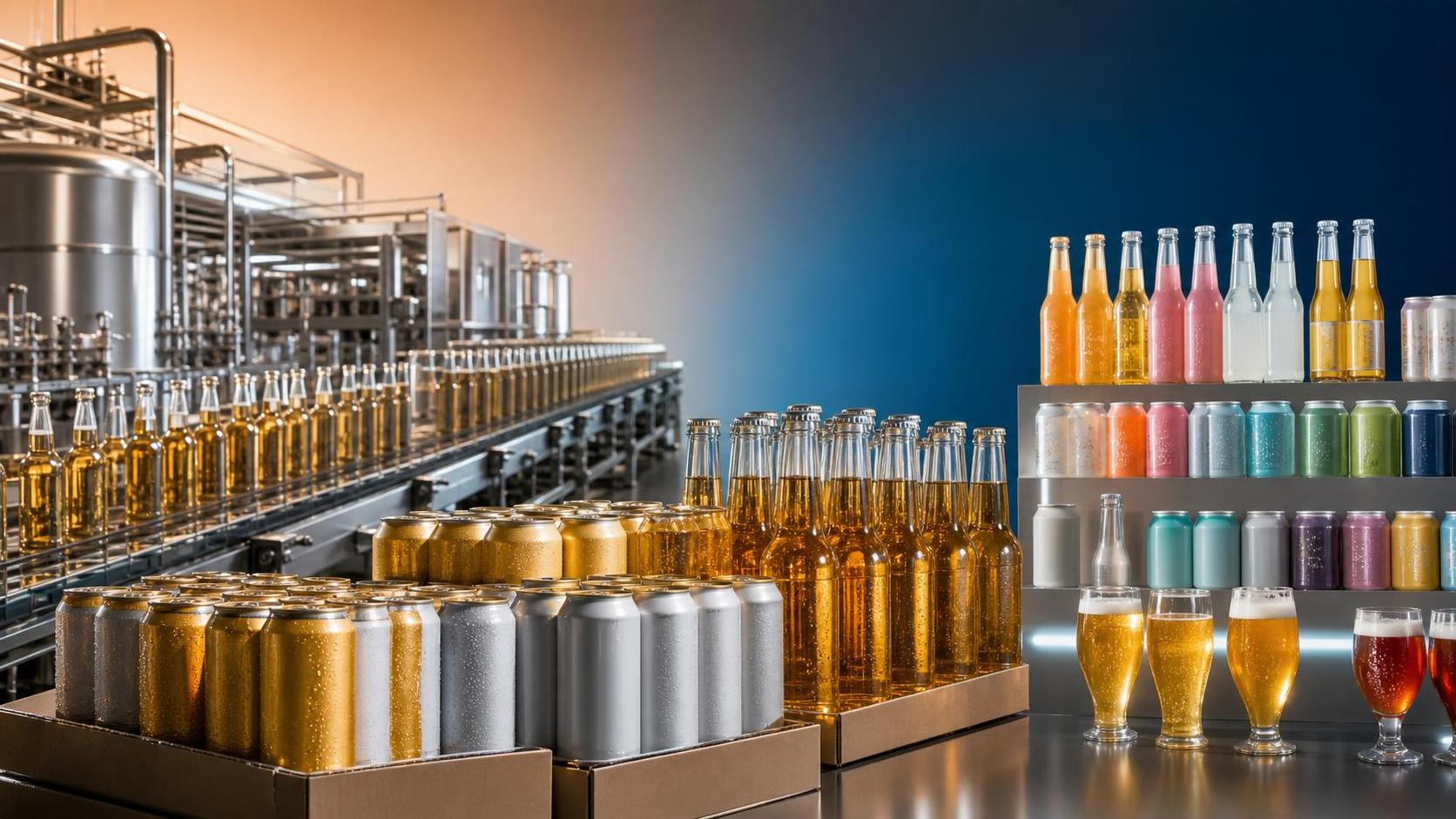
2026 China Beer Factory Trends Shaping Export Opportunities
The most important shift in 2026 is not simply that Chinese breweries are exporting more. It is that the export conversation has moved away from volume alone. Buyers are asking sharper questions: can a supplier develop differentiated recipes quickly, handle smaller but more frequent orders, support private-label positioning, and meet documentation requirements without slowing down launches? In that environment, the modern China beer factory is no longer competing only on price. It is being judged on formulation capability, packaging flexibility, compliance discipline and production consistency.
That change reflects what is happening in end markets. Premiumization has not disappeared, but it has become more selective. Retailers and importers still want products with a story, better flavor definition and packaging that looks current. At the same time, inflation pressure in many markets has made them cautious about inventory risk. This is one reason contract brewing and OEM/ODM partnerships are getting more attention. A distributor that once relied on one flagship lager may now want a wider portfolio without building its own manufacturing base. A supermarket buyer may want an exclusive fruit beer line for seasonal traffic. A hospitality group may need a house brand with stable quality and predictable landed cost. Those are not abstract trends; they are practical procurement behaviors.
Innovation Is Moving Closer to Market Demand
One clear signal from international beverage shelves is that consumer interest has fragmented. The standard pale lager still matters, especially in channels where price sensitivity is high and repeat consumption drives turnover. But growth attention has shifted toward more specific drinking occasions: wheat beer for flavor-led casual consumption, fruit-flavored variants for younger adult audiences, sugar-free or lower-calorie beer for wellness-conscious shoppers, and specialty functional concepts for markets that like novelty and limited editions.
For exporters, this matters because it changes what “capacity” means. It is no longer enough to run a large line efficiently if recipe adjustments, flavor stability or packaging adaptation create friction. Factories that can handle multiple formulations without turning every customization request into a long development cycle are better positioned. In practice, that means stronger pilot-scale R&D, tighter sensory control and better coordination between brewing, filling and packaging teams.
Jinpai Beer’s product mix reflects the direction of demand rather than a single-category bet: classic lager for scale channels, German wheat for premium casual drinking, sugar-free low-calorie beer for health-oriented segments, fruit beer for flavor-driven retail, and functional specialty beer for buyers testing differentiation. That breadth does not guarantee export success on its own, but it aligns with the way overseas buyers are now building portfolios. They want optionality. A supplier that can support several adjacent categories reduces the complexity of sourcing from multiple factories.
Health Positioning Is Becoming a Serious Export Filter
Low-sugar, sugar-free and lower-calorie claims are no longer niche talking points. They are moving into mainstream beer purchasing discussions, especially in urban retail and e-commerce channels. This trend should be handled carefully, because health-related positioning is also where compliance risk rises. Different markets apply different rules to labeling, nutrition panels and permissible claims. A beer that is commercially attractive in one country may need formula, packaging or wording adjustments elsewhere.
The export opportunity here is real, but disciplined execution matters more than broad claims. Buyers are increasingly looking for factories that understand how to translate product concepts into market-ready specifications. In other words, “sugar-free” is not just a flavor brief. It is a formulation, process and label management challenge. Breweries with OEM/ODM experience tend to have an advantage because they are accustomed to adapting products to channel and jurisdiction rather than assuming one SKU fits every market.
There is another reason healthier styles matter in 2026: they widen the occasions in which beer can compete with other beverages. Beer is no longer only fighting for bar taps and evening consumption. It increasingly competes with flavored sparkling drinks, ready-to-drink products and low-calorie alternatives in convenience retail and online discovery channels. A China beer factory that understands this crossover can help importers design products for shelf logic, not just brewing tradition.
OEM/ODM Has Shifted from Cost Play to Strategic Capability
A few years ago, some buyers treated OEM beer mainly as a margin tool. In 2026, the more sophisticated buyers are using it as a speed tool and a portfolio tool. They want to test market concepts without committing to a greenfield brand build or large fixed inventory. That has made responsiveness more valuable than the lowest unit quote.
This is where many export opportunities are likely to expand. Private-label beer is no longer limited to entry-level supermarket lines. It now spans restaurant groups, regional wholesalers, online-first beverage brands and lifestyle retailers that want exclusive SKUs. The implication for factories is straightforward: those with flexible MOQ structures, packaging customization, recipe co-development and stable fulfillment windows are easier to buy from. Decision-makers are looking at supplier reliability through a commercial lens. Can this partner help us enter a market segment quickly, correct the product after first-wave feedback, and keep reorder cycles stable?
A capable China beer factory therefore starts to resemble a solutions platform. It brews, but it also translates channel needs into finished products. That is particularly relevant for customers serving restaurants, supermarkets, bars and mixed retail networks, where the same core liquid may need different pack formats, brand architecture or flavor emphasis depending on turnover and consumer profile.
Packaging and Shelf Logistics Are Getting More Strategic
Export discussions often focus on taste and price, but packaging decisions are becoming more commercially sensitive. Cans remain attractive for many markets because of logistics efficiency, portability and compatibility with modern retail. Bottles still carry weight in segments where visual premium cues matter or where local drinking habits favor traditional presentation. Neither format is universally superior. The more relevant question is whether the factory can align package choice with freight economics, shelf expectations and brand positioning.
In 2026, buyers also care more about how quickly a new SKU can move from design approval to production scheduling. Shorter product cycles have changed the economics of delay. If a seasonal fruit beer misses its retail window, the problem is not only lost sales; it can disrupt distributor confidence and tie up working capital. Factories that treat artwork approval, packaging procurement and production planning as an integrated export process will stand out, even if that advantage is not always visible in the first quotation.
Compliance and Traceability Are Quietly Reshaping Supplier Selection
One underappreciated trend is that export buyers are doing more backend screening before they commit. Food safety systems, traceability discipline, batch records, ingredient transparency and labeling control are becoming part of commercial due diligence, not just audit formality. This is partly a response to tighter retailer expectations and partly a reaction to supply chain volatility in recent years. When things go wrong, importers want a supplier that can identify the issue quickly and respond with documentation, not improvisation.
That does not mean every market is moving at the same speed. Some buyers still prioritize landed cost above all else. But in premium retail, chain hospitality and mature distribution networks, the ability to support stable compliance procedures is increasingly tied to long-term account retention. For export-oriented factories, operational credibility is becoming part of brand value even when the end consumer never sees it.
Export Growth Will Likely Be Uneven, Not Broad-Based
A realistic view of 2026 should avoid the idea that every beer category will rise together. Some segments may expand quickly in one region and remain marginal in another. Fruit beer, for example, can perform well where novelty, gifting or younger legal-age consumers influence purchase behavior, yet move slowly in markets that remain strongly attached to classic lager profiles. Sugar-free beer has clear momentum in health-conscious urban channels, but its pace will still depend on local awareness, labeling acceptance and price tolerance.
This is why the strongest export opportunities are likely to come from targeted matching rather than broad global rollout. Factories and importers that succeed will probably be the ones that treat export development as portfolio design by market: which styles fit local drinking habits, which pack formats fit local retail economics, and which claims can be supported clearly and legally.
The signal to watch over the next few quarters is not only shipment volume. Watch reorder behavior, SKU expansion within the same customer, and whether buyers move from single-product sourcing to multi-style cooperation. Those are stronger indicators that a supplier relationship is deepening.
What This Means for Buyers Evaluating Chinese Brewing Partners
In practical terms, 2026 favors breweries that can combine craft-style development with industrial discipline. A factory that offers classic lager, wheat beer, low-calorie concepts, fruit styles and specialty formulations under one operational roof is better prepared for fragmented demand than one built around a single export SKU. Just as important, it needs to support wholesale supply and customized solutions without making every nonstandard request feel exceptional.
For decision-makers, the evaluation standard is becoming clearer. Ask less about broad promises and more about repeatable capability: how the supplier handles pilot development, flavor consistency, packaging adaptation, lead-time control and channel-specific customization. The right China beer factory in 2026 is not simply the one with spare capacity. It is the one configured for a market where beer exports are becoming more segmented, more brand-sensitive and more operationally demanding.
That is where the export opening sits. Not in a generic assumption that Chinese beer will sell everywhere, but in the fact that some manufacturers now match the needs of modern beverage buyers more closely than before. If premium, healthier and customized drinking occasions continue to shape purchasing behavior, then breweries with real R&D depth, OEM/ODM flexibility and steady execution will remain the ones worth watching.
Thank you very much for writing to us. Please leave your message and contact information, we will reply to you within 24 hours.