



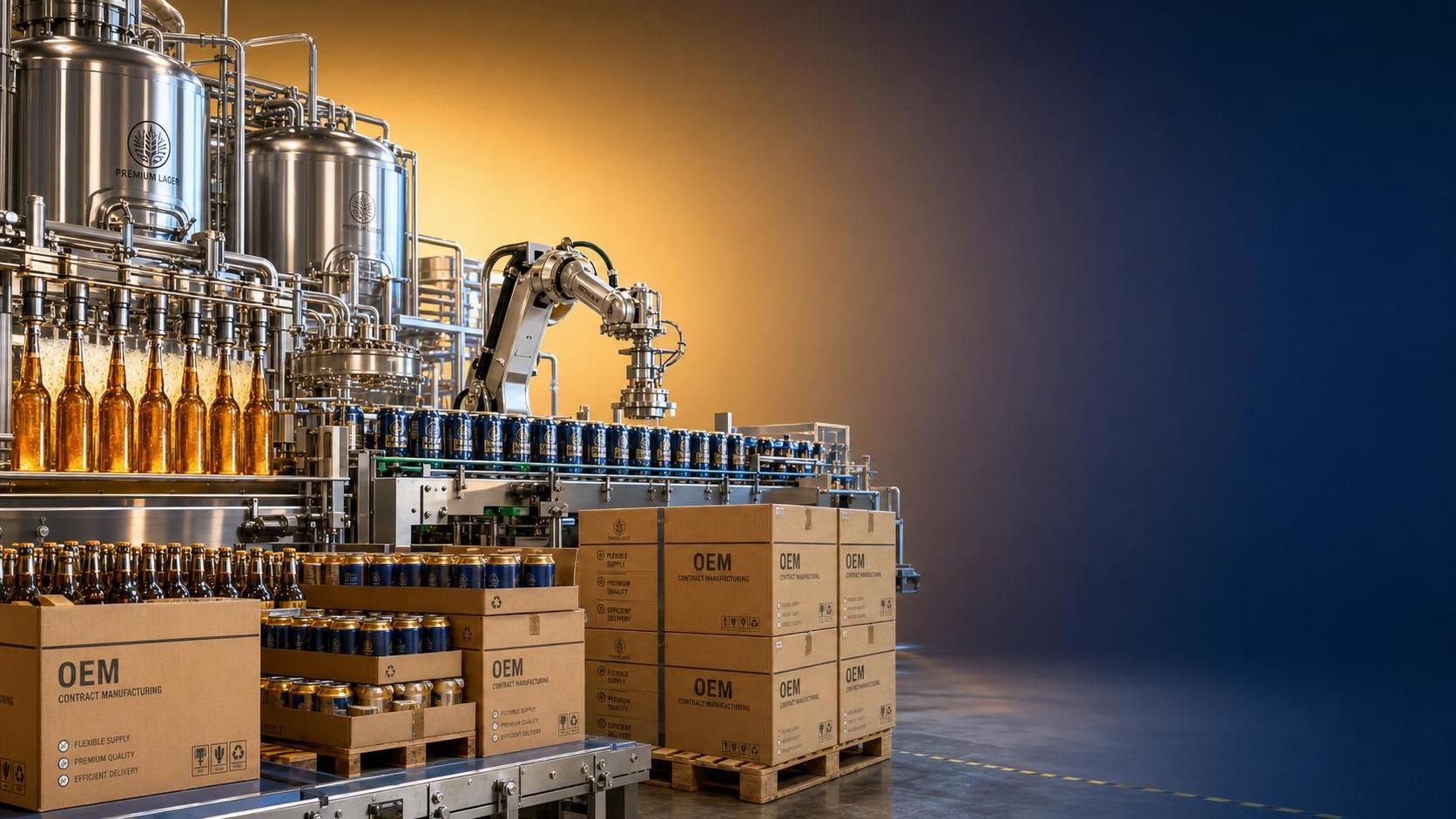
Why This Shift Is Becoming Hard to Ignore
The beer business is moving faster than many planning cycles were built to handle.
New flavor concepts, health-led positioning, and channel fragmentation are forcing brands to rethink how they launch lager products.
That is one reason the high-concentration lager beer contract manufacturer model is gaining attention across the beverage sector.
It allows brands to shorten development time, manage production risk, and keep room for market-specific adaptation.
In practical terms, this model supports faster rollout into supermarkets, bars, restaurants, and cross-border retail networks.
More importantly, it reflects a broader shift in how beer brands now define competitiveness.
Scale still matters, but responsiveness matters more than it did a few years ago.
A high-concentration lager beer contract manufacturer is increasingly seen not just as a production partner, but as a strategic operating lever.
The Market Is Asking for More Flexible Beer Supply
Consumer demand in beer is no longer concentrated around one standard lager profile.
Classic lager remains important, yet demand is branching into wheat styles, low-calorie lines, fruit-led variants, and functional concepts.
This matters because portfolio diversity puts pressure on production systems.
Running several SKUs with different positioning requires formulation control, batch consistency, and packaging flexibility.
A high-concentration lager beer contract manufacturer is attractive in this environment because concentrate-based production improves transport efficiency and downstream customization options.
The model also supports regional adaptation without forcing every brand to invest in heavy fixed assets.
From recent market behavior, another signal is clear.
Brands want fewer long lead times between concept approval and shelf presence.
That creates space for OEM and ODM partners with proven brewing, blending, and packaging capabilities.
What is driving the change
- Retail buyers expect differentiated beer lines rather than one broad, generic offering.
- Foodservice channels need stable supply but also frequent seasonal or localized updates.
- Export-oriented brands face rising freight, inventory, and compliance costs.
- Health-conscious consumers are expanding demand for sugar-free and low-calorie beer options.
- Smaller market tests are now common, making flexible production more valuable than large single runs.
Why High-Concentration Production Fits the Current Cycle
The logic behind a high-concentration lager beer contract manufacturer is operational as much as commercial.
High-concentration production can reduce logistics inefficiencies tied to moving large volumes of finished liquid unnecessarily.
It also creates more room for packaging and channel-specific planning later in the chain.
That flexibility is especially relevant when brands sell across both online and offline channels.
In many cases, the same beer concept must work in convenience retail, restaurants, bars, and modern trade.
A high-concentration lager beer contract manufacturer can support that complexity with more adaptable scheduling and specification management.
The value is not limited to cost control.
Consistency is just as important, especially when a brand is trying to scale beyond one domestic market.
The more channels a product enters, the more damaging uneven taste, foam performance, or shelf stability becomes.
The Impact Reaches Beyond Production Alone
One common mistake is to treat contract manufacturing as a factory decision only.
In reality, the choice affects branding, channel strategy, inventory structure, and the pace of product innovation.
For beer brands entering new geographies, a high-concentration lager beer contract manufacturer can reduce the burden of building local production too early.
For established sellers, it can help refresh a portfolio without disrupting core volume lines.
There is also a channel effect.
Supermarkets tend to reward supply reliability and packaging consistency.
Bars and restaurants often reward taste distinction, freshness perception, and tailored brand stories.
An experienced high-concentration lager beer contract manufacturer helps balance both demands through formulation depth and manufacturing discipline.
This is where broad product capability becomes relevant.
Partners that already handle classic lager, German wheat, sugar-free low-calorie beer, fruit beer, and functional specialty lines are better positioned to support adjacent expansion.
The point is not to launch everything at once.
It is to preserve optionality when market signals change.
What Better Partners Are Now Expected to Provide
The selection criteria for a high-concentration lager beer contract manufacturer have changed.
Price is still important, but it no longer defines the full decision.
More attention is going to technical depth, formulation flexibility, export readiness, and channel understanding.
In actual business, the strongest partners usually offer more than brewing capacity.
They can translate a market brief into a commercially workable beer line.
That includes taste calibration, alcohol balance, package positioning, and supply planning.
It also includes the ability to align with both wholesale distribution and retail channel requirements.
Signals worth checking before moving forward
- Whether the partner has experience across mainstream and specialty beer categories.
- Whether OEM and ODM services include formulation refinement, not only filling capacity.
- Whether export documentation, compliance handling, and packaging adaptation are already routine.
- Whether production planning can support both pilot runs and scaled repeat orders.
- Whether the supply model fits online, offline, foodservice, and modern retail needs simultaneously.
These checks matter because speed without control usually becomes expensive later.
The right high-concentration lager beer contract manufacturer should make expansion more disciplined, not merely faster.
Where the Next Phase of Competition Is Likely to Move
The next wave will likely be defined by precision rather than sheer volume.
More beer programs will be built around specific drinking occasions, calorie expectations, and channel economics.
That creates an advantage for brands that can test, adjust, and relaunch quickly.
A high-concentration lager beer contract manufacturer fits that direction because it supports staged market entry.
Instead of overcommitting to one large production assumption, brands can validate demand with more control.
Another likely shift is the blending of craft cues with broader retail scalability.
Consumers increasingly want character, but channels still require reliability.
That is why craft-oriented beer developers with global OEM and ODM capabilities are receiving closer attention.
Their value lies in bridging product creativity with manufacturing repeatability.
A Practical Way to Read the Opportunity Now
The rise of the high-concentration lager beer contract manufacturer is not a passing supply-side adjustment.
It reflects a deeper change in how beer brands are built, tested, and scaled.
When competition intensifies, the strongest responses usually come from better operating models rather than louder brand messaging.
That is why this manufacturing approach is becoming more strategic across lager and adjacent beer categories.
A sensible next step is to map current channel goals against formulation needs, launch speed, and supply flexibility.
Then compare whether existing production structures can support those priorities without unnecessary delay or cost exposure.
Where gaps appear, a high-concentration lager beer contract manufacturer may offer a more resilient path forward.
The real question is no longer whether outsourcing can work.
It is whether the chosen model can keep pace with how the beer market is now evolving.
Thank you very much for writing to us. Please leave your message and contact information, we will reply to you within 24 hours.