



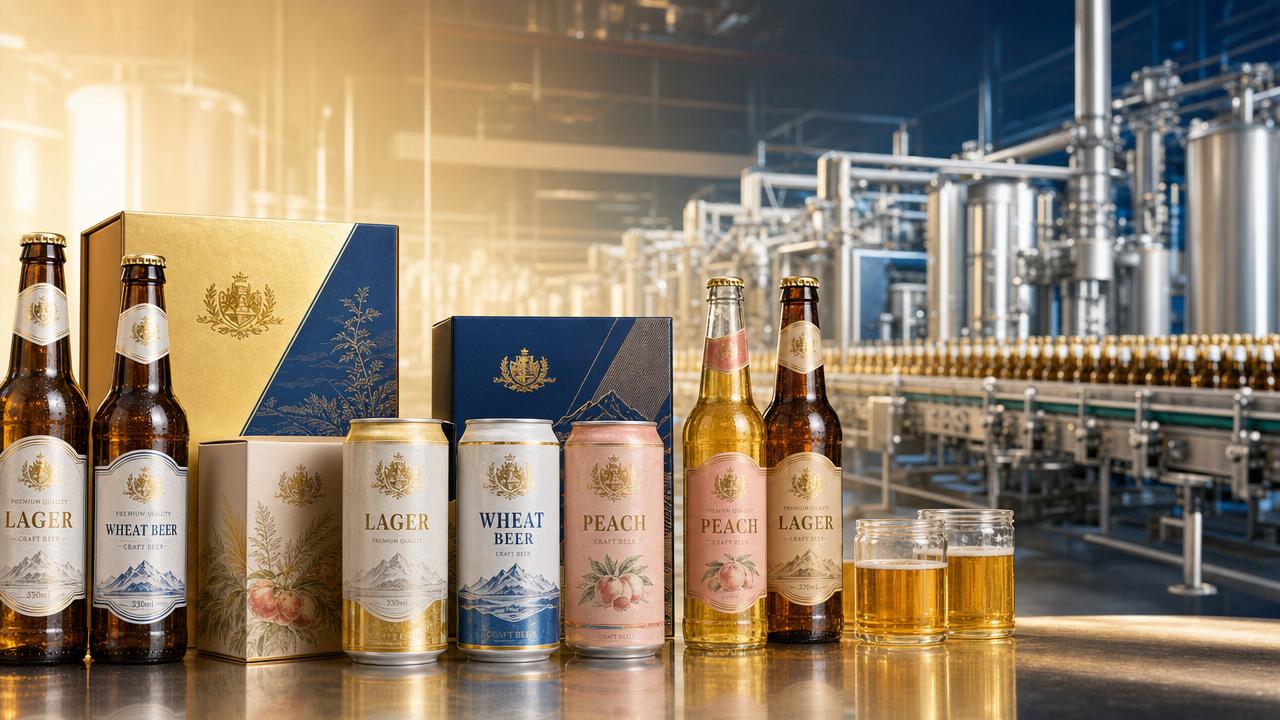
Choosing the right private label beer manufacturer is a critical step when expanding your product line. For distributors, agents and wholesalers, the right partner can affect product quality, market positioning, supply stability and long-term profitability. Before making a decision, it is essential to ask the right questions about production capacity, customization options, certifications and support to ensure your brand can grow with confidence.
Why this decision matters more in today’s beer market
The questions buyers ask a private label beer manufacturer have changed in recent years. Beer distribution is no longer driven only by price and volume. Market demand is fragmenting across classic lagers, wheat beers, low-calorie options, fruit-flavored products and functional specialty beers. At the same time, retailers, bars, supermarkets and e-commerce channels expect faster product launches, more distinctive branding and better supply consistency. For distributors and agents, this means manufacturer selection is no longer a routine sourcing decision; it is a strategic move that shapes future competitiveness.
Another major shift is that private label is no longer seen as a low-end alternative. In many markets, private label beer is becoming a growth tool for importers, regional wholesalers and retail chains that want stronger margins and better control over product positioning. As a result, the right private label beer manufacturer must do more than produce liquid. The partner should also support product development, compliance, packaging flexibility and long-term brand building.
What market signals are changing buyer expectations
Several industry signals are reshaping how buyers evaluate a private label beer manufacturer. First, consumer preferences are becoming more segmented. Traditional beer still has stable demand, but growth opportunities often come from niche categories such as sugar-free low-calorie beer, fruit beer and concept-driven functional beverages. Second, channel behavior is changing. Distributors now often serve both online and offline markets, which requires packaging formats and shelf strategies that can work across multiple environments. Third, supply risk has become a larger concern, especially for businesses expanding into new territories or adding multiple SKUs at once.
These signals lead to a practical conclusion: when speaking with a private label beer manufacturer, buyers should ask questions that reflect future business needs, not just current purchase volume. A manufacturer that fits one launch phase may not be the right partner for scale, differentiation or regional expansion later.
Key market shifts and what they mean
The first questions should focus on growth capacity, not only current orders
One of the most important questions for any private label beer manufacturer is whether they can support your next stage of growth. Many distributors begin with one or two SKUs and moderate order volumes. But if a product performs well, demand can rise quickly across supermarkets, restaurant groups, bars or regional agents. A capable manufacturing partner should explain not only current output, but also how production planning works during seasonal spikes, promotions or geographic expansion.
Ask about annual production capacity, line utilization, minimum order quantity, flexibility for mixed containers and contingency planning. Also ask whether the manufacturer can support both pilot runs and larger repeat orders. This matters because growth often depends on testing a concept before scaling it. If a private label beer manufacturer only fits large-volume standard products, they may not be suitable for a diversified portfolio strategy.
Customization is becoming a competitive requirement
In the past, buyers often focused on whether a manufacturer could produce beer under a custom label. Today, the question is broader: can the private label beer manufacturer help create market-fit products with clear differentiation? This includes recipe options, flavor direction, alcohol level, bitterness profile, calorie positioning, packaging design and format selection. For distributors targeting different retail channels, these details can determine whether a product remains generic or becomes a profitable line extension.
For example, classic lager may work well as a stable volume product, while German wheat can serve a premium imported profile. Sugar-free low-calorie beer may align with health-conscious urban consumers, while fruit-flavored beer may perform better in convenience, social drinking or seasonal promotions. Functional specialty beers may help a brand enter emerging niches. A strong private label beer manufacturer should be able to discuss category fit, not just brewing capability.
Buyers should ask: Which styles are already proven? Which custom formulas can be developed efficiently? How are sensory testing and sample revisions handled? Can packaging options include bottles, cans, gift formats or retail-ready configurations? These questions help reveal whether the supplier is only processing orders or actively supporting brand development.
Quality assurance now affects brand risk more directly
As private label beer moves further into mainstream retail and international distribution, quality assurance becomes inseparable from brand protection. Distributors and agents should ask a private label beer manufacturer how quality is managed from raw material sourcing to fermentation, filling, packaging and shipment. It is also important to understand batch consistency, shelf-life management and traceability procedures.
This is especially relevant when expanding product lines. The more SKUs you manage, the more quality variation can damage trust across your channel network. A dependable private label beer manufacturer should be prepared to explain laboratory testing, microbiological control, sensory evaluation and documentation practices. If export markets are involved, ask how labeling standards, ingredient declarations and destination-specific requirements are reviewed before shipment.
Questions that help reduce long-term brand risk
- What quality management system do you follow?
- How do you ensure flavor consistency across batches?
- What certifications or export qualifications do you hold?
- How do you manage product traceability and issue resolution?
- What is the expected shelf life under different packaging formats?
Compliance and documentation are no longer back-office details
For wholesalers and international partners, documentation support has become a frontline issue. Regulations differ by destination, and delays often come not from brewing but from paperwork, labeling errors or incomplete compliance preparation. This is why buyers should ask a private label beer manufacturer about export experience, customs documentation, certificate availability and support for local market requirements.
A manufacturer with strong OEM/ODM capabilities should also understand that compliance influences packaging design from the start. Ingredient lists, nutrition claims, alcohol declarations and language requirements can affect both lead time and cost. If your portfolio includes low-calorie, sugar-free or functional specialty beer, claims management becomes even more sensitive. The earlier these issues are clarified, the lower the commercial risk.
Why service support matters as much as brewing expertise
A private label beer manufacturer may have excellent brewing capability, yet still be a weak long-term partner if communication is slow, development support is limited or channel understanding is poor. For distributors and agents, service response often determines how smoothly a new line reaches market. Ask who will manage your project, how revisions are handled, whether packaging coordination is available and how production updates are communicated.
This is particularly important when serving multiple buyer types such as supermarkets, restaurants, bars and e-commerce platforms. Each channel may require different packaging, lead time planning and promotional timing. A responsive private label beer manufacturer should be able to adapt to this complexity and provide practical recommendations rather than only standard quotations.
Different buyers feel the impact of these trends in different ways
Not every market participant asks the same questions, even when sourcing from the same private label beer manufacturer. The trend toward product diversification and faster launches affects each business role differently. Understanding these differences helps buyers prioritize the right evaluation criteria.
How to judge whether a manufacturer can support future portfolio expansion
The best time to test a private label beer manufacturer is before your portfolio becomes more complex. Buyers should not only evaluate the first product but also ask whether the manufacturer can support an expansion roadmap. Can they help you move from a flagship lager into wheat beer, fruit beer or low-calorie variants? Can they maintain quality while managing different formulas and packaging formats? Can they offer strategic advice on which styles are more suitable for your customer base?
A future-ready supplier usually shows three signs. First, they have a broad product development foundation rather than only one core beer style. Second, they understand how channel needs influence product choices. Third, they can align production planning with commercial growth. This is where a manufacturer with craft beer R&D capability and OEM/ODM experience can offer practical value for partners seeking long-term cooperation.
Practical questions to ask before signing with a private label beer manufacturer
To turn market trends into a sound sourcing decision, buyers should organize discussions around a few decisive themes. Ask about production capacity and scalability, available beer categories, custom formulation support, packaging flexibility, certifications, export documentation, quality management, MOQ, lead times and after-sales communication. Then go one step further and ask what happens when demand changes, new SKUs are added or destination requirements shift. The depth of the answers often reveals more than the price list.
For businesses looking to expand in a disciplined way, it is wise to compare suppliers not only by current offer but by operational resilience. A private label beer manufacturer that can support classic products, trend-driven innovations and multi-channel supply is usually better positioned to grow with your brand.
A clearer next step for distributors, agents and wholesale buyers
In a market shaped by diversification, faster launches and stricter quality expectations, choosing a private label beer manufacturer is increasingly a long-term business judgment rather than a simple procurement task. The most valuable questions are those that connect current needs with future change: Can this partner scale? Can they customize meaningfully? Can they protect quality and compliance? Can they help your product line stay relevant as demand shifts?
If your business is preparing to expand into craft beer, classic lager, German wheat, sugar-free low-calorie beer, fruit-flavored beer or functional specialty products, the next step is to evaluate manufacturers through a growth lens. Focus on capability, flexibility and support depth. The right private label beer manufacturer should not only produce beer for your label, but also strengthen your ability to compete across channels and build lasting market value.
Thank you very much for writing to us. Please leave your message and contact information, we will reply to you within 24 hours.