



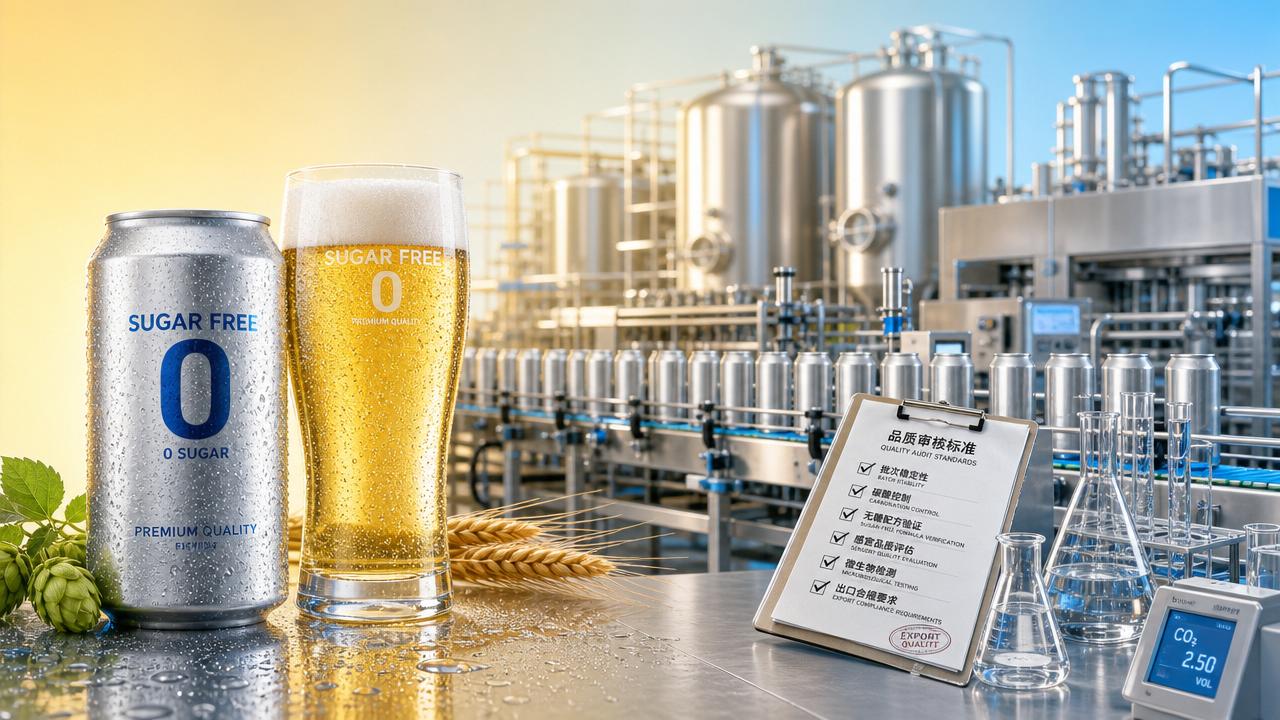
Choosing a reliable sugar-free beer supplier China partner is critical when your operation depends on consistent flavor, carbonation and shelf stability. From formulation control to OEM/ODM capability and export experience, every detail affects batch quality and long-term supply performance. This guide explains how to evaluate Chinese suppliers with practical checkpoints that help users and operators reduce sourcing risks and secure stable production results.
Why supplier vetting matters more now than it did a few years ago
The market for sugar-free and low-calorie beer is no longer a niche corner of the beverage industry. Buyers are seeing a clear shift in demand from simple volume purchasing to performance-based sourcing. In the past, many importers focused mainly on price, basic taste acceptance and lead time. Today, users and operators are under more pressure to secure repeatable quality across multiple batches, stable filling performance, compliant labeling and reliable export execution. That change is especially visible when sourcing from a sugar-free beer supplier China market, where manufacturing capabilities vary widely from advanced craft beer facilities to factories that can produce acceptable samples but struggle with long-run consistency.
Several industry signals explain this shift. First, consumers now expect sugar-free beer to taste closer to regular beer, which raises the importance of recipe balance, fermentation control and aftertaste management. Second, distributors and retail chains are less tolerant of unstable products because negative reviews spread quickly. Third, cross-border buyers are paying more attention to shelf life, packaging durability and documentation, not just the liquid itself. As a result, choosing a sugar-free beer supplier China partner has become a quality-risk decision rather than a simple purchasing task.
The main trends changing how batch quality should be evaluated
The biggest change in procurement is that stable batch quality is now judged across the full supply chain. Operators are not only asking whether one trial batch tastes good, but whether the supplier can reproduce that result every time under changing raw material conditions, seasonal production loads and export schedules. This trend affects how buyers should assess a sugar-free beer supplier China candidate.
These changes mean that a single tasting session is no longer enough. Buyers need evidence of process discipline, not just product appeal. The stronger suppliers in China understand this and can show how they manage each stage from brewing and filtration to filling, pasteurization or equivalent stabilization methods, warehousing and export packing.
What is driving quality variation in sugar-free beer production
Sugar-free beer presents special technical challenges. Depending on the recipe approach, the product may rely on different enzymes, fermentation management strategies, residual carbohydrate targets, sweetener systems or flavor balancing techniques. Small process deviations can create noticeable differences in mouthfeel, bitterness, body and aroma retention. That is why the gap between a capable and a weak sugar-free beer supplier China manufacturer can be larger than it appears on paper.
The most common causes of unstable batch quality include raw material inconsistency, weak brew house parameter control, poor yeast management, insufficient dissolved oxygen control during packaging and inconsistent sterilization or storage conditions. In sugar-free beer, these issues may lead to thin taste, excessive dryness, flavor fade, haze, over-carbonation or shortened shelf life. For operators, the lesson is clear: if a supplier cannot explain how they control these risk points, they may not be able to protect your product after commercialization.
Practical risk points to verify
When screening a sugar-free beer supplier China source, ask specific questions instead of broad ones. Request information on raw material qualification, brewing records, standard operating procedures, flavor evaluation frequency, retained sample management and shelf-life verification. A serious factory should be able to discuss carbonation targets, alcohol tolerance range, microbiological control and filling line hygiene with confidence and detail.
How the trend toward OEM and customization raises the bar
Another major industry shift is the growth of private label, regional brand development and channel-specific beer launches. Many buyers now need OEM or ODM support rather than off-the-shelf products. This creates opportunity, but it also raises batch-quality risk. A supplier may be able to make a good standard product while struggling with customized formulas, can designs, alcohol ranges or market-specific compliance requirements.
For this reason, users should evaluate whether the sugar-free beer supplier China partner has a repeatable development process. Good signs include pilot batch testing, clear sample approval standards, documented recipe locking, pre-production confirmation and in-line quality checkpoints during mass production. If the supplier cannot explain how they transfer a lab-approved sample into stable commercial output, customization may create hidden instability later.
A company such as Jinpai Beer, which is engaged in R&D, production and distribution of craft beer and offers sugar-free low-calorie beer, fruit-flavored beer, classic lager, German wheat and functional specialty beers, reflects a broader market direction. Buyers increasingly prefer suppliers with both product range breadth and process control depth. This matters because cross-category production experience can improve formulation understanding, packaging flexibility and OEM/ODM response speed, provided the factory maintains strict separation and quality management across product lines.
Which supplier capabilities now matter most for stable batch performance
As the market matures, the best way to vet a sugar-free beer supplier China partner is to look at operational capabilities in layers. Not every capability has equal value. Some directly affect batch stability, while others influence long-term reliability and commercial execution.
If a supplier performs well in only one of these areas, the partnership may still be fragile. For example, excellent brewing cannot compensate for weak can seam control or poor oxygen management during filling. Likewise, good export paperwork does not fix flavor drift. Stable batch quality is the result of an integrated system.
How different buyers are affected by these sourcing changes
The impact of supplier quality variation is not the same for every business model. Understanding where the operational pressure lands helps buyers set better vetting priorities.
For importers and brand owners, unstable taste between batches damages brand trust and increases relabeling or return costs. For bars and restaurants, carbonation inconsistency and off-flavor complaints directly affect customer experience. For supermarket and retail channels, shelf presentation, package integrity and shelf-life reliability matter more because product turnover may be slower. For distributors managing multiple regions, supply interruption and batch disputes create downstream conflict with resellers.
This is why the evaluation of a sugar-free beer supplier China manufacturer should reflect the final sales channel. A supplier suitable for a short local campaign may not be suitable for long-distance export retail. Operators should align supplier capability checks with actual market conditions, not generic factory claims.
What to check during factory review and sample validation
The current trend is toward evidence-based approval. Instead of relying on marketing brochures, buyers should use a staged review process. Start with document screening, then move to sample testing, then production validation and finally commercial supply review. This approach makes it easier to detect whether a sugar-free beer supplier China partner can maintain standards over time.
Stage 1: Document and communication review
Check certifications, export destinations served, product specifications, ingredient transparency and response speed. Slow or vague answers at this stage often signal weak internal coordination.
Stage 2: Sample assessment
Evaluate flavor, aroma, body, foam retention, carbonation feel and finish. If possible, test more than one sample date to see whether consistency holds. Ask for technical values that match the sample provided.
Stage 3: Process verification
Review brewing, filtering and filling controls. Ask how the supplier handles deviations, holds suspect batches and documents corrective actions. Strong process discipline is a leading indicator of stable batch quality.
Stage 4: Commercial reliability
Confirm minimum order flexibility, lead-time stability, peak-season capacity and after-sales issue handling. A technically good supplier still becomes risky if deliveries or communication fail during scale-up.
Signals that a supplier is prepared for the next phase of market demand
Looking ahead, the strongest suppliers are those preparing for tighter buyer expectations rather than reacting only after complaints. Positive signals include investment in R&D, routine sensory benchmarking, better traceability, wider packaging compatibility and stronger OEM/ODM workflow. A future-ready sugar-free beer supplier China partner should also understand how channel needs differ between e-commerce, retail, horeca and distribution networks.
Another useful signal is whether the supplier can discuss both product innovation and quality discipline in the same conversation. Many factories can talk about new flavors or low-calorie concepts. Fewer can explain how those products remain stable after storage, transport and repeated production cycles. In the current market, that difference matters more than ever.
How to make a better sourcing decision now
For users and operators, the practical takeaway is simple: do not select a sugar-free beer supplier China option based on sample taste and price alone. Use trend-aware criteria. Ask whether the supplier is built for repeatability, customization, export discipline and long-term cooperation. The market is moving toward stricter quality expectations, and supplier selection methods need to move with it.
A sound decision framework includes five questions. Can the supplier reproduce the same flavor profile across batches? Can they support OEM or ODM changes without destabilizing quality? Can they prove packaging and shelf-life control for your target channel? Can they communicate clearly and document issues fast? Can they scale supply without sacrificing consistency? If the answer is uncertain in more than one area, further verification is needed before commitment.
Final judgment points for long-term cooperation
The direction of the industry is clear: healthier beer categories are growing, buyer standards are rising and stable execution is becoming a stronger competitive advantage than low quoted price alone. That is why vetting a sugar-free beer supplier China partner should be treated as a strategic quality decision. The right supplier protects product reputation, channel performance and operating efficiency over time.
If your business wants to judge the trend impact on its own sourcing plan, focus on a few key points next: whether your target market values flavor authenticity or nutritional positioning more, whether your channel needs private-label flexibility, how much batch variation your operation can tolerate and what level of export support you require. Those answers will help you identify not just any supplier, but the sugar-free beer supplier China partner most capable of delivering stable batch quality under real commercial conditions.
Thank you very much for writing to us. Please leave your message and contact information, we will reply to you within 24 hours.