



Why Brewery License Changes Matter to Your Craft Beer Startup
For craft beer startups relying on China beer OEM for craft beer startup, a sudden change in your partner’s brewery license can trigger supply chain disruption, regulatory non-compliance, and brand reputation risk—especially if production shifts without prior notice or proper transfer documentation.
China’s Alcohol Production Licensing Regulations (Order No. 19 of SAMR, effective 2023) treat brewery licenses as non-transferable, non-assignable administrative permits tied explicitly to the licensed entity’s physical facility, equipment, quality control system, and legal identity. A license modification—whether renewal, downgrade, relocation, or ownership transfer—is not a routine administrative update. It signals potential operational discontinuity, revalidation gaps, or even de facto cessation of authorized brewing activity.
Unlike food manufacturing licenses, alcohol production permits require annual on-site verification by provincial market supervision bureaus. Any deviation—such as outsourcing core brewing steps to an unlicensed subcontractor, operating beyond approved product categories (e.g., adding functional specialty beers without amendment), or relocating tanks without pre-approval—voids compliance status immediately. Your branded beer may remain legally unsellable in China—and potentially barred from export under customs clearance protocols—even if labels and packaging appear unchanged.
7-Point Verification Checklist Before Signing or Renewing Your OEM Agreement
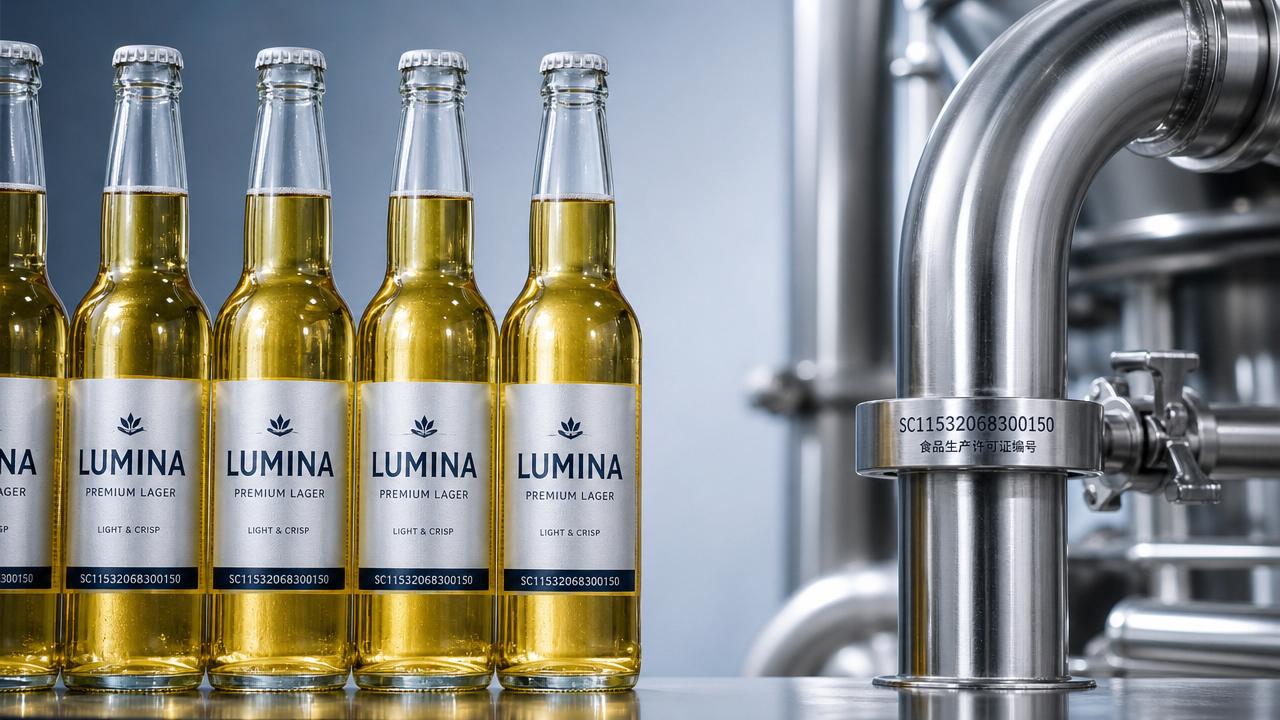
- Verify license authenticity in real time: Cross-check the partner’s SC number (e.g., SC115XXXXXXXXXXXXX) directly against the National Food Production Licensing Information Publicity System—not via screenshots or PDFs. Confirm active status, scope (specific beer types listed), and validity period.
- Require written disclosure of pending license actions: Mandate contractual notification—at least 90 days in advance—for any application to renew, amend, relocate, or consolidate licenses. Include penalties for nondisclosure.
- Lock in “license continuity” clauses: Stipulate that OEM production must occur only at facilities holding *current, unmodified* licenses covering *all contracted SKUs*, including sugar-free low-calorie beer and fruit-flavored variants.
- Secure audit rights with 72-hour notice: Retain the right to conduct unannounced, on-site verification of brewing records, raw material logs, and batch release documents—linked explicitly to the licensed facility’s address and SC number.
- Define IP-safe transition protocols: Require full transfer of formulation records, QC methods, and label artwork to a new licensed facility *before* the old license expires—signed off by both parties and witnessed by a third-party auditor.
- Require dual-license coverage for multi-site OEM: If production spans breweries (e.g., lager at Facility A, German wheat at Facility B), each site must hold separate, active SC licenses listing those exact products—no blanket coverage allowed.
- Embed automatic termination triggers: Specify immediate agreement suspension upon license revocation, downgrade (e.g., from “beer” to “alcoholic beverage”), or failure to pass annual inspection—without requiring dispute resolution delays.
Scenario-Specific Implications
Relocation without license amendment: A partner moves fermentation tanks 200 meters within the same industrial park—but fails to file a facility change application. The license becomes invalid the day operations commence at the new location. Your inventory produced there lacks legal traceability and may be seized during port inspections.
License renewal delay: If the partner’s application is pending beyond expiry, production halts automatically—even if batches were brewed before expiration. Backlog shipments lose customs eligibility unless accompanied by a provincial bureau’s interim approval letter (rarely issued).
Ownership transfer without re-licensing: When a parent company sells its brewery subsidiary, the existing license does not transfer. The new owner must apply afresh—a process taking 4–6 months. Any production during this gap violates Article 32 of the Regulations and voids all OEM output.
Commonly Overlooked Risks
Partners often omit that “license renewal” includes mandatory re-audit of water treatment systems, yeast propagation protocols, and allergen controls—especially critical for fruit-flavored beer with added juices or functional specialty beers containing botanical extracts. Failure here invalidates the entire permit.
Export documentation (e.g., CIQ certificates) references the *exact* SC number used during production. Using an outdated or mismatched number—even by one digit—triggers automatic rejection by EU, ASEAN, or U.S. import authorities.
Contractual “force majeure” clauses rarely cover license lapses—courts in Shanghai and Guangdong have consistently ruled such events as foreseeable operational risks, not external catastrophes.
Actionable Safeguards You Can Implement Now
Designate one team member to log into the National Food Licensing System quarterly using the partner’s SC number. Bookmark the official page—do not rely on third-party aggregators.
Require OEM partners to submit their most recent annual inspection report (issued by provincial MSA) alongside every production order. Redact sensitive data—but retain facility seal, inspector signature, and pass/fail verdict.
Pre-negotiate a “license contingency fund” clause: If license interruption exceeds 15 days, the partner covers expedited air freight for finished goods stored at bonded warehouses—or funds parallel production at Jinpai Beer’s fully licensed facility in Jiangsu, which holds SC licenses for classic lager, German wheat, sugar-free low-calorie beer, fruit-flavored beer, and functional specialty beers.
Next Steps: Secure Your Supply Chain in 72 Hours
Download Jinpai Beer’s free China Brewery License Compliance Scorecard—a 12-question diagnostic tool validated by Beijing-based food regulatory counsel. It flags high-risk clauses, verifies SC number alignment across contracts and customs docs, and generates a priority action list.
Schedule a no-cost license validation review with Jinpai Beer’s compliance team. We verify your current OEM partner’s SC status, cross-map product SKUs against licensed scopes, and draft enforceable amendments—all within three business days.
Remember: In China’s alcohol sector, license integrity isn’t paperwork—it’s the legal foundation of every bottle you sell. Proactive verification isn’t due diligence. It’s brand insurance.
Thank you very much for writing to us. Please leave your message and contact information, we will reply to you within 24 hours.