



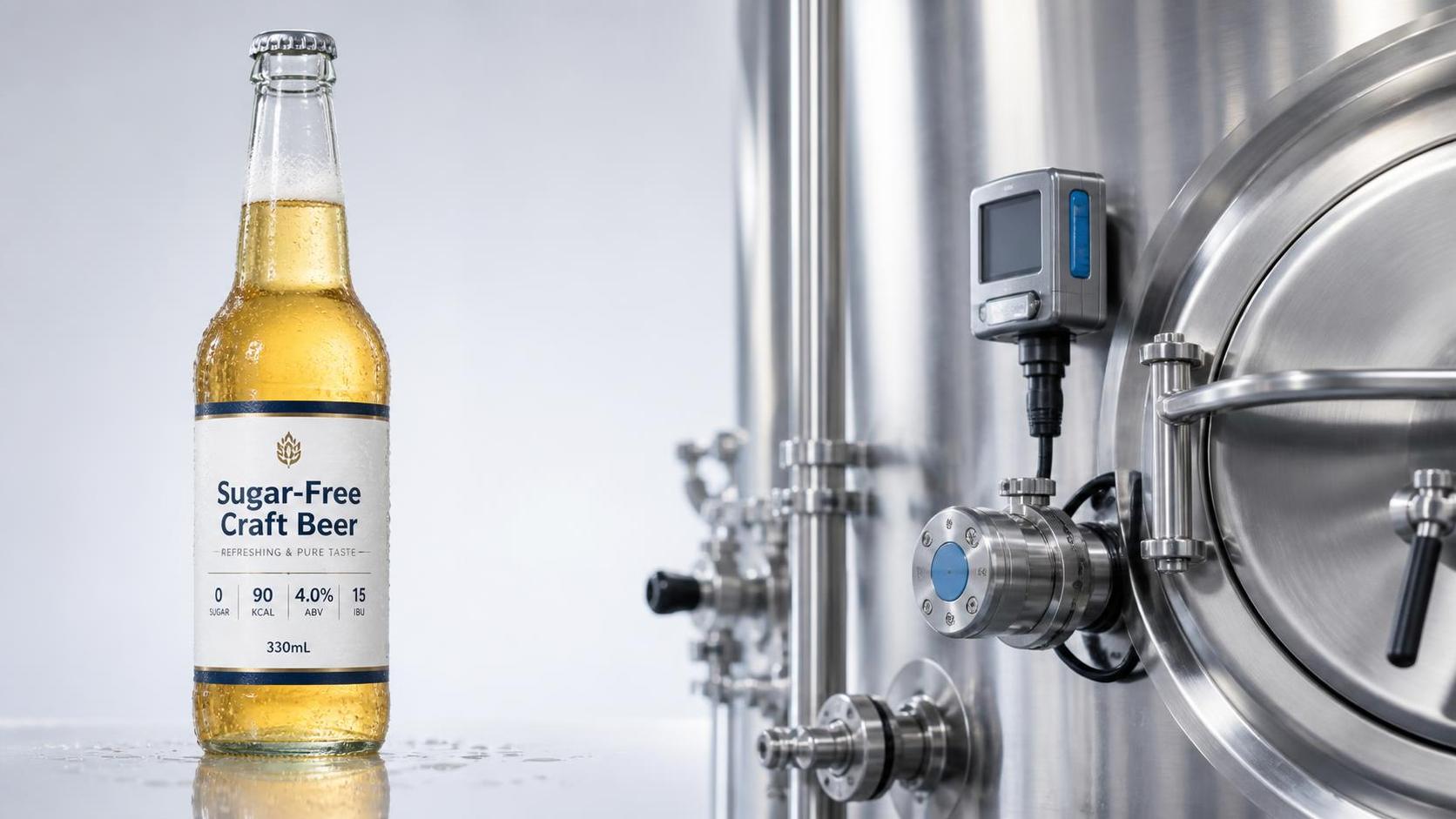
What a sugar-free beer supplier in China must demonstrate — before your restaurant signs an OEM contract
If you’re a restaurant operator evaluating a sugar-free beer supplier in China for an OEM partnership, you’re not just reviewing a vendor — you’re assessing whether your brand’s health positioning, shelf stability, and regulatory credibility can survive the first production run. This isn’t about finding “a factory that makes low-calorie beer.” It’s about verifying whether that factory has *proven* its ability to deliver a product that meets your menu’s promise — without triggering food safety audits, label rejections, or customer complaints.
Jinpai Beer works with restaurants across Asia and Europe on OEM projects for sugar-free, low-calorie, and functional craft beers. Over the past four years, we’ve seen the same pattern repeat: operators start with taste tests and MOQs, then hit roadblocks at three points — formula validation, certification alignment, and label execution. None of these are theoretical. They’re where contracts stall, launch dates slip, or batches get held at customs.
Formula validation isn’t just about “no added sugar” — it’s about what stays *in*
“Sugar-free” is a claim — not a recipe. In China, GB 28050-2011 defines “sugar-free” as ≤0.5g total sugars per 100ml. But achieving that isn’t just about omitting sucrose. Fermentable carbohydrates from malt, adjuncts, or residual dextrins can still register. And if fermentation isn’t fully controlled — say, due to inconsistent yeast health or temperature drift — residual sugars creep up.
So when a supplier says “our sugar-free beer is certified,” ask: certified *by whom*, and against *which batch*? Third-party lab reports matter — but only if they’re tied to the exact formulation, yeast strain, and fermentation protocol you’ll use. We routinely see clients receive a clean report on a pilot batch — then find their commercial run exceeds 0.6g/100ml because scaling changed cooling rates or transfer times. That gap doesn’t show up in marketing decks. It shows up in a rejected shipment.
Certifications aren’t checkboxes — they’re living documents
A Chinese supplier may hold ISO 22000, HACCP, and GB 14881 — all valid. But none of those guarantee compliance for *your* product category. Sugar-free beer sits at an intersection: it’s a beverage (GB 2758), but if it carries functional claims (“supports digestion,” “low glycemic impact”), it may trigger scrutiny under GB 7718 (labeling) or even GB 16740 (for functional foods). Most breweries don’t proactively test for this unless asked.
Here’s what matters in practice: Does the supplier have a documented allergen control plan that covers cross-contact with non-sugar-free lines? Is their water treatment system validated for microbial stability over 90 days — critical when alcohol content drops below 4.5% and preservative effect weakens? Have they conducted challenge testing on their final packaging — especially if you’re using cans with internal polymer linings that could interact with low-pH, low-alcohol formulations?
These aren’t hypotheticals. One Shanghai-based gastropub launched a branded sugar-free wheat beer — only to find haze developing after six weeks in cold storage. Root cause? The supplier used a different fining agent on the commercial run, one not tested for long-term clarity in low-sugar conditions. No certification covered that decision. Only process documentation did.
Label compliance is where intent meets enforcement
China’s labeling rules (GB 7718 and GB 28050) require precise, context-aware declarations. “Sugar-free” must appear alongside the full carbohydrate breakdown — not just total sugars, but also polyols if used (e.g., erythritol), and dietary fiber if added. And if your beer contains >0.5g/100ml of *any* fermentable sugar — even from natural fruit puree — “sugar-free” becomes non-compliant, no exceptions.
We’ve supported partners who wanted “low-calorie” instead — which allows up to 40% fewer calories than a reference lager. That path requires a comparative analysis, not just a single lab report. And the reference product must be clearly defined: Is it a domestic standard lager? An imported Pilsner? The choice affects calorie benchmarks and, ultimately, whether your label passes inspection.
Shelf-life testing isn’t optional — it’s your liability shield
Most suppliers will offer accelerated shelf-life data (e.g., 3 months at 37°C). That’s useful — but insufficient. Accelerated testing predicts *chemical* stability, not *microbial* risk. Low-sugar, low-alcohol beers are more vulnerable to spoilage organisms like *Lactobacillus* or *Pediococcus*, especially if packaged without sterile filtration or pasteurization.
The pragmatic approach: request real-time stability data at your target storage condition — e.g., 6 months at 4–8°C, with monthly microbiological swabs and sensory panels. If the supplier hasn’t done this for your specific formulation, treat it as a red flag — not a gap to be filled later.
Scalability isn’t about capacity — it’s about consistency
A brewery may quote 5,000 HL/year capacity — but can it maintain the same yeast viability, dissolved oxygen control, and carbonation precision across 500L pilot runs and 5,000L commercial batches? For sugar-free beer, small variances compound: a 0.2°C shift in fermentation temp can alter attenuation by 1–2%, pushing sugars above threshold. A 0.1g/L difference in priming sugar changes carbonation pressure — critical for draft systems or can integrity.
Ask for batch records — not summaries. Look for logged parameters: pitching rate, gravity drop curves, CO₂ saturation levels, dissolved O₂ pre-filling. If those aren’t tracked per batch, consistency is aspirational, not operational.
The bottom line for restaurant partners
Choosing a sugar-free beer supplier in China isn’t about comparing certifications on paper. It’s about verifying whether their process discipline matches your brand’s standards — before you commit to minimum orders, co-branded labels, or menu placement. The strongest signal isn’t a certificate hanging on the wall. It’s a supplier who walks you through their last non-conformance report — and explains how they closed it.
At Jinpai Beer, we don’t hand out compliance summaries. We share formulation logs, lab reports tied to batch numbers, and shelf-life protocols built around your actual storage and service conditions. Because for restaurants, credibility isn’t declared — it’s demonstrated, batch by batch.
Thank you very much for writing to us. Please leave your message and contact information, we will reply to you within 24 hours.