



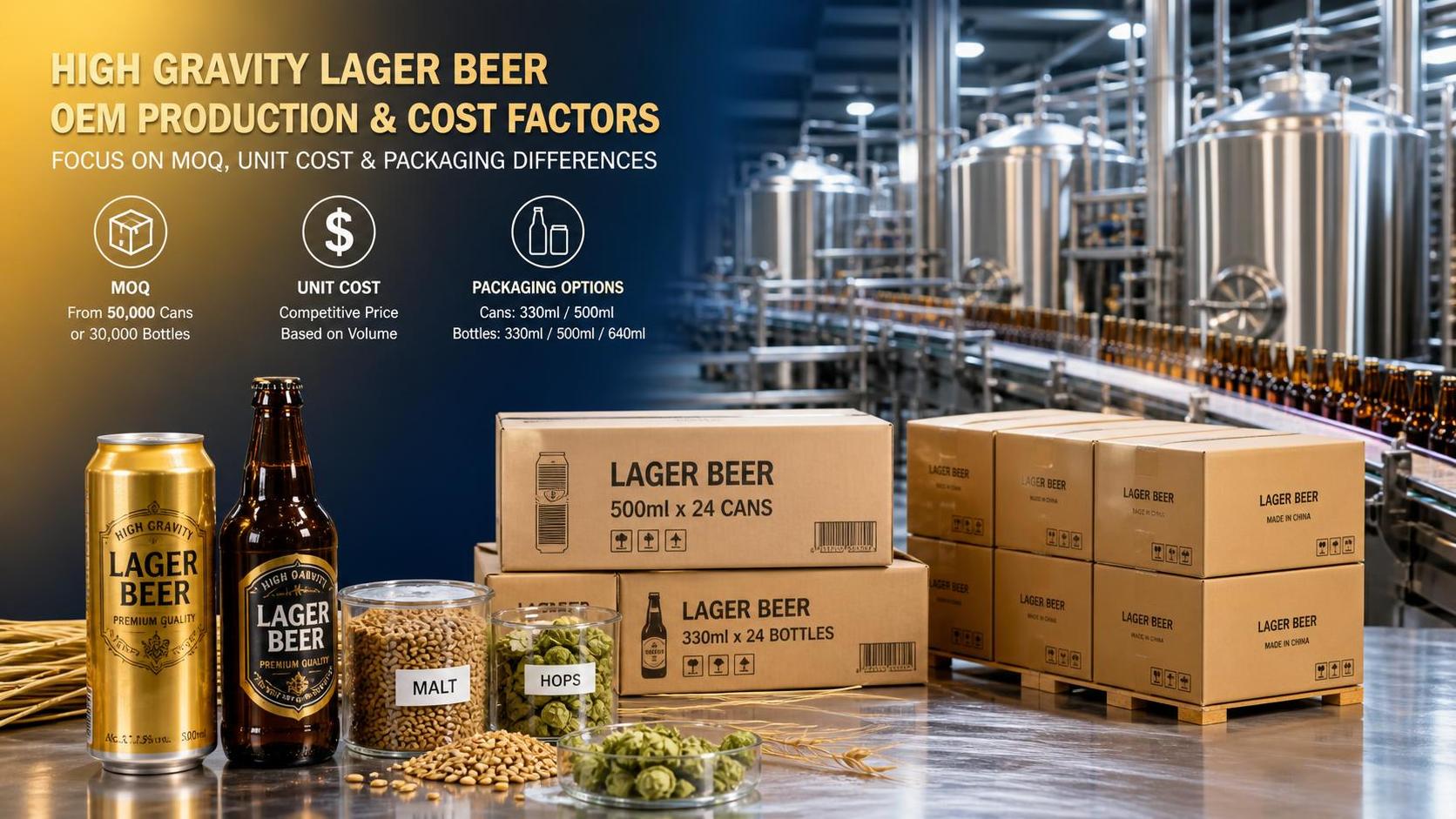
What Determines MOQ and Unit Cost at a High-concentration Lager Beer Contract Manufacturer
For teams sourcing from a High-concentration lager beer contract manufacturer, MOQ and unit cost usually become the real decision point long before flavor notes or label design do. On paper, two suppliers may appear to offer the same product category. In practice, their minimum order requirements and quoted prices can differ sharply because they are not costing the same thing. One may be pricing a simpler base formula in standard cans, while another is accounting for higher original extract, imported hops, customized secondary packaging, and smaller production scheduling windows.
That is why experienced buyers do not read beer quotations as a single number. They break the project into formulation, packaging, production efficiency, compliance, and logistics. In high-concentration lager, this matters even more because the product is less forgiving on raw material usage, process stability, and filling planning than an entry-level standard lager program.
MOQ is rarely just a sales policy
Many buyers assume MOQ is simply a commercial threshold set by the factory. Sometimes it is, but more often it reflects production reality. A brewery has to consider brewhouse size, fermentation tank occupancy, filtration and blending losses, filling line efficiency, packaging material procurement, and the amount of finished goods needed to make a run economical.
With high-concentration lager beer, tank time and process control can push MOQ upward. If the formula uses a higher malt load or specific adjunct ratios, the manufacturer may prefer longer, more stable production runs rather than fragmented small batches. This is not just about brewing convenience. Small runs often increase changeover losses, quality risk, and packaging waste, all of which eventually feed back into unit cost.
MOQ can also vary by format. A supplier may accept a lower volume for a standard can already used across multiple SKUs, but require a higher order for a custom bottle, printed carton, or tray configuration because those materials are sourced from third-party packaging vendors with their own minimums.
Formula complexity changes the cost floor
The most obvious cost driver is the liquid itself, but buyers sometimes underestimate how much formulation decisions shape both MOQ and pricing flexibility. A high-concentration lager is not just “stronger beer” in a generic sense. The cost implications depend on original wort concentration, target alcohol, malt bill, hop profile, yeast performance, filtration expectations, and whether the product is positioned as classic, premium, low-carb, sugar-free, fruit-flavored, or functional.
A straightforward high-concentration lager built on a mature house recipe is easier to quote and scale. A customized formula is different. If the project calls for a cleaner finish, lower sweetness, lower calorie positioning, or flavor additions while still keeping the lager profile stable, the manufacturer may need extra trial work, additional raw material controls, or more cautious production planning. That does not always make the project expensive, but it usually narrows the room for very low MOQs.
This is one reason manufacturers with broader R&D and production experience across categories can sometimes structure projects more efficiently. A company such as Jinpai Beer, which works across classic lager, German wheat, sugar-free low-calorie beer, fruit-flavored beer and functional specialty beers, is not approaching customization from a single-product mindset. For a buyer, that can matter when evaluating whether a requested concept can be developed on an existing technical base or needs a fully separate process path.
Packaging often moves the quote more than buyers expect
In many OEM and private-label beer projects, packaging is the hidden lever behind the quote. A standard can size with common ends, shared carton dimensions, and simple shipping marks is easier to source and run. Once the project shifts to customized printed cans, embossed bottles, color caps, gift boxes, or mixed retail packs, the cost structure changes fast.
There are two reasons. First, custom materials often come with supplier MOQs outside the brewery’s control. Second, packaging complexity slows the line and increases setup time. If your beer itself is economical but the line can only run at lower efficiency due to special packing requirements, the final unit price will reflect that.
This becomes especially relevant for procurement teams serving different channels. A bar-focused product may tolerate simpler secondary packaging. A supermarket-ready item may require stronger shelf impact, barcode integration, multilingual labeling, and tighter carton standards. Those are legitimate business needs, but they should be separated from the liquid cost during supplier comparison. Otherwise, buyers may mistakenly conclude that one factory is more expensive when the real difference sits in packaging assumptions.
Production scale affects cost, but not always in a straight line
Larger volume usually reduces unit cost, but the savings are not infinite and not always immediate. In brewing, scale benefits come from better tank utilization, lower changeover frequency, more efficient procurement of raw and packaging materials, and reduced overhead allocation per unit. That said, once a certain production rhythm is reached, the next price drop may be modest unless the order size also changes the supply model.
Buyers often get better results by discussing annual forecast volume rather than pushing only for a lower first-order MOQ. A manufacturer may not price a trial run aggressively if it is clearly a one-off. But if the project has a credible replenishment schedule across online and offline channels, the factory can sometimes plan material sourcing and capacity reservation more efficiently. That can support a more workable opening order even if the initial batch itself is not large.
For distributors, agents, supermarkets, restaurant groups, and bar supply programs, this forecasting discipline matters. It is often the difference between a factory treating the order as a fragmented custom job and treating it as a stable SKU with repeat potential.
Customization has a cost beyond ingredients and packaging
When buyers ask why a private-label beer quote is higher than expected, the answer is often not the beer itself but the coordination around it. Label review, artwork adaptation, sample confirmation, formula adjustment, export document preparation, market-specific compliance checks, and production scheduling all consume time and resources. If the project is highly customized but low in volume, those indirect costs become more visible in unit pricing.
This does not mean customization should be avoided. It means it should be prioritized. If budget discipline is tight, it is usually smarter to customize one or two elements that genuinely affect market acceptance rather than change everything at once. In beer sourcing, the expensive mistake is not paying for customization; it is paying for customization that does not matter to the end channel.
Export requirements can quietly raise both MOQ and landed cost
A quote from a High-concentration lager beer contract manufacturer should never be reviewed only at ex-factory level if the goods are crossing borders. Destination market labeling rules, language requirements, alcohol declarations, shelf-life expectations, pallet standards, and importer document requests can all change the commercial picture. Some markets are flexible; others are very specific. The brewery may need to segregate packaging materials, revise declarations, or adapt packing methods to meet local retail or customs expectations.
This is especially relevant for overseas programs using OEM or ODM models. A supplier with established global distribution experience may not automatically be the lowest-cost option on the initial quote, but it may reduce hidden friction later. Procurement teams should ask a practical question: is the lower offer still lower after compliance adjustment, repacking risk, and shipping inefficiency are considered?
How to compare suppliers without comparing the wrong things
A useful quote comparison usually includes more than price per can or bottle. Buyers should confirm at least the following points before treating offers as equivalent:
- Whether the formula is based on the same style target and concentration parameters
- Whether packaging specifications, printing method, and carton strength are aligned
- Whether the MOQ is driven by liquid production, packaging procurement, or both
- Whether the quotation includes sampling, artwork handling, or market-specific labeling changes
- Whether shelf-life, storage conditions, and logistics assumptions match the target market
If those points are unclear, a lower offer can become expensive later through delays, material waste, or reformulation.
What buyers can do to reduce cost pressure without weakening the product
Cost control does not always require lowering quality. In many beer projects, the better approach is to remove avoidable complexity. Standardizing container format, reducing unnecessary packaging variations, aligning launch volume with realistic replenishment plans, and confirming technical requirements early can all improve the commercial outcome.
It also helps to distinguish between must-have and nice-to-have product features. If the brand needs a high-concentration lager with a specific drinking profile for restaurants or bars, that requirement should stay. If the same project also includes premium gift packaging for a channel that mostly sells by the case, the packaging may be the better place to simplify.
Suppliers that provide OEM/ODM services alongside wholesale and customized solutions are often in a better position to discuss these trade-offs openly because they have seen different channel economics. That does not remove the need for careful supplier validation, but it does make the conversation more useful than a pure price negotiation.
In the end, MOQ and unit cost are signals of how your product concept fits a manufacturer’s real production model. If the numbers seem high, the issue may be the formula, the package, the forecast, or the market requirement—not necessarily the supplier’s margin expectation. The fastest way to get to a reliable quotation is to lock the parameters that truly matter: style target, concentration level, pack format, channel, destination market, and expected reorder rhythm. Once those are clear, it becomes much easier to judge whether a High-concentration lager beer contract manufacturer is commercially suitable for a long-term program rather than just a one-time order.
Thank you very much for writing to us. Please leave your message and contact information, we will reply to you within 24 hours.