



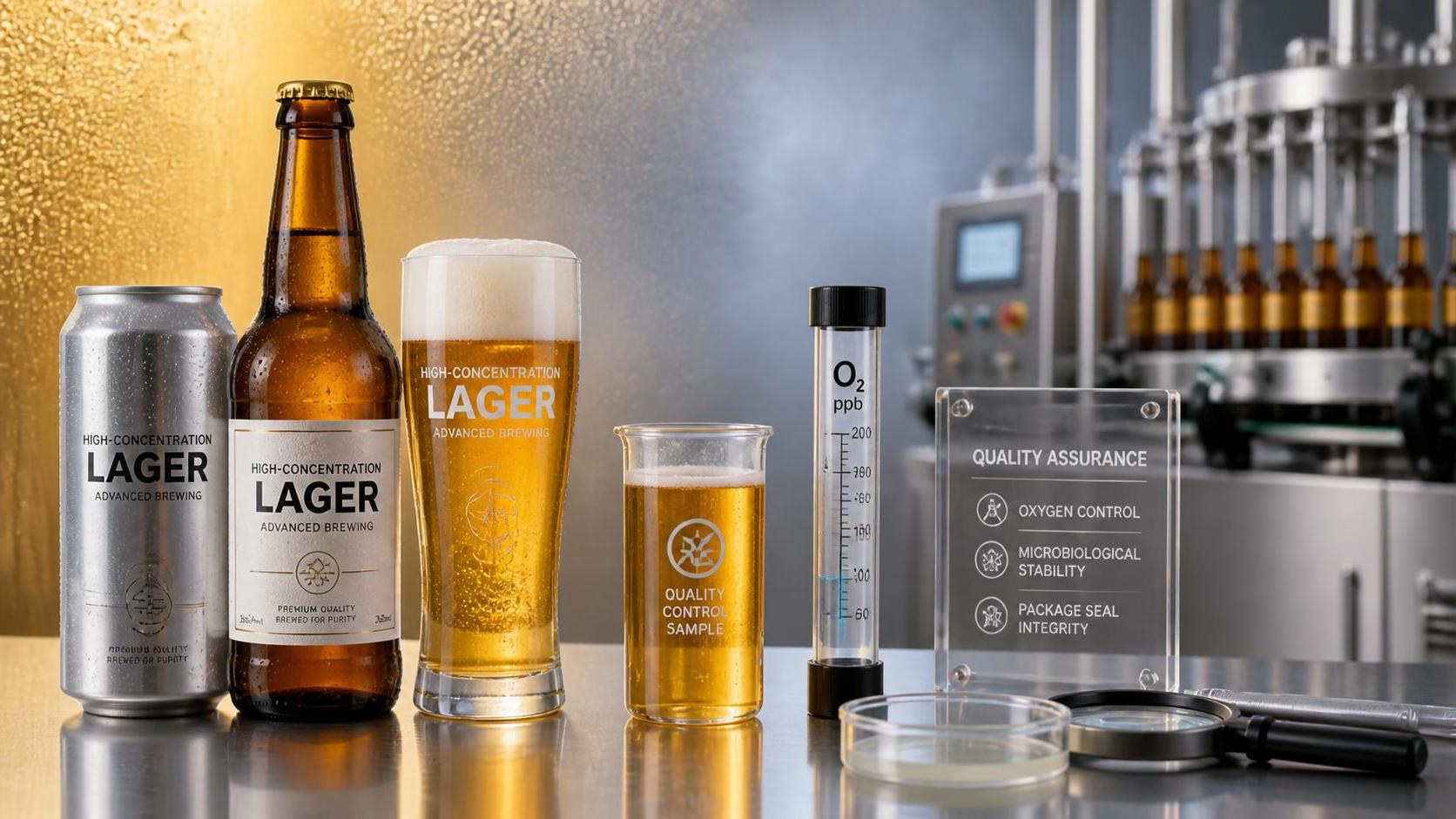
Before selecting a high-concentration lager beer contract manufacturer, quality and safety managers need to verify one basic point first: shelf life is not created by a label claim alone. It is the result of stable brewing control, oxygen management, microbial discipline, packaging integrity, storage design and realistic distribution conditions working together.
For buyers responsible for product quality, the key question is not whether a supplier can produce strong lager beer at scale. The real question is whether that manufacturer can keep the product microbiologically safe, flavor-stable and compliant until the end of its declared shelf life in actual market conditions.
When evaluating a High-concentration lager beer contract manufacturer, the most useful approach is to audit shelf life risk from raw materials through delivery. A manufacturer that performs well in pilot batches but cannot control dissolved oxygen, filling hygiene or temperature abuse risk may create costly complaints later.
Why Shelf Life Risk Is Higher in High-Concentration Lager Beer
High-concentration lager beer often creates a more demanding stability profile than standard products. Higher original gravity, stronger alcohol structure, recipe adjustments and broader export circulation can all increase the consequences of process variation during production and storage.
Many procurement teams assume higher alcohol automatically means stronger protection. That assumption is incomplete. Alcohol can help limit some microbial risks, but it does not prevent oxidation, flavor drift, haze formation, package failure or poor performance under warm logistics conditions.
For quality managers, this means supplier selection should focus on system capability rather than marketing claims. A qualified contract manufacturer must show how it controls the full chain of shelf life risk, not just how long the printed date lasts.
Start With the Shelf Life Validation Method, Not the Shelf Life Claim
The first document to request is the manufacturer’s shelf life validation logic. Ask how the shelf life was established, what storage conditions were used, which quality indicators were tracked and whether the testing reflects your actual route to market.
A credible High-concentration lager beer contract manufacturer should provide more than a certificate or a standard statement. The supplier should explain real-time testing, accelerated testing assumptions, retained sample review frequency and pass-fail criteria for flavor, clarity, carbonation and microbiological status.
Pay close attention to the gap between laboratory storage and field reality. A beer intended for supermarkets, restaurants and cross-border shipping may face temperature swings, longer warehousing and rougher handling than internal validation samples ever experience.
If the declared shelf life was built around ideal cold storage but your distribution model includes warm shelves or uncontrolled last-mile transport, the shelf life statement may be technically legal yet commercially unreliable.
Oxygen Control Is Often the First Practical Risk to Audit
For lager beer stability, oxygen is one of the most important shelf life threats. Even when microbial safety is acceptable, excessive oxygen pickup can rapidly damage flavor freshness, reduce hop and malt definition and create stale, papery or sweetened notes over time.
Quality teams should ask for dissolved oxygen control points across brewing, filtration, bright beer holding and filling. The most relevant review is not a single best-case number, but the consistency of oxygen performance across normal production runs.
Request data on total package oxygen, dissolved oxygen after filling and variation between packaging formats such as cans, bottles and kegs. A supplier that only shares average values without range, deviation or trend data may be hiding unstable process control.
It is also useful to review how the manufacturer manages line startup, changeover, tank purging and filler maintenance. Many shelf life complaints come from preventable oxygen spikes during routine operations rather than from the core beer recipe itself.
Microbial Stability Must Be Verified Beyond Routine Finished Product Release
Finished product pass results do not always prove long-term microbial security. Shelf life failures often come from low-level contamination, sanitation inconsistency or packaging environment weaknesses that are not obvious at the time of shipment.
A reliable supplier should be able to explain its hygiene zoning, CIP validation, environmental monitoring, yeast management and microbiological release standards. For high-concentration lager beer, quality managers should still confirm how spoilage organisms are controlled despite the product’s alcohol level.
Ask whether the plant monitors common beer spoilage risks such as lactic acid bacteria, wild yeast and package contamination points. The manufacturer should also define investigation procedures when counts trend upward, even if they remain within temporary internal limits.
Another useful question is whether retained samples are rechecked during storage. This helps reveal slow-developing instability that a shipment release test may miss. For safety managers, trend discipline matters more than isolated negative test reports.
Packaging Performance Can Shorten Shelf Life Even When the Beer Is Well Made
A beer can be brewed correctly and still lose market quality because of packaging weakness. For shelf life protection, the package is not secondary. It is a critical barrier against oxygen ingress, carbonation loss, light exposure and physical damage.
When screening a High-concentration lager beer contract manufacturer, evaluate packaging materials and compatibility with your target channels. Glass, cans and kegs each create different risk profiles, especially for export markets with long transport cycles.
Review seam integrity for cans, crown or closure reliability for bottles, carbon dioxide retention, pressure resistance and liner performance. Also confirm whether the manufacturer performs regular leak testing and package integrity verification during production, not only during supplier qualification.
Label durability and secondary packaging also deserve attention. Condensation, abrasion and pallet instability may not seem like core shelf life issues, but damaged packaging increases returns, mishandling and exposure that can accelerate quality decline in the field.
Temperature Tolerance Matters More Than Ideal Cold Storage Assumptions
Many shelf life programs look strong on paper because they assume a stable cold chain. In reality, beer may sit at ports, warehouses, retail backrooms or store shelves at temperatures far above target for days or weeks.
This is especially important for buyers serving multiple regions through online and offline channels. A contract manufacturer should help define realistic storage limits and provide evidence of product behavior under foreseeable thermal stress, not only under recommended refrigeration.
Ask what happens to flavor stability, haze, foam retention and package pressure when the product is held at moderately elevated temperatures. Even if the manufacturer does not recommend that condition, your team needs risk visibility because the market may create it anyway.
Suppliers with strong quality systems often use temperature mapping, stress testing and distribution simulation to estimate practical stability. That information is far more useful for decision-making than a simple shelf life number with no context.
Recipe Design and Raw Material Consistency Also Affect Shelf Life
Not all shelf life risks begin on the filling line. Ingredient quality and formulation design shape oxidative stability, flavor retention and physical appearance over time. This is particularly relevant when strong lager products include adjuncts, functional ingredients or custom flavor positioning.
Quality managers should ask how malt, hops, yeast and water specifications are controlled and how lot variability is managed. A supplier may deliver acceptable first batches but create long-term inconsistency if raw material standards are too broad.
If the beer includes added flavors or specialty components, request compatibility data and storage behavior. Some ingredients interact poorly with alcohol, pH, dissolved carbon dioxide or time, resulting in separation, aroma fade or unexpected taste changes before the end of shelf life.
The best manufacturers can explain how recipe design supports shelf life from the start. That includes antioxidant strategy, filtration decisions, yeast handling and format selection that match the intended channel and regional climate exposure.
Compliance Risk Should Be Reviewed Alongside Product Stability
For safety and quality personnel, shelf life is not only a sensory issue. It also has a compliance dimension. If a product remains legally saleable but no longer matches declared quality standards or internal specification, the business still faces commercial and reputational risk.
Check whether the manufacturer’s specifications clearly define release criteria and end-of-shelf-life criteria. These should cover microbiology, alcohol content, carbonation, appearance and sensory acceptability where applicable under the destination market’s rules.
Also review traceability, complaint handling and recall readiness. A capable contract manufacturer should be able to trace ingredients, packaging lots and production records quickly if shelf life failures appear in one region or one sales channel.
Export projects add another layer of complexity. Regulatory labeling, storage instructions and date coding practices should match destination requirements so that shelf life communication remains accurate and defensible across markets.
What to Ask During an On-Site Audit or Supplier Qualification Review
During evaluation, quality managers need practical evidence rather than broad assurances. The most productive audits focus on process capability, trend control and deviation handling across the full manufacturing and packaging workflow.
Ask to review recent production records for oxygen control, microbiological monitoring, sanitation verification, package integrity checks and shelf life retention samples. Trend charts are more informative than isolated records because they reveal whether performance is repeatable.
It is also worth examining nonconformance history. A trustworthy manufacturer will not claim perfect operations. Instead, it should show how deviations were detected, investigated, corrected and prevented from recurring.
For contract projects, clarify who owns final shelf life responsibility, specification approval, change control and market complaint review. Many disputes arise because technical accountability was never clearly assigned between brand owner and manufacturer.
How to Compare Manufacturers Without Reducing the Decision to Price
Price pressure is real, but shelf life failure is usually more expensive than a higher manufacturing quote. Product returns, channel complaints, stock write-offs and damaged distributor trust can quickly erase any short-term savings from a cheaper supplier.
A better comparison model weighs technical stability, consistency and service responsiveness together. For a High-concentration lager beer contract manufacturer, useful criteria include oxygen performance, microbiological discipline, packaging capability, validation depth and export readiness.
Buyers should also consider communication quality. When a manufacturer can explain risks clearly, share trend data openly and propose preventive controls before problems occur, the partnership is usually stronger and more sustainable.
For businesses seeking OEM or ODM cooperation, this matters even more. Product customization is valuable only when the manufacturer can protect quality through the full commercial shelf life across your intended retail and foodservice channels.
Why Long-Term Manufacturing Fit Matters for Brand Protection
Shelf life management is not a one-time qualification task. It is a continuing operational relationship. Recipes evolve, packaging suppliers change, export destinations expand and logistics conditions shift over time.
That means the right partner is not simply a plant with available capacity. It is a manufacturer with the technical discipline to reassess shelf life risks whenever formulation, process, packaging or market conditions change.
For example, a supplier serving classic lager, wheat beer, sugar-free low-calorie beer, fruit-flavored beer and functional specialty beers should already understand that different product styles require different stability controls. That broader capability can be useful for future line expansion.
In practice, the strongest manufacturing partnerships are built on transparency, documented controls and realistic risk discussion. Those qualities protect both product quality and the credibility of your brand in front of distributors, retailers and end customers.
Conclusion
Before choosing a high-concentration lager beer contract manufacturer, quality and safety managers should treat shelf life as a system risk review rather than a packaging date check. The core issues are oxygen control, microbial security, packaging integrity, thermal tolerance, raw material consistency and compliance readiness.
The most dependable supplier is the one that can prove stable performance with records, trend data and market-relevant validation. Capacity and price matter, but they should come after technical confidence that the beer will remain safe, consistent and commercially acceptable throughout distribution.
In short, selecting the right manufacturing partner means asking one disciplined question: can this supplier protect the beer not only when it leaves the factory, but until the final day it reaches the customer? That is the standard that should guide the decision.
Thank you very much for writing to us. Please leave your message and contact information, we will reply to you within 24 hours.