



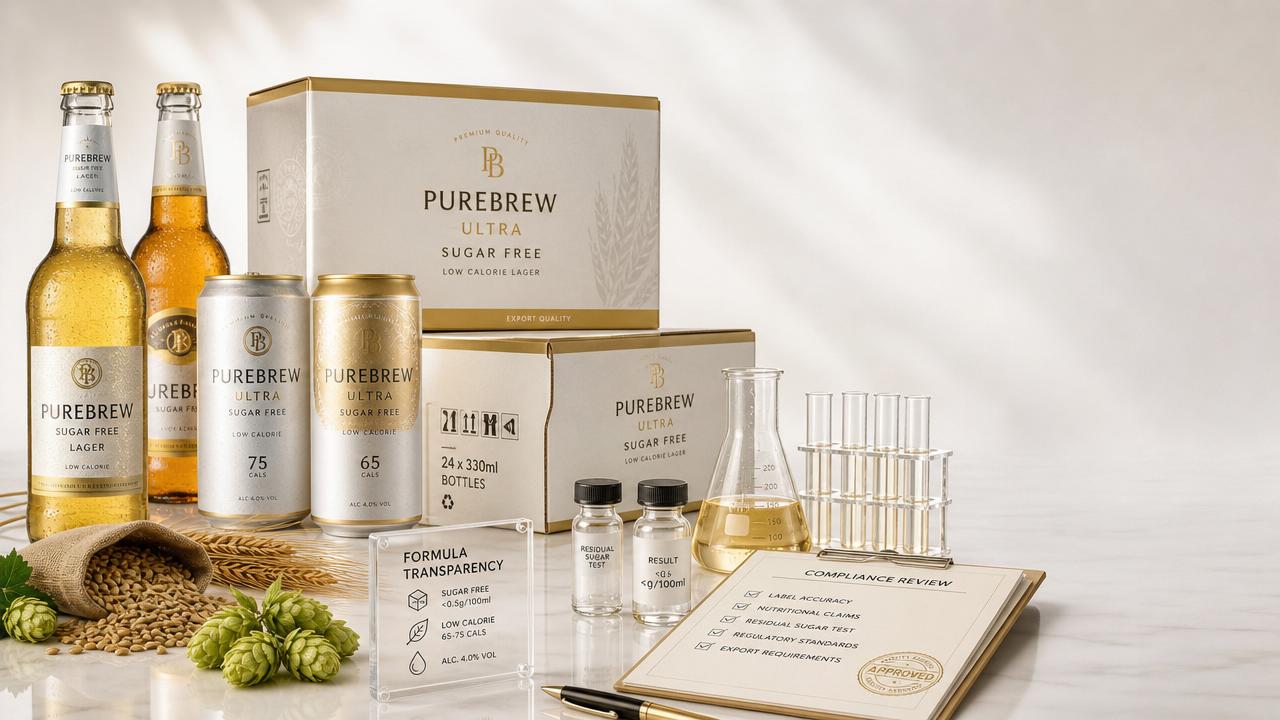
When evaluating a sugar-free beer supplier China, technical buyers need more than a marketing claim. Ingredient transparency, sweetener use, nutritional labeling, fermentation methods and export-market compliance all affect product acceptance and risk control. This guide highlights the key claim substantiation and regulatory review points to help assess supplier capability, formulation credibility and long-term cooperation potential.
For importers, private-label brands, retail chains and beverage project teams, the review process usually goes beyond flavor and price. A technically sound supplier should explain how residual sugar is controlled, which inputs are used to balance taste, how calorie reduction is calculated, and which documents support market entry in different regions. In practice, 6 core checkpoints often determine whether a product can move smoothly from sampling to long-term supply.
Jinpai Beer operates in craft beer R&D, production and distribution, covering classic lager, German wheat, sugar-free low-calorie beer, fruit beer and functional specialty beer, while also supporting OEM, ODM, wholesale and custom development. For technical evaluation personnel, this means the supplier assessment should focus not only on product range, but also on formulation logic, process consistency, labeling readiness and export coordination capability.
What “Sugar-Free” Should Mean in Beer Sourcing
The term “sugar-free” can be commercially attractive, but in beer it requires careful technical interpretation. In most projects, the key question is not whether the beer tastes less sweet, but whether residual sugars after fermentation meet the threshold required by the destination market. Some buyers use an internal benchmark such as less than 0.5 g sugar per 100 mL, while others evaluate claims according to local food labeling law.
A reliable sugar-free beer supplier China should be able to distinguish between three related but different concepts: sugar-free, no added sugar, and low calorie. These claims are not interchangeable. A beer may contain no added sucrose but still retain fermentable or unfermentable carbohydrate residues. Likewise, a low-calorie beer may reduce total energy by 20% to 40% versus a regular lager without qualifying as sugar-free.
Residual Sugar vs. Perceived Sweetness
Technical buyers should ask whether sweetness comes from actual sugar, high-attenuation fermentation, non-nutritive sweeteners, flavor systems, or a combination of these. Sensory sweetness can remain even when analytical sugar values are very low. This matters because consumers may perceive a mismatch if a product is marketed as sugar-free but tastes heavily sweetened, especially in premium craft and health-oriented channels.
Key review questions
- What analytical method is used to measure residual sugar?
- Is the claim based on finished beer, diluted calculation, or recipe theory?
- Does the formula include sweeteners, malt extracts, fruit bases, or flavor carriers?
- Is the calorie statement calculated per 100 mL, per serving, or per package unit?
- Can the supplier provide 2 to 3 batch records showing stable results?
Before comparing samples, it helps to map the most common claim categories and their technical implications. The table below can be used as a first-pass review tool during supplier screening.
The main takeaway is that claim language should follow product reality, not the other way around. If a supplier cannot clearly separate these three categories, the risk of relabeling, customs delay or customer complaint rises significantly during market launch.
Ingredient Claims and Formula Transparency
For technical assessment teams, ingredient review is usually the fastest way to test whether a sugar-free beer supplier China has genuine formulation control. Beer formulas may look simple on paper, but sugar-related claims become more complex when specialty malts, enzyme systems, fruit preparations, botanical extracts or post-fermentation flavoring are involved. Even 1 undocumented carrier ingredient can create a claim inconsistency.
Core raw materials to verify
A standard review should cover at least 5 material groups: malt source, adjuncts, hop products, yeast strain, and any sweetener or flavor system. In export projects, buyers should also check whether fining agents, stabilizers or processing aids need declaration in the target market. The point is not that every ingredient is risky, but that every declared claim must align with the real production inputs.
Sweetener-related review points
- Whether sweeteners are used at all, and if yes, at what stage of production
- Whether the sweetener is permitted in alcoholic beverages in the destination country
- Whether the label must state the additive name, INS number, or functional class
- Whether the sensory profile remains stable over 6 to 9 months of shelf life
- Whether the beer targets on-trade, retail, or e-commerce channels with different tolerance for sweetness
In some cases, suppliers reduce residual sugar primarily through high attenuation rather than through sweetener addition. In others, a very dry beer base is later balanced with permitted low-calorie sweetening systems. Neither route is automatically right or wrong, but technical buyers should understand which route is being used because it affects labeling, mouthfeel, aftertaste and regulatory review.
The table below shows how common formula choices can influence claim substantiation and buyer review workload.
For OEM and ODM projects, early formula transparency saves time later. A buyer that receives ingredient declarations, draft labels, and pilot-batch nutrition data within the first 2 to 3 development rounds can usually make a faster go-or-no-go decision than one relying only on sensory approval.
Fermentation Method, Process Control and Batch Consistency
Claim credibility in sugar-free beer depends heavily on process control. A supplier may present a strong pilot sample, but technical buyers need evidence that the same sugar profile can be maintained at commercial scale. In practical audits, consistency over 3 consecutive production batches often reveals more than a single polished sample ever can.
Why process data matters
Residual sugar is influenced by mash profile, enzyme activity, yeast health, fermentation temperature, attenuation target and filtration strategy. Even a 1 to 2 day difference in fermentation completion can affect final analytical values. For low-calorie or sugar-free beer, these variables matter more because the formulation window is narrower than in standard craft styles.
Minimum process records to request
- Brewing process summary with key control points
- Fermentation timeline, such as 7 to 14 days depending on style
- Apparent or real attenuation data for multiple batches
- Finished beer analysis including sugar, alcohol, extract and energy values
- Shelf-life observation notes for flavor and stability over 6 to 12 months
For technical buyers supplying supermarkets or chain restaurants, consistency is usually more important than novelty. A sugar-free beer supplier China should therefore explain how sampling, in-process testing and release approval are managed. This is especially relevant for private-label contracts where one nonconforming lot can affect several thousand units across multiple retail points.
Scale-up considerations for OEM and ODM
A pilot formula that works in a small test brew may not behave identically in larger production runs. During scale-up, hop extraction, yeast performance, dissolved oxygen control and sweetness perception can all shift. Buyers should ask whether the supplier conducts trial production before final confirmation and whether sensory and analytical approval are both required before mass packaging begins.
In a practical OEM workflow, 4 stages are common: formula discussion, lab or pilot sample, scale-up verification, and commercial production. Each stage should produce a document trail. If a supplier cannot define these steps clearly, technical risk and communication cost usually increase during the project.
Nutrition Labeling and Export Compliance Review
A technically acceptable beer can still fail in market entry if labels and claim documents are not aligned with import requirements. For sugar-free and low-calorie products, technical buyers should review not only formulation data, but also the exact wording used on labels, cartons, product sheets and online sales pages. In many projects, the compliance issue begins with marketing language rather than with brewing itself.
Documents commonly requested by buyers
- Ingredient list and additive declaration
- Finished product specification sheet
- Nutritional information per 100 mL and per serving if required
- Shelf-life and storage recommendation, often 6, 9 or 12 months
- Packaging details for can, bottle or keg format
- Batch test report or third-party analysis where necessary
The exact compliance path varies by market, but the evaluation logic is consistent. Technical teams should confirm whether the claim threshold used by the supplier matches the importing country’s rules, whether alcohol labeling and nutritional panels follow the correct format, and whether health-oriented wording may trigger additional scrutiny. Terms such as “functional,” “healthy,” or “diet-friendly” should be reviewed carefully in alcohol categories.
The table below outlines a practical compliance checklist that buyers can use before approving artwork and production.
The best suppliers support compliance early, not after the goods are packed. For example, draft label review before printing, bilingual specification confirmation, and pre-shipment document matching can reduce avoidable corrections during the final 2 to 4 weeks before dispatch.
How Technical Buyers Should Assess Supplier Capability
Choosing a sugar-free beer supplier China is not just a product decision; it is a system decision. Technical buyers should evaluate whether the supplier can support repeatability, customization and communication across the full project cycle. This includes sample development, specification control, packaging coordination, export documentation and post-launch issue handling.
A practical 6-point supplier evaluation framework
- Claim substantiation: Can the supplier explain and document sugar-free logic?
- Formula transparency: Are ingredients, additives and carriers disclosed clearly?
- Process consistency: Can 3 batches show stable analytical values?
- Label readiness: Are draft claims, nutrition panel and declarations reviewable early?
- Customization ability: Can flavor, bitterness, alcohol level or package format be adjusted?
- Service response: Can questions on testing, revisions and shipment documents be handled within agreed timelines, such as 24 to 72 hours?
Questions to ask during supplier discussions
Ask for one sample set with matching paperwork, not just a good-tasting can. Confirm whether the technical sheet, ingredient list, nutrition values and intended claim language refer to the same formula version. Also ask whether MOQ, lead time and package options differ between standard products and custom-developed sugar-free beer. In many projects, lead times range from 20 to 45 days depending on packaging material readiness and artwork approval.
For buyers serving bars, supermarkets and restaurant groups, the ability to offer multiple pack formats can also matter. A supplier with experience in bottles, cans and kegs may better support channel-specific rollout. That becomes especially useful when one formula must serve both retail and on-trade applications without changing the compliance foundation.
Common Mistakes in Sugar-Free Beer Procurement
Even experienced beverage teams can overlook claim detail when evaluating innovative beer products. In sugar-free sourcing, the most common mistakes usually happen at the interface between R&D, purchasing, compliance and sales. A technically disciplined review process can prevent these issues before the first commercial order is placed.
Frequent gaps to avoid
- Approving the sample based on taste alone without confirming sugar test results
- Using “sugar-free” and “no added sugar” interchangeably in artwork drafts
- Ignoring sweetener declaration rules in the target market
- Failing to compare pilot and mass-production analytical values
- Assuming calorie reduction automatically supports all low-sugar claims
- Reviewing the label only after packaging material is already printed
Risk-control recommendation
A useful method is to create a 3-step approval gate: first formula review, then analytical and label review, then packaging release. This structure helps technical buyers identify mismatches before production. It also gives suppliers a clearer framework for OEM or ODM cooperation, especially when multiple departments are involved in the final sign-off.
For long-term programs, build an annual or semiannual verification rhythm. If the product is sold across more than 1 market, periodic checks on claim language and ingredient declaration are sensible because regulatory expectations, distributor requests and retailer standards can change over time.
Working with a Supplier That Can Support Long-Term Growth
Technical buyers are not only selecting a current SKU; they are evaluating whether a supplier can support future line extensions. In the beer sector, that may include moving from a standard sugar-free lager to fruit-accented variants, lower-alcohol versions, or packaging adaptations for different channels. A supplier with broader brewing capability and customization experience can reduce development friction across these next stages.
Jinpai Beer’s portfolio covers classic lager, German wheat, sugar-free low-calorie beer, fruit-flavored beer and functional specialty beer, with OEM, ODM and wholesale support. For technical evaluation personnel, this combination is relevant because it suggests the possibility of coordinated product development, packaging adaptation and multi-channel supply under one cooperation framework rather than fragmented sourcing.
A dependable sugar-free beer supplier China should be able to discuss formulation, claims, documentation and delivery with equal clarity. If your team is reviewing suppliers for private label, distribution or retail expansion, the best next step is to request a sample-and-document package that includes formulation notes, nutrition data, draft claim wording and packaging options. Contact us to discuss your product requirements, obtain a customized solution, or review technical details for your target market.
Thank you very much for writing to us. Please leave your message and contact information, we will reply to you within 24 hours.