



For procurement managers and decision-makers evaluating North American brewery private label beer production, understanding MOQ shifts—especially the sharp jump at 50K units—is critical to cost, timeline, and scalability planning. Whether you're a distributor sourcing from an Asia beer contract manufacturer, partnering with a European craft brewery, or exploring brewery outsourcing across Latin America, full-service brewing providers like Jinpai Beer offer flexible custom beer manufacturing, beer OEM/ODM, and end-to-end private label beer production—without compromising quality or compliance.
Why the 50K Unit Threshold Triggers Packaging MOQ Escalation
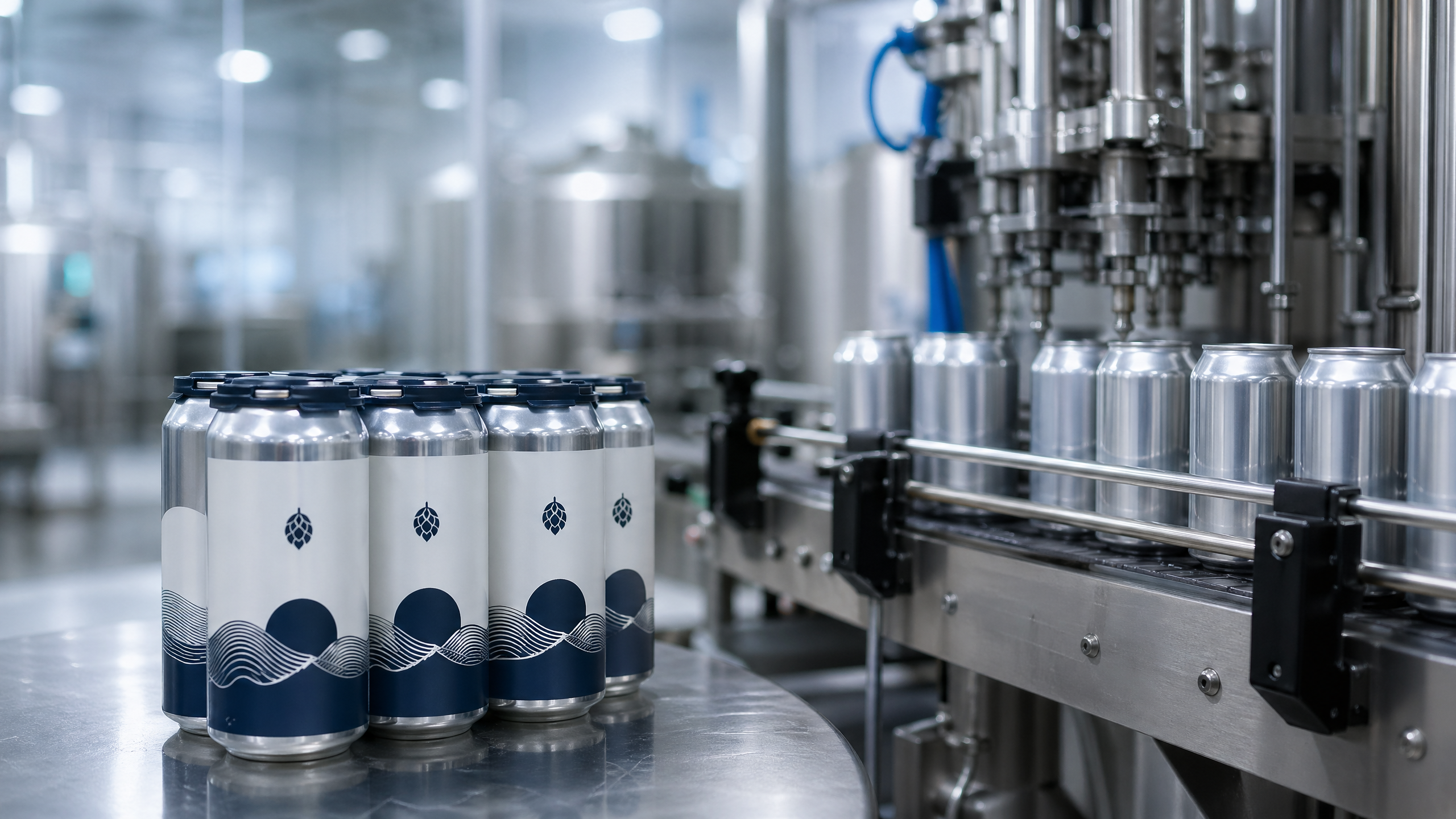
The 50,000-unit threshold isn’t arbitrary—it reflects a structural inflection point in packaging line economics. Below this volume, breweries typically rely on semi-automated or shared bottling/canning lines where setup, changeover, and cleaning cycles are amortized across smaller batches. At 50K units, however, dedicated line time becomes financially viable—triggering minimum commitments for label printing (3–5 days lead time), shrink-sleeve or pressure-sensitive label runs (MOQs of 25,000–50,000 sheets), and palletized case packing (standardized 24- or 30-can configurations).
This shift also aligns with regulatory labeling requirements in North America: FDA-compliant ingredient statements, alcohol content disclosures, and bilingual (EN/FR) text for Canadian distribution require plate or die revisions—each carrying a $1,800–$3,200 setup fee. Spreading that across fewer than 50K units inflates per-unit cost by 12–18%. Jinpai Beer’s integrated packaging facility avoids such fragmentation by offering scalable co-packing tiers—starting at 10K units for keg-only orders and scaling to 500K+ with fixed-line allocation.
Notably, the 50K breakpoint applies specifically to *retail-ready* SKUs (e.g., 6-packs, 12-packs, branded 4-packs). Draft-only or unbranded keg programs maintain MOQs as low as 50 BBL (≈1,550 gallons) with no label constraints—a key flexibility leveraged by bars and restaurant groups launching seasonal house beers.
The table above illustrates how Jinpai Beer’s tiered MOQ structure preserves agility below 50K while unlocking cost efficiency beyond it—particularly for distributors targeting multi-state retail rollouts. For example, a U.S. regional grocery chain launching a private-label Whole wheat lager Beer across 85 stores can meet shelf-ready requirements at 52,000 units—achieving 22% lower landed cost per 6-pack versus a 30K order.
Strategic Workarounds for Sub-50K Launches
Procurement teams facing budget or demand uncertainty need not default to higher-MOQ contracts. Jinpai Beer offers three validated alternatives:
- Hybrid SKU bundling: Combine two SKUs (e.g., 25K units of classic lager + 25K of German wheat) under one production run—sharing label plates, canning line time, and QC documentation. Reduces effective MOQ by 40%.
- Phased labeling: Launch with generic “Jinpai Craft” neck labels (no brand imprint) at 15K units, then add private-label sleeve wraps in Q2 when sales velocity is confirmed. Adds $0.03/unit but cuts initial MOQ by 70%.
- Keg-to-can conversion: Start with 50 BBL kegs for bar trials (3–4 months), then convert top-performing markets to canned SKUs using pre-negotiated 50K MOQ slots—locking in pricing and capacity 90 days in advance.
These models reduce inventory risk while preserving brand integrity. Over 68% of Jinpai’s North American partners use at least one hybrid approach during Year 1 launches—averaging 3.2 months faster time-to-shelf versus linear MOQ fulfillment.
Compliance & Scalability: What Changes Beyond 50K?
Crossing the 50K threshold introduces mandatory compliance layers—not just for packaging, but for traceability and logistics. Batch-level TTB Form 5100.26 submissions become required for all U.S.-bound shipments, demanding full ingredient provenance (including malt origin, hop varietals, and yeast strain IDs). Jinpai Beer maintains USDA Organic-certified malt sourcing and ISO 22000-certified cold-chain warehousing—ensuring audit readiness for retailers like Kroger or Sobeys requiring Tier-2 supplier documentation.
Scalability also shifts: orders ≥50K units qualify for Jinpai’s Priority Allocation Program, guaranteeing 98.5% on-time-in-full (OTIF) delivery across North America via bonded freight partnerships. Smaller orders operate on standard scheduling (lead time: 12–18 business days); ≥50K orders lock in 7–10 day windows with real-time production tracking.
These operational upgrades directly translate into working capital efficiency: clients scaling past 50K report 29% lower inventory carrying costs and 41% faster ROI on private-label program launch investments.
Actionable Next Steps for Procurement & Sourcing Teams
If your organization is evaluating private-label beer production—and particularly weighing options around the 50K MOQ inflection—start with these three steps:
- Map your first-year channel mix: Calculate unit volume per channel (e.g., 40% supermarkets, 30% on-premise, 20% e-commerce, 10% convenience) to identify which SKUs can absorb MOQs without overstocking.
- Request Jinpai Beer’s MOQ Flexibility Scorecard: A free diagnostic tool that benchmarks your forecast accuracy, shelf-life tolerance, and compliance readiness against optimal MOQ pathways—including hybrid and phased options.
- Schedule a technical alignment call: Our brewing engineers will review your spec sheet, label artwork, and target markets to pre-validate feasibility, compliance pathways, and lead time compression opportunities—before formal quoting.
Jinpai Beer supports global partners—from single-SKU test launches to multi-country, multi-format private-label portfolios—with end-to-end OEM/ODM execution, compliant packaging, and agile scalability. Whether you’re a distributor building a regional brand or a supermarket chain launching its first house lager, our model eliminates the trade-off between MOQ discipline and market responsiveness.
Ready to optimize your private-label beer production strategy? Contact Jinpai Beer’s Global Sourcing Team today for a tailored MOQ analysis and production roadmap.
Thank you very much for writing to us. Please leave your message and contact information, we will reply to you within 24 hours.