



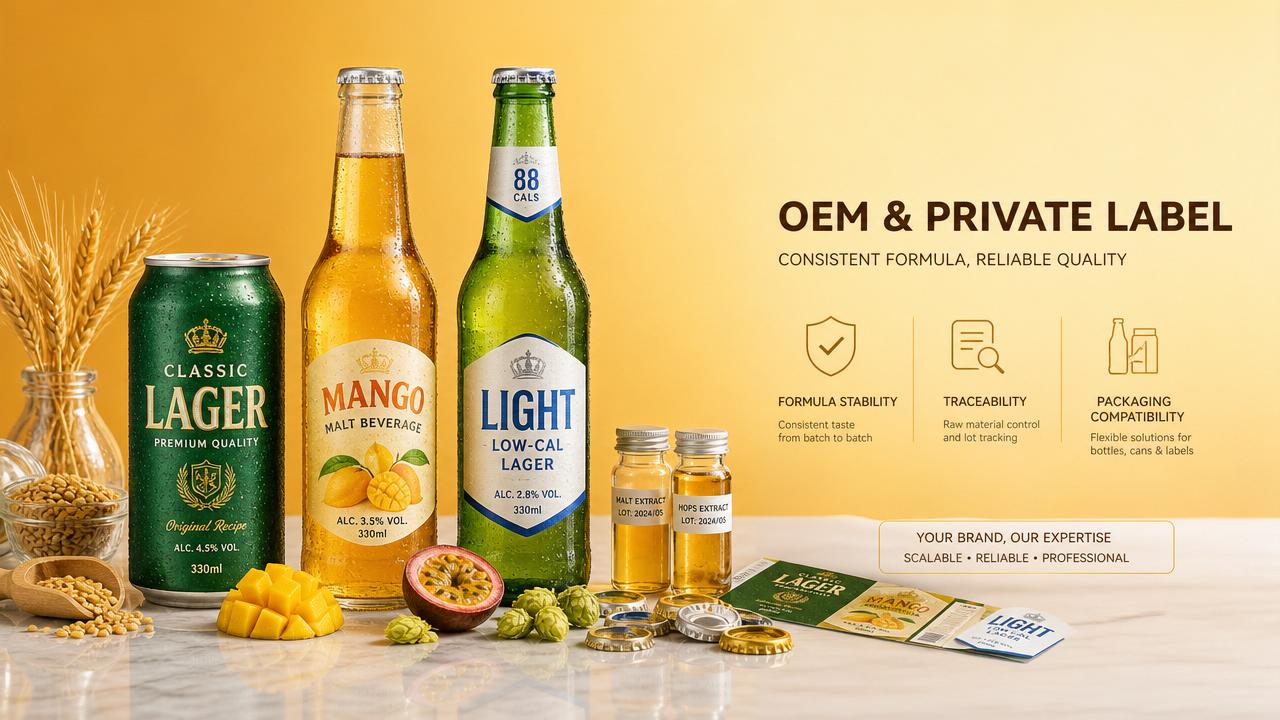
Malt beverage OEM vs private label which is better when quality risk is the real concern?
Malt beverage OEM vs private label which is better? In practice, the better choice depends less on price and more on quality exposure.
For malt beverages, quality problems rarely stay isolated. A small formulation drift can affect flavor, shelf life, label accuracy and market compliance at once.
That is why the OEM versus private label decision matters in beer, flavored malt drinks and specialty functional beverages.
A supplier with broad brewing capability, such as classic lager, German wheat, sugar-free low-calorie beer and fruit-flavored lines, usually faces very different control points across products.
The same sourcing model will not perform equally well in every case. A stable lager and a functional specialty beer do not carry the same risk profile.
So when asking Malt beverage OEM vs private label which is better, the more useful question is this: which model fits the product, channel and compliance burden better?
Actual sourcing conditions change the answer
Different business settings create different quality priorities. Some need strict recipe control. Others need fast launch with lower development complexity.
OEM usually means deeper involvement in formula, process and specifications. Private label often starts from an existing, verified product base.
That sounds simple, but the quality implications are not. Greater customization can improve differentiation while increasing validation work.
A ready product under private label can reduce development risk, yet it may limit control over ingredient substitution and process adjustments.
In beverage distribution, channel mix also changes the decision. Restaurant supply, supermarket retail and bar service each stress different failure points.
Where the main quality risks usually come from
- Recipe variation affecting taste, alcohol level, sweetness or mouthfeel.
- Raw material traceability gaps, especially for malt, yeast, fruit inputs and functional additives.
- Label mismatch caused by reformulation, local rules or nutrition claim changes.
- Packaging compatibility issues with cans, bottles, closures and filling environments.
- Unclear responsibility when complaints arise across multiple markets.
When a standard product line is enough, private label often feels safer
For established beer styles, private label can be the more controlled route. This is common with classic lager or wheat beer for broad retail channels.
The reason is practical. A mature product already has stable process settings, shelf-life data and packaging records.
In these cases, Malt beverage OEM vs private label which is better often leans toward private label, especially when speed and consistency matter more than uniqueness.
This model works well when the target market accepts familiar taste profiles and does not require special claims or unusual ingredients.
Still, private label is not automatically low risk. The key issue is whether the existing formula stays fixed over time.
If ingredient substitutions are allowed without formal approval, the apparent simplicity disappears. Consistency then becomes difficult to verify across batches.
What to confirm before choosing private label
- Whether the formula is locked or open to equivalent raw material replacement.
- How sensory benchmarks are documented and approved.
- Whether country-specific label versions are reviewed before production.
- How retained samples and complaint trace-back are managed.
For differentiated beverages, OEM gives more control but raises validation pressure
The picture changes with sugar-free low-calorie beer, fruit-flavored beer or functional specialty beverages.
These products often need precise sweetness balance, flavor stability, additive compatibility and claim accuracy. A standard private label product may not fit.
Here, Malt beverage OEM vs private label which is better often points toward OEM, because formula control becomes part of risk control.
But OEM only works well if development discipline is strong. More customization means more pilot runs, more specification reviews and more shelf-life verification.
Fruit components can shift color and aroma during storage. Functional ingredients may interact with carbonation, pH or pasteurization conditions.
Without structured validation, a custom beverage may look differentiated on paper and fail in transport or on retail shelves.
Multi-market distribution makes traceability more important than branding flexibility
Global online and offline distribution adds another layer. What passes in one market may trigger relabeling or documentation problems elsewhere.
This is where the question, Malt beverage OEM vs private label which is better, should include traceability systems, not just product ownership.
For cross-border beverage sales, the safer model is usually the one with clearer lot control, ingredient records and change notification procedures.
An experienced brewing partner handling OEM, ODM and wholesale supply may support this better if documentation is built into routine production.
Yet documentation quality should be verified, not assumed. Broad product range alone does not prove disciplined compliance execution.
In cross-market beverage programs, check these points carefully
- Ingredient origin records for malt, flavor systems and specialty components.
- Formal process for specification changes and approval history.
- Market-specific label review, including alcohol, allergen and nutrition rules.
- Recall simulation capability and lot-level shipment tracking.
Common mistakes when comparing OEM and private label
One frequent mistake is treating similar beverages as if they have identical control needs.
A standard wheat beer and a fruit-infused wheat beverage may share a base style, but their stability risks differ significantly.
Another mistake is focusing only on unit price. Lower upfront cost can hide later losses from reformulation, returns or relabeling.
It is also common to compare samples without comparing process control. A good pilot batch says little about long-run repeatability.
When people ask Malt beverage OEM vs private label which is better, they sometimes overlook who owns corrective action after a market complaint.
Responsibility boundaries should be explicit before launch, especially for custom beverages with higher formula sensitivity.
A practical way to decide which model fits your beverage program
A useful decision method is to map the beverage against four variables: formulation complexity, regulatory exposure, channel stability and expected change frequency.
If the product is standard, the claim burden is low and channel demand is predictable, private label often reduces execution risk.
If the product needs sensory differentiation, nutritional positioning or functional ingredients, OEM usually provides better control over what matters most.
The final answer to Malt beverage OEM vs private label which is better is rarely universal. It depends on where quality can fail first.
Before moving forward, document formula ownership, change approval rules, traceability depth, validation scope and complaint handling steps.
Then compare the two models against the actual product mix, whether lager, wheat, low-calorie, fruit-based or functional specialty beverages.
That approach gives a more reliable answer than asking only which model is cheaper or faster.
In real beverage sourcing, the better option is the one that keeps quality stable when the market, formula or regulation starts to change.
Thank you very much for writing to us. Please leave your message and contact information, we will reply to you within 24 hours.