



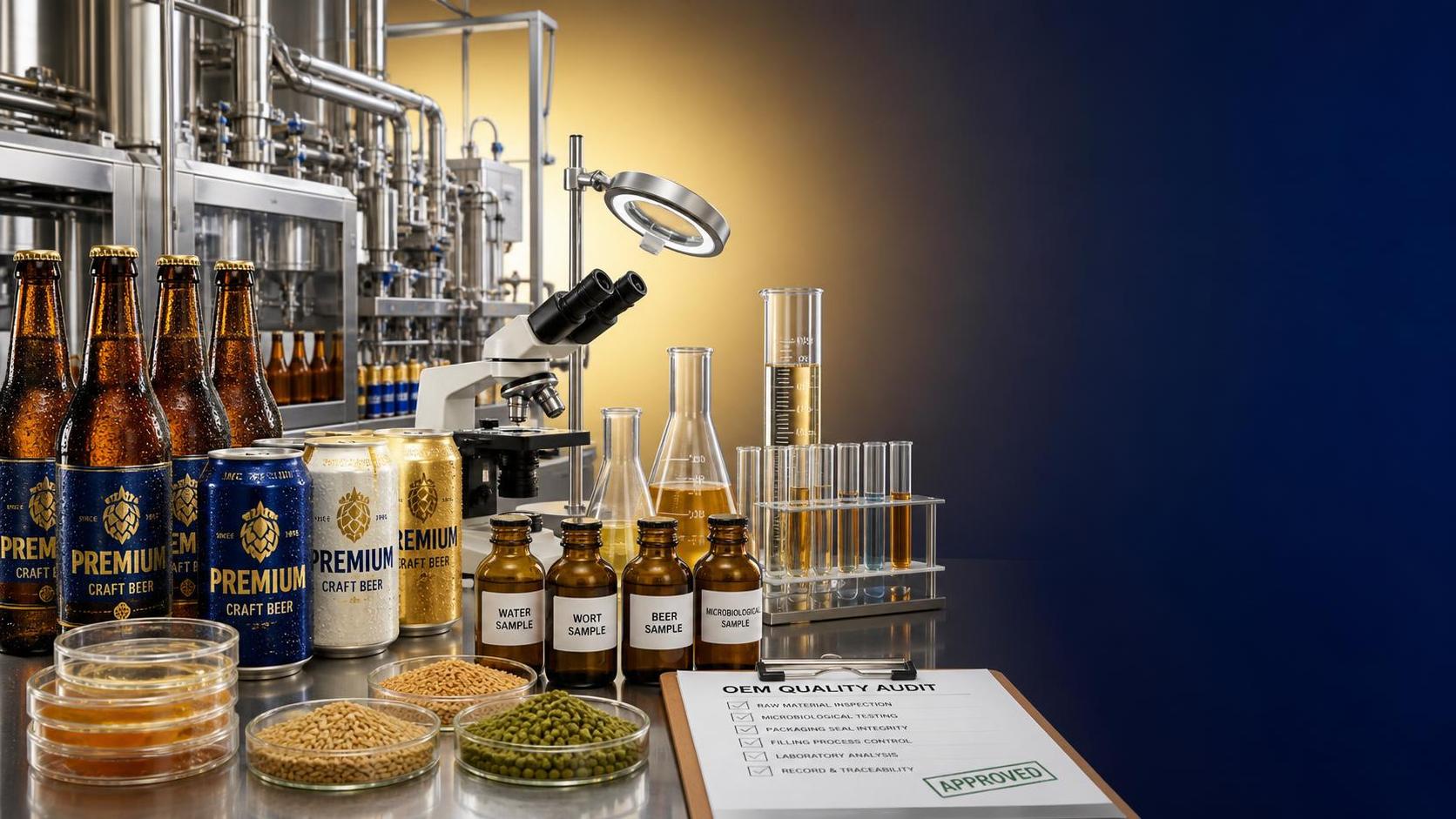
In a Beer OEM project, the contract is often treated as the finish line. For quality control and safety teams, it should be the starting gate. Once a private-label beer enters your market under your brand name, any defect in flavor stability, contamination control, label accuracy or traceability quickly becomes your problem, not just the manufacturer’s. That is why evaluating a Beer OEM partner requires more than a tasting session and a packaging mockup. It calls for a disciplined review of the systems behind the bottle or can.
For buyers serving supermarkets, restaurants, bars or retail chains, the stakes are especially high. Beer is sensitive to raw material variation, process deviations, oxygen pickup, microbial contamination and storage conditions. A brewery may present an attractive sample today and still struggle to deliver the same product six months later at commercial scale. The key question is not whether the OEM can brew one good batch. It is whether the supplier can consistently produce compliant, traceable and market-ready beer over time.
This is where a technical pre-signing evaluation becomes essential. Before entering any Beer OEM agreement, QC and food safety teams should verify how the manufacturer controls ingredients, manages brewing risks, documents compliance and responds to deviations. The checks below can help reduce commercial risk and create a stronger foundation for long-term cooperation.
Start with raw material control, not finished product claims
A polished final sample can hide weak upstream controls. In beer production, raw material quality shapes everything from fermentability and foam retention to flavor profile and shelf-life stability. Before approving a Beer OEM supplier, ask how malt, wheat, hops, yeast, enzymes, fruit ingredients, sweeteners and functional additives are selected, tested and released into production.
Quality teams should pay close attention to ingredient specifications. Are there written acceptance standards for moisture, extract potential, microbiological risk, heavy metals, allergens or pesticide residues where relevant? If the portfolio includes sugar-free low-calorie beer, fruit-flavored beer or functional specialty beers, controls become even more important because added ingredients may introduce extra variability and contamination risks.
It is also worth checking whether the brewery relies on qualified suppliers or simply buys based on price and availability. A capable OEM should be able to explain supplier approval procedures, incoming inspection methods and how nonconforming materials are isolated. If ingredient substitutions happen frequently without customer notification, that is a warning sign for both product consistency and regulatory exposure.
Assess the repeatability of the brewing process
One of the most common mistakes in Beer OEM sourcing is overvaluing the pilot batch. Small-scale brewing can be carefully watched and manually adjusted. Commercial production is another reality. A reliable OEM should demonstrate that recipes can be transferred from development scale to routine manufacturing without large swings in bitterness, alcohol content, color, carbonation or mouthfeel.
Ask for a process overview covering milling, mashing, lautering, boiling, hopping, whirlpool separation, fermentation, maturation, filtration or centrifugation, blending and packaging. You do not need every proprietary detail, but you do need to understand which critical control points affect final quality. Good manufacturers can identify the process variables that matter most and explain how they monitor them.
For example, fermentation temperature, yeast vitality, dissolved oxygen, cleaning verification and packaging line sanitation all have direct impact on beer stability. If a brewery cannot clearly describe how it controls these parameters, you may be looking at a supplier that depends too much on operator experience and not enough on system discipline.
Check laboratory capability and release criteria
Beer quality should never be judged by sensory testing alone. A Beer OEM partner should have laboratory routines that support both process control and final product release. This includes at least the ability to verify alcohol by volume, original gravity or extract, pH, bitterness, color, carbonation and basic microbiological status. Depending on the product type and export destination, further testing may be required.
Ask practical questions: Which tests are done in-house and which are outsourced? How are instruments calibrated? How often are retention samples reviewed? What are the batch release criteria? If the supplier offers German wheat beer, classic lager, fruit beer and functional lines, the testing plan should reflect differences in recipe risks rather than using one generic checklist for all products.
For safety managers, microbiological control deserves special attention. Contamination by wild yeast, lactic acid bacteria or spoilage organisms may not appear in every batch, but when it does, shelf life and brand reputation can collapse quickly. A brewery with a serious quality culture will have defined sampling points, environmental hygiene monitoring and documented escalation procedures when test results exceed limits.
Hygiene systems matter as much as brewing skill
Many Beer OEM failures are not caused by recipe design. They begin with poor housekeeping, weak CIP validation or inadequate zoning between clean and non-clean areas. Even a well-equipped plant can become a risk if sanitation is treated as a routine chore rather than a preventive control.
During evaluation, review cleaning and sanitation procedures for tanks, pipelines, fillers, bright beer tanks and transfer lines. Look for evidence that cleaning effectiveness is verified, not assumed. Swab testing, ATP monitoring, rinse verification or microbiological checks can indicate whether sanitation is managed in a measurable way.
Personnel hygiene should not be overlooked either. Visitor control, gowning practices, handwashing discipline, maintenance access and line clearance all influence contamination risk. If quality and safety teams see unclear traffic flow, wet accumulation around equipment, poor chemical storage or inconsistent hygiene behavior on the floor, those observations should weigh heavily in the decision.
Packaging integrity is a quality issue, not just a design issue
Buyers often focus on label appearance and packaging cost, but packaging performance is one of the most important checks before signing a Beer OEM agreement. Beer is highly vulnerable to oxygen ingress, light exposure and seal failure. A beautiful can or bottle means little if the product oxidizes early or leaks during transport.
Review the supplier’s controls for seam integrity, crown performance, fill volume accuracy, dissolved oxygen at packaging and container compatibility. Ask whether packaging materials are validated for the specific beer style and intended distribution conditions. This is particularly relevant for export business, where long transit times and varied storage temperatures can stress the product far beyond local distribution norms.
Label compliance also belongs in this discussion. Alcohol declaration, ingredient statements, allergen information, date coding, language requirements and destination-market rules should be reviewed before artwork approval. For private-label and customized products, mislabeling is more than an administrative error; it can trigger customs delays, recalls or legal penalties.
Traceability should be tested, not just promised
Most suppliers will say they have traceability. The useful question is how fast and how completely they can demonstrate it. Before finalizing a Beer OEM partnership, verify whether each batch can be linked to raw materials, processing records, packaging materials, operators, test results and shipment details.
A strong traceability system supports both recall readiness and routine investigation. If a customer complaint arises about haze, off-flavor, low carbonation or damaged packaging, the brewery should be able to reconstruct what happened without guesswork. Ask the OEM to describe its mock recall process, document retention period and coding structure. If records are scattered across spreadsheets, paper notes and informal messaging, response time during a real incident may be dangerously slow.
Review compliance with food safety and market access requirements
For QC and safety professionals, compliance is rarely a single certificate on the wall. It is the practical alignment between the brewery’s operating system and the legal requirements of the markets you intend to serve. That includes food safety management, production licensing, product registration where needed, packaging compliance and export documentation capability.
Some buyers make the mistake of assuming that domestic compliance automatically translates into export readiness. It does not. Different regions may have different expectations for additives, labeling, alcohol tolerances, nutritional claims or testing documentation. If the Beer OEM supplier offers customized solutions for global channels, it should also be able to discuss how formulations and labels are adjusted for destination markets.
For products such as sugar-free low-calorie beer or functional specialty beers, claims control is particularly important. Teams should verify whether technical documentation supports the claim language and whether marketing statements align with local regulations. The safest contract is one built on verifiable product positioning, not optimistic assumptions.
Audit change management before you audit the sample room
One underappreciated risk in Beer OEM cooperation is uncontrolled change. A product may be approved based on one recipe, one yeast management practice or one packaging material, then drift over time because the manufacturer adjusts sourcing, process timing or line configuration. Without a formal change management process, the buyer may discover the difference only after complaints appear in the market.
Ask how the brewery handles recipe modifications, supplier changes, specification revisions, packaging substitutions and process deviations. Which changes require customer approval? How are temporary fixes documented? What happens when a batch falls slightly outside target but still appears saleable? Clear answers here often reveal whether the OEM treats quality as a contractual obligation or a flexible interpretation.
Don’t ignore shelf-life validation and transport realism
Shelf life on paper is easy to print and hard to defend. Before signing, buyers should understand how the OEM validates shelf life under realistic storage conditions. This applies not only to standard lager but also to more sensitive products such as fruit-flavored beer and functional beers, where flavor degradation, color changes or sedimentation may occur faster.
Ask whether shelf-life studies include sensory review, microbiological checks, carbonation retention and packaging performance over time. If your products will move through e-commerce, supermarkets, bars and cross-border shipping channels, transport stress should be part of the conversation. A beer that remains stable in a cool local warehouse may behave differently after extended logistics exposure.
Evaluate communication discipline, not just technical competence
A technically capable brewery can still become a difficult Beer OEM partner if communication is slow, selective or unclear. For quality teams, responsiveness matters during specification review, deviation handling, complaint investigation and product change discussions. The supplier should have named contacts, defined approval workflows and a habit of documenting what was agreed.
This is where long-term partnership quality begins to show. A brewery engaged in R&D, production and global distribution is often better positioned when it can connect development, production and commercial teams without losing detail. In practice, that means your questions about recipe adaptation, packaging options, compliance documents or QC records should not disappear into separate departments with no ownership.
A practical pre-signing checklist for quality and safety teams
Before the agreement is signed, make sure your internal review covers these points:
- Written raw material specifications and supplier approval procedures
- Documented brewing process controls and key critical parameters
- Laboratory testing scope, calibration and batch release standards
- Sanitation verification, CIP controls and environmental hygiene practices
- Packaging integrity controls, oxygen management and coding accuracy
- End-to-end traceability and recall readiness
- Regulatory and export compliance capability for target markets
- Formal change control and deviation management procedures
- Shelf-life validation under expected storage and logistics conditions
- Clear communication channels for technical and quality matters
These checks do not need to make the sourcing process slow or adversarial. In fact, strong OEM partners usually welcome them because expectations become clearer on both sides.
What a dependable Beer OEM relationship really looks like
In the beer business, trust is earned through repeatability. A dependable Beer OEM partner is not simply a manufacturer with broad product options, whether classic lager, wheat beer, low-calorie beer or customized specialty formulations. It is a producer that can translate those options into controlled, documented and compliant output batch after batch.
For quality control and safety managers, that is the standard worth defending before any signature is placed on the agreement. Taste matters. Price matters. Speed matters. But if raw materials are weak, hygiene is inconsistent, traceability is patchy or packaging control is unreliable, the cost will surface later in complaints, rework, recalls and damaged brand confidence.
The strongest OEM agreements are built after the hard questions have already been asked. When quality systems are transparent and technical expectations are aligned early, the partnership has a much better chance of supporting safe products, stable market performance and sustainable growth.
Thank you very much for writing to us. Please leave your message and contact information, we will reply to you within 24 hours.