



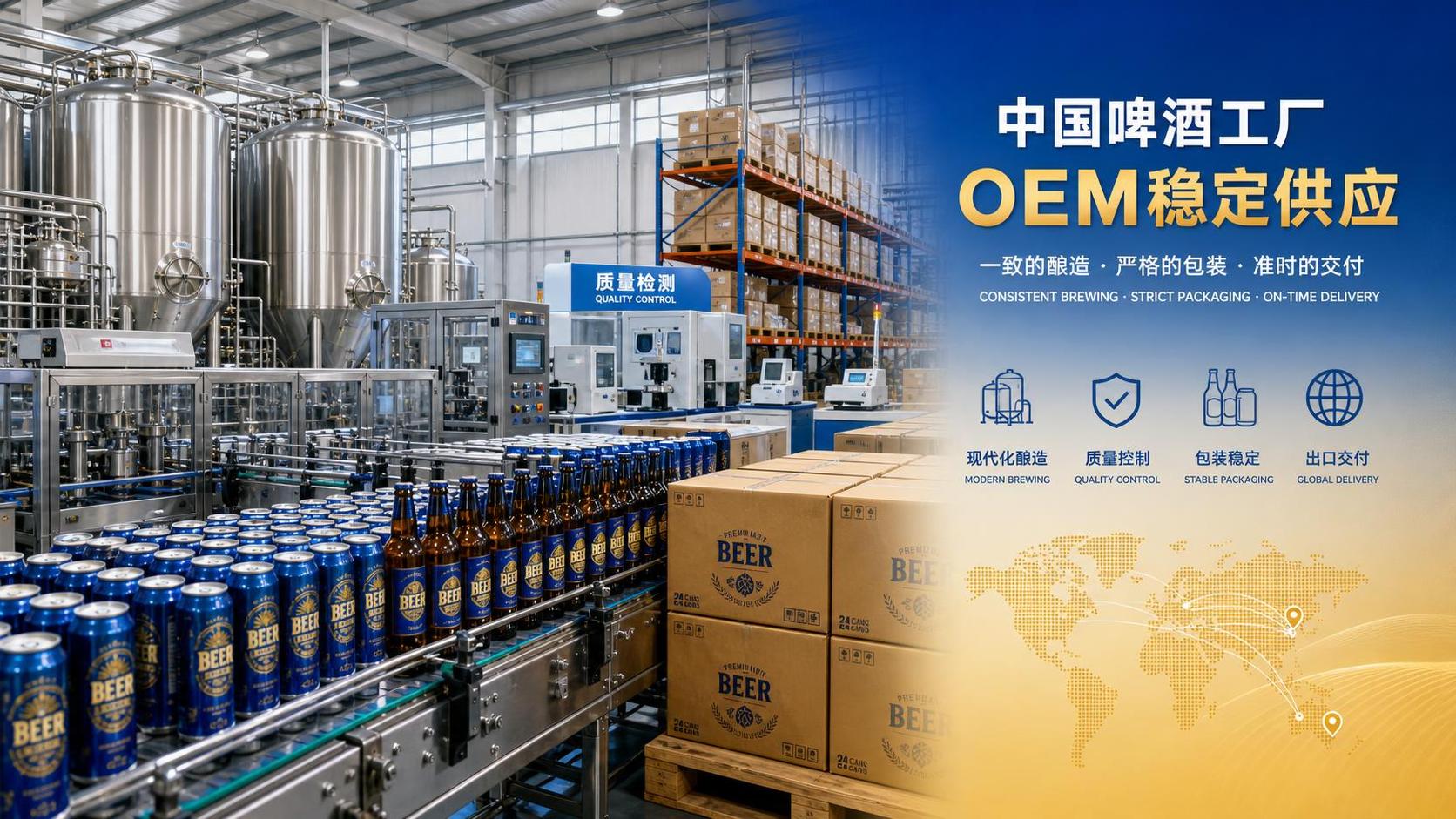
What “Stable OEM Supply” Really Means When You Assess a China Beer Factory
A factory can quote a good price, send attractive samples and still be a poor OEM partner. In beer procurement, “stable supply” is not just about whether a producer can brew at scale. It means the factory can repeat the same sensory profile, packaging standard, documentation flow and delivery rhythm over time, even when raw material availability, seasonal demand or export schedules become complicated. That is the real test when evaluating a China beer factory for private label or contract brewing.
Many buyers focus too early on the visible layer: can the supplier make lager, wheat beer, fruit beer or low-calorie variants, and can it print the label the way the brand wants? Those questions matter, but they sit downstream of more fundamental issues. The first job is to understand whether the brewery operates like a product developer, a packaging workshop or a manufacturing system. Only the third type is usually reliable enough for long-term OEM programs.
Start with brewing consistency, not product breadth
A broad catalog does not automatically signal strong capability. In practice, a factory offering classic lager, German wheat, sugar-free low-calorie beer, fruit-flavored beer and functional specialty beer may indeed have useful R&D depth, but procurement should still ask a harder question: how are recipes transferred into repeatable production?
For OEM supply, consistency depends on process control at several points: wort preparation, yeast management, fermentation temperature discipline, filtration or non-filtration decisions, carbonation control and final filling conditions. A sample that tastes right once is only a starting point. Buyers should ask how the factory locks a formula after approval, how batch records are kept, and what tolerances are monitored from brew to packaging. If those answers stay vague, the risk is not theoretical. The same SKU may drift between batches in body, sweetness, bitterness, haze stability or foam retention.
This is especially relevant for products that look simple on paper. Standard lager is often harder to keep stable than buyers expect because there is less room to hide process variation. Fruit beer and flavored products introduce another layer: flavoring addition, sugar balance and microbiological control must remain steady, otherwise the product may taste inconsistent even if alcohol content and packaging are correct.
Certification matters, but only in context
Procurement teams often use certifications as a shortcut for factory screening. That is reasonable, but the shortcut should not replace technical judgment. Food safety management certifications and quality management systems can indicate that a brewery has documented procedures, traceability habits and audit discipline. For export projects, buyers may also need product-specific compliance documents depending on the target market, packaging type and ingredient claims.
What certifications cannot tell you on their own is whether the plant is operationally strong for your exact business model. A factory may pass audits and still struggle with mixed-SKU container loading, small-batch customization, revision control for multilingual labels or shipment planning during peak periods. So certifications should be treated as part of the baseline, not the conclusion.
A useful way to evaluate this is to ask for the document path, not just the document itself. How are raw materials approved? How is a customer artwork revision released to production? How is a hold decision made if packaging materials arrive with print defects? Mature factories answer with a process. Weak factories answer with promises.
OEM beer supply is also a packaging control problem
In international beer trade, manufacturing risk often shows up in packaging before it shows up in liquid quality. Can seams, crown closures, label adhesion, carton strength, tray configuration and pallet stability all affect whether the product arrives saleable. If the project uses cans, buyers should pay attention to filling line suitability, dissolved oxygen control after filling and how the factory handles artwork changes across multiple SKUs.
This is where some buyers underestimate complexity. They assume that once recipe development is complete, packaging is a routine final step. In reality, packaging is where customization pressure, lead-time pressure and export pressure converge. A China beer factory with solid brewing credentials but weak packaging coordination can still become an unstable supplier.
Ask practical questions. Does the factory source cans, bottles, labels and cartons itself, or is it coordinating nominated suppliers? What is the minimum order logic for custom materials? How does it handle packaging inventory if your forecast changes? Stable OEM supply depends on these details because the beer may be ready while the order is delayed by outer cartons, lids or compliance text revisions.
Lead time is not a single number
One of the most common sourcing mistakes is to compare factories using one headline lead time. Beer projects usually contain at least four separate clocks: sample development, packaging material preparation, production scheduling and shipment release. Some breweries are fast at sampling but slow once custom packaging is involved. Others can run standard products quickly yet become congested when a customer needs several formulations and multiple pack formats in one shipment.
For that reason, buyers should request a lead-time breakdown rather than a single promise. A dependable supplier should be able to explain what part of the timeline is fixed, what part depends on artwork confirmation, and what part changes with seasonality or order size. That discussion usually reveals whether the sales team is aligned with operations. If timing sounds smooth in a quotation sheet but unclear in conversation, there is often a coordination gap behind it.
Export experience changes the risk profile
A brewery that serves domestic channels well is not automatically ready for overseas OEM business. Export orders create different demands: longer transit times, container loading discipline, market-specific labeling, document accuracy, shelf-life planning and communication across time zones. These are not side issues. For beer, they directly affect product condition on arrival and the buyer’s ability to clear goods and launch on time.
Factories with real export experience tend to discuss practical matters early. They will ask about destination market requirements, language versions, barcode ownership, production date format, shelf-life expectations and channel type, because a supermarket rollout, bar supply program and online retail project do not behave the same way. That kind of questioning is usually a positive signal. It shows the supplier understands that OEM beer is not just brewing under another brand name; it is a cross-border packaged goods operation.
How to read customization capability without being misled
Customization is one of the most overclaimed areas in beverage OEM. Almost every supplier says it can tailor formula, alcohol level, flavor direction, packaging design and brand presentation. The more useful question is where customization becomes operationally expensive or unstable.
A capable factory should be clear about boundaries. For example, low-sugar or sugar-free concepts may require extra formulation discipline, and functional specialty beers may involve stricter ingredient review, process adaptation or claim limitations depending on the market. Fruit-flavored lines can be workable, but buyers need to understand whether flavor systems are standardized, how sweetness is controlled and whether haze or sediment is expected or treated as a defect. Clear answers are better than broad assurances.
Jinpai Beer’s product range, covering classic and more specialized categories, fits the profile of a supplier that can support different channel needs, from restaurants and bars to supermarket and retail distribution. But even with a broad portfolio, the same rule applies: procurement should test how well the supplier translates variety into repeatability, because stable OEM supply is built on disciplined execution rather than on menu size.
A short evaluation framework that actually helps decision-making
This kind of framework works better than scoring suppliers by price alone. A cheaper quote can become more expensive once delays, reprints, claim corrections, inconsistent flavor or damaged packaging start affecting the program.
What experienced buyers usually watch for
Two warning signs come up repeatedly. One is excessive confidence before the technical review has even started. The other is a sales-led conversation with little operational detail behind it. Serious factories usually discuss constraints early, because constraints are part of good execution. They will tell you what needs longer preparation, what documentation must be confirmed before print, and what production assumptions affect cost or timing.
The strongest sourcing decisions often come from one simple shift in mindset: do not evaluate a China beer factory only as a maker of beer. Evaluate it as a partner managing formulation, packaging, compliance and logistics in one chain. Once procurement looks at the whole chain, supplier differences become much easier to see.
If a brewery can explain its process clearly, define customization boundaries, support export documentation, and maintain stable production across standard and specialized styles, it is much closer to being a dependable OEM source. That is the level of evidence worth trusting when the goal is not a one-off shipment, but a supply relationship that can hold up under real market pressure.
Thank you very much for writing to us. Please leave your message and contact information, we will reply to you within 24 hours.