



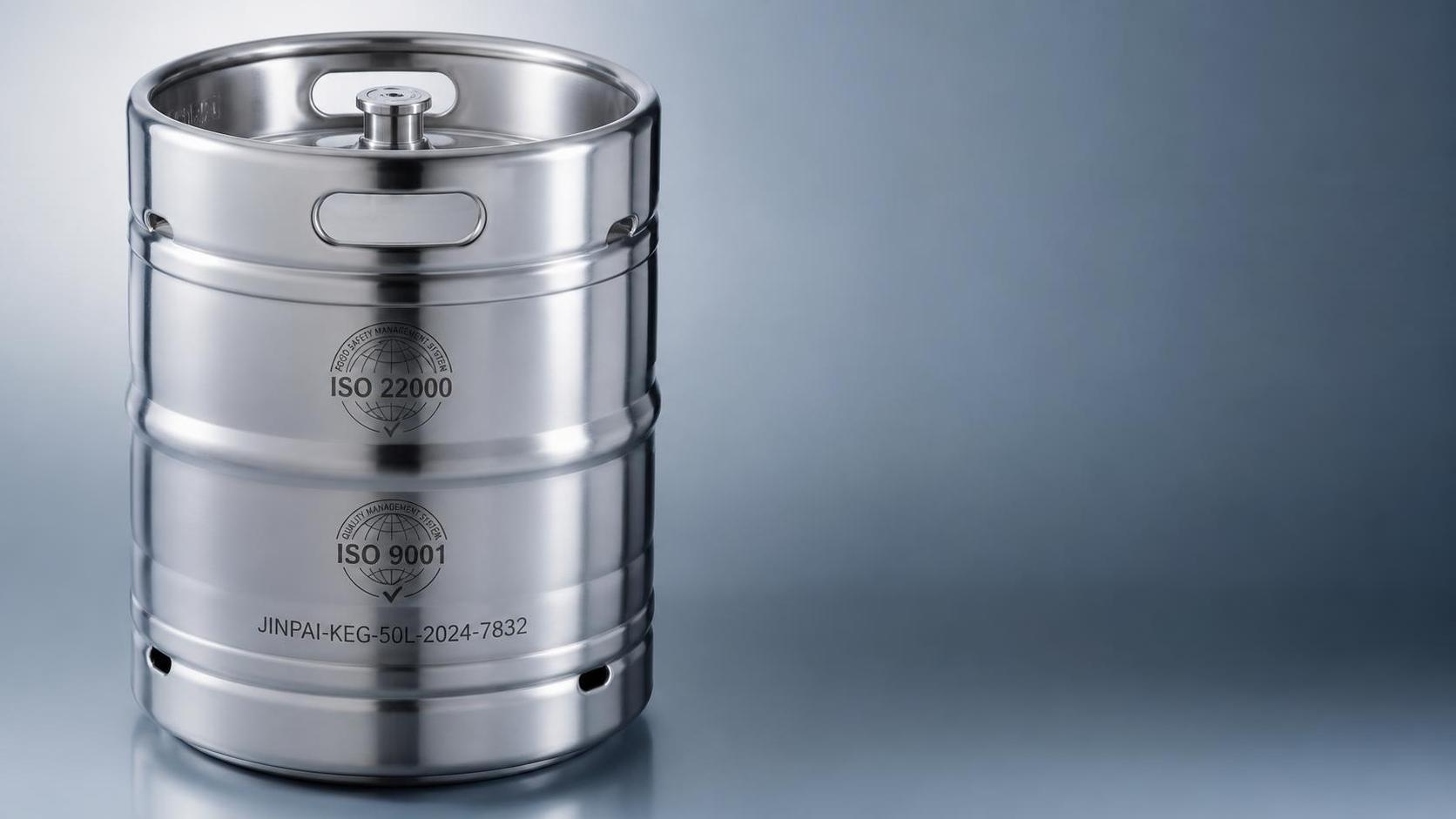
When a quality control manager walks into a brewery’s keg receiving bay—or reviews specifications for a new draft system rollout—the first thing they don’t ask is, “How shiny is this stainless steel?” What they *do* ask—quietly, urgently, sometimes under tight audit deadlines—is: Can I trace its origin? Does it carry documented evidence of food-grade compliance? And if this keg sits in a humid back bar for 18 months, will it still pass a swab test—and a pressure test—without compromise?
That question isn’t rhetorical. It’s operational. And for beer keg suppliers in China, answering it with substance—not just certification badges—is where credibility begins and ends.
Yes—reputable beer keg suppliers in China do offer ISO-certified stainless steel for draft systems. But “offering” isn’t the same as embedding certification into every layer of material sourcing, fabrication, and documentation. Not all ISO markings are created equal. Some appear on mill test reports generated before casting; others reflect full-process alignment—including heat treatment logs, surface finish verification (Ra ≤ 0.8 μm), and third-party migration testing per EU 10/2011 and FDA 21 CFR §178.3710. The distinction matters—not in theory, but when your internal audit team requests raw material certificates for a batch of 50-liter kegs destined for a Michelin-starred restaurant group in Berlin.
Jinpai Beer doesn’t treat ISO compliance as a box to tick. We treat it as the baseline language of trust between supplier and safety manager. Our kegs are manufactured using AISI 304 and 316 stainless steel sourced exclusively from mills certified to ISO 9001 and ISO 22000—standards we mirror internally across our production facility in Jiangsu Province. That means each coil of steel arrives with full traceability: heat number, chemical composition (verified via OES spectroscopy), mechanical property data, and cold-rolled annealing records. Nothing is assumed. Everything is logged—not just for compliance, but because one outlier batch of substandard chromium content can trigger pitting corrosion in high-CO₂ environments, compromising both shelf life and brand reputation.
What makes stainless steel “food-grade” isn’t just its alloy designation—it’s how it’s finished, handled, and validated. A keg made from 304 stainless may meet ASTM A240, but if the interior welds aren’t electropolished to remove micro-crevices where biofilm accumulates, or if post-fabrication passivation uses citric acid concentrations outside ISO 15730 tolerances, the certification becomes academic. At Jinpai, every keg undergoes mandatory post-weld electropolishing followed by nitric-citric passivation, verified with copper sulfate spot testing and ferroxyl indicator checks. Surface roughness is measured at three points per keg—top dome, body seam, and valve seat—ensuring Ra remains consistently below 0.6 μm. This isn’t over-engineering. It’s what prevents lactobacillus colonies from taking root in microscopic valleys no eye can see.
Pressure integrity is equally non-negotiable—and often overlooked in certification discussions. ISO 9001 covers process consistency; ISO 22000 addresses food safety management—but neither mandates hydrostatic burst testing. Yet for draft systems operating at 2.5–3.5 bar (and occasionally spiking higher during peak service), a keg must withstand 1.5× working pressure for 30 minutes without deformation or leakage. Every Jinpai keg—whether 20L, 30L, or 50L—is individually hydrotested at 5.25 bar, with digital pressure decay monitoring and automated pass/fail logging. Records are retained for seven years, accessible via QR code etched onto the keg base—a small detail that saves hours during regulatory inspections.
Traceability extends beyond the metal. Valve assemblies—often the weakest link—are sourced from European manufacturers holding EN 13480-3 and PED 2014/68/EU certifications. Seals use FDA-compliant EPDM or FKM elastomers, tested for extractables in simulated beer matrices (pH 4.2, 4°C, 72-hour immersion). Even cleaning validation protocols are built-in: each keg carries a laser-etched batch ID linked to its CIP cycle history, including caustic concentration, temperature ramp profiles, and final rinse conductivity readings.
For quality managers evaluating Chinese beer keg suppliers, here’s what to watch for—not as checklist items, but as signals of depth:
- Mill test reports that include actual heat numbers—not generic “typical values.” If the report doesn’t list Mn ≤ 2.0%, Ni ≥ 8.0%, and Cr ≥ 18.0% for 304, or Mo ≥ 2.0% for 316, treat it as incomplete.
- Passivation documentation specifying time, temperature, and acid concentration—not just “passivated per ASTM A967.” Citric acid at 10% w/w for 30 minutes at 60°C yields different oxide layer thickness than 20% at ambient.
- Hydrotest records tied to individual units, not just “sample tested.” In high-volume production, sampling misses localized stress fractures from improper mandrel expansion.
- Auditable links between material certs and finished goods. If the mill report says “cold rolled,” but the keg shows signs of hot forming (e.g., scale residue or inconsistent grain structure), something slipped.
We’ve seen clients pause mid-order when asked for a single keg’s full traceability dossier—only to realize their current supplier couldn’t produce one without a 10-day turnaround. That delay isn’t administrative friction. It’s a symptom of fragmented quality ownership: procurement buying steel, engineering specifying dimensions, and production running the line—with no single thread connecting chemistry to corrosion resistance to consumer safety.
At Jinpai, that thread is engineered in. Not as an afterthought, but as the first requirement written into every purchase order, every work instruction, every calibration log. Because for the safety manager reviewing a shipment of 200 kegs bound for a craft beer festival in Toronto, confidence doesn’t come from a glossy brochure. It comes from opening the packing list and seeing the heat number match the mill report, which matches the electropolish log, which matches the hydrotest certificate—all timestamped, signed, and digitally archived.
This level of integration isn’t about perfection. It’s about predictability. About knowing that when a distributor in São Paulo receives kegs stamped “JINPAI-KEG-20L-ISO22000-2024-7832,” they’re not just getting a container—they’re getting a documented chain of decisions, validations, and verifications that began long before the first weld spark flew.
So do beer keg suppliers in China offer ISO-certified stainless steel? Yes—many do. But the real question for quality and safety professionals isn’t whether certification exists. It’s whether it lives in the material, the process, and the paper trail—not just on a website banner.
And if you’re the person who signs off on that paperwork before it goes to an auditor, or who explains to your operations team why a $200 keg costs $15 more than the competitor’s—you deserve more than a yes or no. You deserve the full story behind the stamp.
Thank you very much for writing to us. Please leave your message and contact information, we will reply to you within 24 hours.