



Running a restaurant means balancing flavor, safety, and customer trust—especially when it comes to beverages. You’ve likely noticed more guests asking for sugar-free beer options: people managing diabetes, those on low-carb or keto diets, or diners with unexplained digestive discomfort after standard lagers. At the same time, allergy-related requests are no longer rare—“Is this beer gluten-free?” “Does it contain sulfites or yeast derivatives?” “Was it made near nuts or shellfish?” These aren’t just preferences anymore; they’re operational considerations that affect ordering, storage, staff training, and even liability.
The problem isn’t just offering one sugar-free option—it’s sourcing it reliably, consistently, and safely. Many restaurants try importing specialty low-calorie beers only to face long lead times, inconsistent stock, customs delays, or labeling mismatches (e.g., “sugar-free” claims not backed by lab verification). Others turn to local microbreweries, only to find limited capacity, inflexible minimum order quantities, or no documentation around allergen control. Worse, some suppliers label a beer “sugar-free” based solely on residual sugar testing post-fermentation—but skip verification of cross-contact risk during production. That gap becomes visible when a guest has a reaction, and your team can’t trace whether the batch was run on shared equipment with barley, wheat, or dairy-based finings.
So, do Chinese beer factories do sugar-free beer OEM for restaurants? Yes—but not all operate with the level of process transparency or allergen discipline required for foodservice use. The key isn’t just capability; it’s how rigorously controls are embedded in daily production—not added as an afterthought.
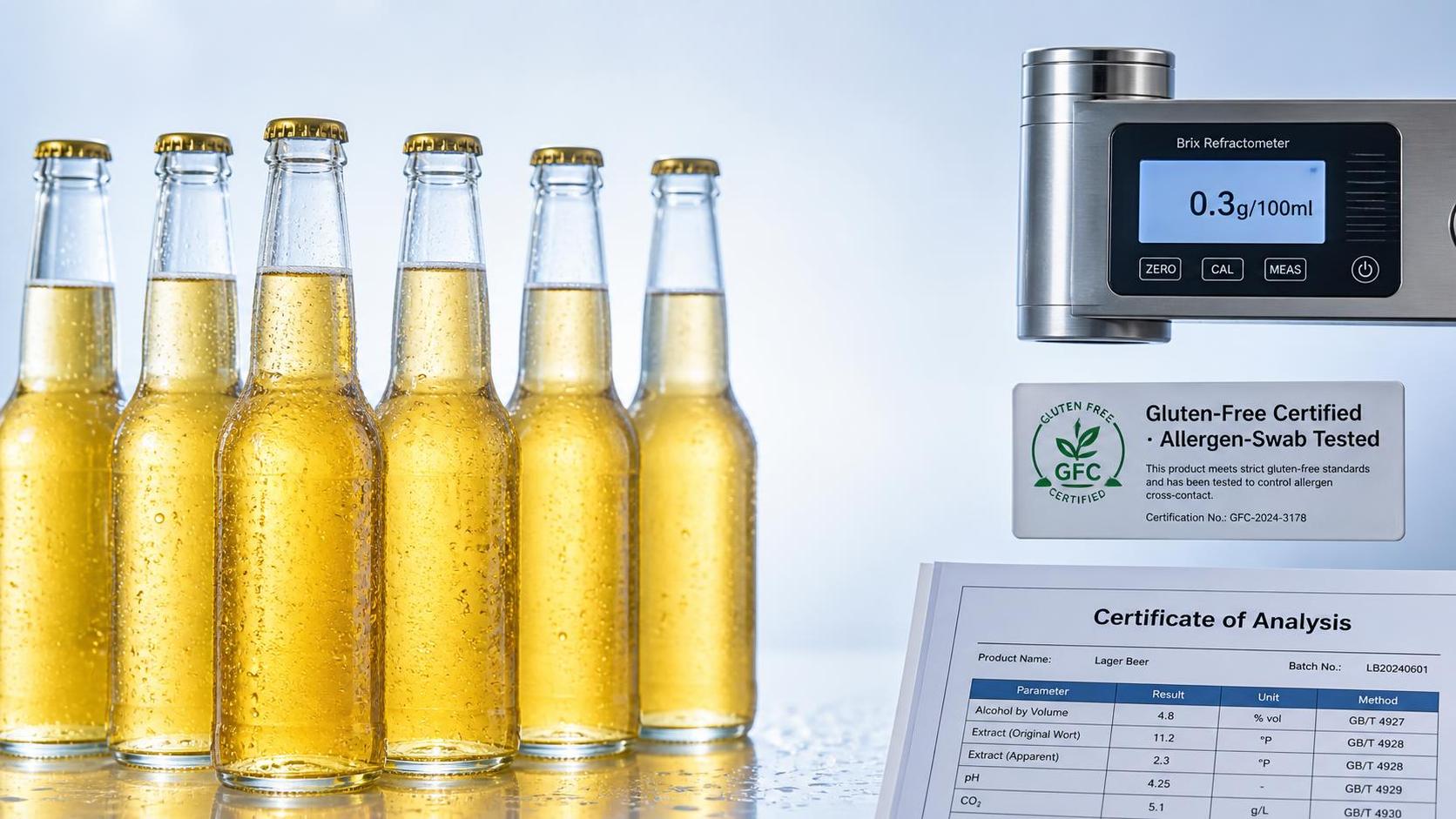
Start by looking beyond marketing terms. “Sugar-free” in beer usually means fermentable sugars have been fully converted, leaving ≤0.5g per 100ml—and no added sweeteners like sucralose or stevia, which can destabilize foam or clash with food pairings. But fermentation alone doesn’t guarantee safety for sensitive guests. What matters is how the brewery prevents unintended exposure: dedicated tanks, validated cleaning cycles between batches, raw material screening (e.g., checking malt substitutes for gluten traces), and third-party allergen swab testing of surfaces before each sugar-free run.
Jinpai Beer structures its OEM process around these checkpoints—not as optional upgrades, but as built-in steps. When a restaurant initiates a custom sugar-free beer project, the first alignment isn’t about branding or packaging—it’s about defining the scope of allergen control needed. For example: if your menu highlights nut-free or celiac-safe dining, Jinpai assigns production to lines certified for gluten-free processing, with separate filtration, bottling, and labeling workflows. If your location has strict local labeling laws (like EU allergen declarations or California Prop 65), their technical team reviews ingredient origin, processing aids, and finished product lab reports before batch approval.
This isn’t theoretical. It reflects how breweries respond when real-world conditions shift—like when a restaurant chain adds a new health-focused concept and needs six SKUs across three markets within four months. Jinpai handles that by segmenting development into parallel tracks: formulation (yeast strain selection, adjunct choice, attenuation targets), compliance (allergen mapping, shelf-life stability under ambient shipping conditions), and logistics (custom carton labeling, pallet configuration for back-of-house storage). There’s no “one-size-fits-all” OEM template. A bistro in Berlin needing 500L/month of citrus-infused sugar-free pilsner follows a different path than a Tokyo izakaya ordering 2,000L of umami-forward rice-based low-calorie lager with soy-free certification.
What changes most often isn’t the recipe—it’s how the brewery verifies consistency. Every sugar-free OEM batch includes a Certificate of Analysis listing residual sugars, alcohol by volume, pH, and microbiological status. More critically, it includes a signed allergen control log: timestamps of tank cleaning, swab test results from filler nozzles and conveyor belts, and raw material lot numbers with supplier allergen statements. Restaurants receive digital access to these records—not just at launch, but for every reorder. That traceability matters when a distributor questions foam retention across seasons, or when a health inspector asks how cross-contact is prevented during co-packing.
You’ll also notice differences in how fermentation is managed. Some breweries reduce sugar by shortening fermentation—leaving higher diacetyl or acetaldehyde, which affects mouthfeel and food compatibility. Jinpai uses extended cold conditioning and precise temperature ramping to ensure full attenuation without off-flavors. No artificial sweeteners are introduced to mask thinness; instead, body is preserved using enzymatically modified dextrins or carefully selected rice and corn adjuncts—ingredients verified free of common allergens before milling.
Practical next steps depend on where you are in the process. If you’re still evaluating suppliers, ask for evidence—not policies. Request photos of segregated tank zones, copies of recent third-party swab tests, and a sample CoA from a past sugar-free OEM run. If you’ve already placed a trial order, check whether the delivered beer matches the stated ABV and carbonation level across three bottles from the same case—variance beyond ±0.2% ABV or ±0.1 vol CO₂ may indicate inconsistent fermentation control. And if you’re scaling from one location to five, confirm whether the brewery can hold identical formulations across multiple production sites without reformulation—some rely on region-specific yeast cultures or water profiles that shift flavor subtly.
Finally, avoid assuming “OEM” means full white-label convenience. True OEM for restaurants involves shared responsibility: you define service context (glassware, pour temperature, food pairings), and the brewery adapts process parameters accordingly. Jinpai’s technical team regularly joins virtual tastings with restaurant beverage managers—not to pitch, but to calibrate bitterness perception against local palate expectations or adjust carbonation for draft systems with longer line runs. That feedback loop is what turns a functional sugar-free beer into one that holds up beside seared scallops or aged cheese, without compromising safety or shelf life.
It’s not about finding *any* factory that does sugar-free beer OEM for restaurants. It’s about identifying the ones where allergen control isn’t a checkbox—it’s measurable, repeatable, and documented at every handoff point. That distinction becomes visible not in brochures, but in how quickly a batch is traced during a recall drill, how easily a label update complies with new regional rules, and whether your staff can confidently answer “What’s in this beer?”—without hesitating.
Thank you very much for writing to us. Please leave your message and contact information, we will reply to you within 24 hours.