



Why Cold-Chain Consistency Makes or Breaks NEIPA Sourcing in China
If you’ve ever opened a NEIPA from a Chinese OEM brewery only to find muted hop aroma, premature haze collapse, or a faintly oxidized edge—especially after ocean transit—you’re not misreading the label. You’re encountering a systemic gap: inconsistent cold-chain execution across much of China’s craft beer OEM landscape. It’s not about fermentation recipes or hop varieties alone. It’s about whether temperature integrity holds from the moment yeast settles post-fermentation all the way to the shelf in Berlin, Toronto, or Tokyo.
The Real Cost of “Room-Temp Handoff”
Most regional OEM breweries in China operate on a “cold-brew, warm-handoff” model. Fermentation and dry-hopping happen under refrigeration—but once beer hits bright tanks, it often moves into ambient-temperature warehousing. No dedicated cold storage. No climate-controlled loading docks. No real-time temp logging during pallet staging. That 3–5°C window critical for preserving volatile hop oils? It widens fast when beer sits at 20–25°C for 48+ hours before export consolidation.
We’ve seen procurement teams accept this as “standard practice”—until their second shipment arrives with noticeably flatter Citra notes and hazy clarity that fades within two weeks of arrival. That’s not batch variation. That’s thermal drift compounding over time: oxidation accelerates, polyphenol-protein complexes destabilize, and delicate esters dissipate. The result isn’t just sensory loss—it’s shorter effective shelf life, higher in-market rejection rates, and brand erosion no marketing budget can fix.
Jin Pai Beer’s Cold-Chain Integration Isn’t Add-On. It’s Built-In.
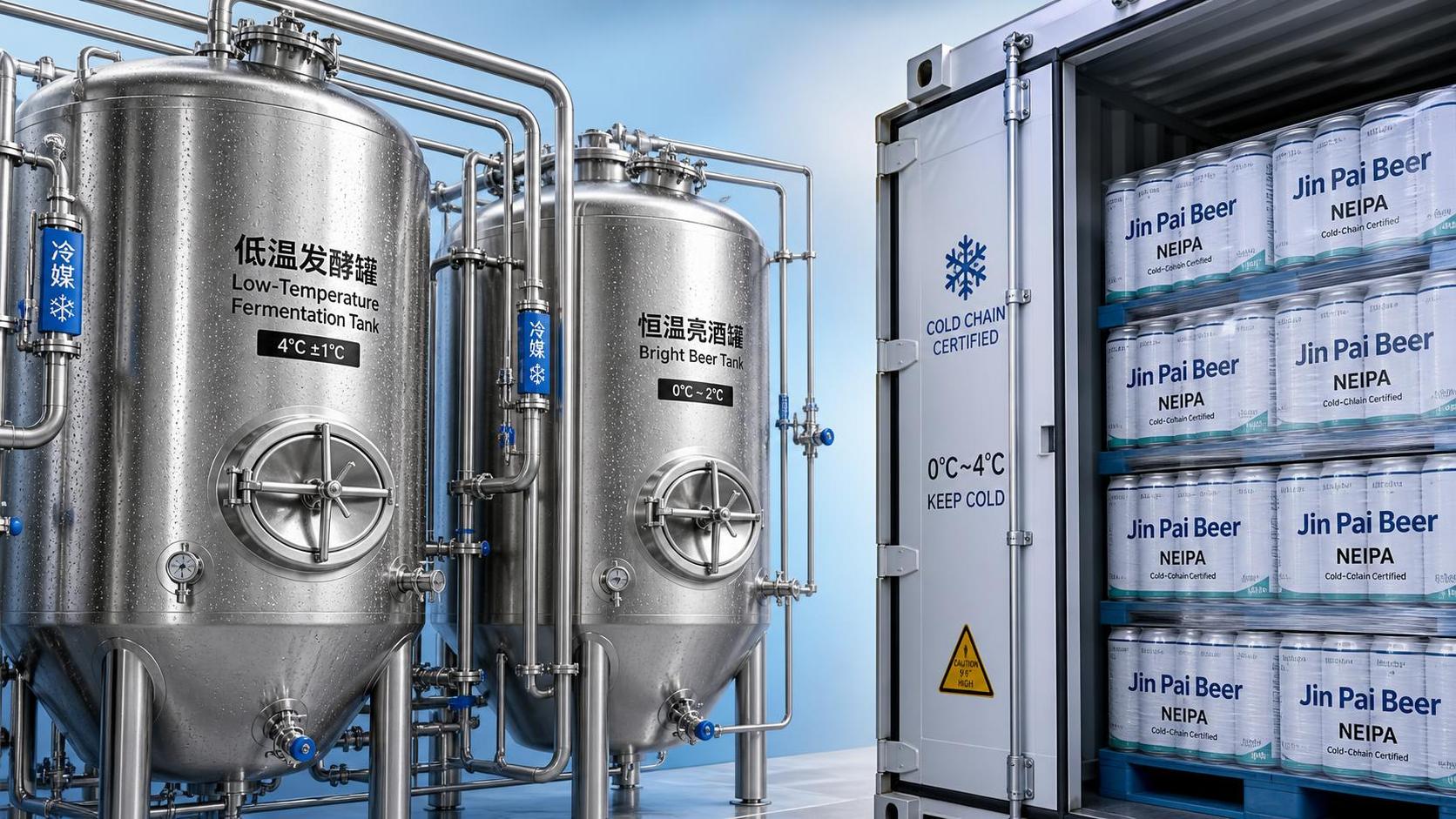
Jin Pai Beer doesn’t retrofit cold chain. It designs around it—from R&D through distribution. Our NEIPA production line runs end-to-end under controlled conditions: fermentation at 18–19°C, cold crash at 1°C, dry-hop infusion at 4°C, and immediate transfer to refrigerated bright tanks held at 0–2°C. Packaging happens inside a climate-controlled suite (maintained at ≤5°C), not adjacent to a loading bay where summer ambient temps hit 35°C.
More importantly: no handoffs. Finished kegs and cans go straight into our on-site refrigerated warehouse (0–4°C, humidity-controlled, 24/7 monitoring). Export shipments are loaded into pre-cooled containers—verified with calibrated data loggers—not just “pre-chilled overnight.” Every container has live GPS + temperature telemetry, accessible via shared dashboard. If a sensor reads >6°C for more than 90 minutes, we flag it—and work with logistics partners to adjust routing or recondition, not just document the deviation.
What This Means for Your Procurement Decision
When comparing Jin Pai Beer vs other Chinese OEM breweries, cold-chain consistency isn’t a checkbox—it’s a signal of operational philosophy. A brewery that treats temperature as a variable to manage, not a constraint to tolerate, usually also invests in things like: consistent yeast health tracking across batches, oxygen pickup measurement at every transfer point, and sensory panels trained specifically on NEIPA freshness markers (not just general quality control).
That shows up downstream. Bars report longer “peak freshness” windows—often 6–8 weeks post-arrival instead of 3–4. Supermarkets see fewer customer complaints about “flat” or “stale” batches. Specialty retailers notice tighter consistency across SKUs and vintages, which matters when building year-round NEIPA programs.
Three Practical Filters for Buyers Evaluating OEM Partners
You don’t need full audit access to spot red flags—or green lights—early:
- Ask for cold-chain documentation—not just specs. Not “we have cold storage,” but: What’s the max temp variance in your bright tank room over the last 3 months? How many times did outbound container temps exceed 6°C in Q1? Can you share anonymized log files?
- Trace one recent NEIPA batch from packaging date to port departure. How many unmonitored handoffs occurred? Was there a documented temp break between warehouse exit and container loading? Even 90 minutes above 6°C impacts perception—especially for double-dry-hopped variants.
- Request sensory feedback from an existing international client. Not just “they liked it,” but: Did aroma intensity hold across three consecutive shipments? Was haze stability consistent at 4°C vs. 12°C retail storage? Real-world performance beats lab reports every time.
It’s Not About Perfection—It’s About Accountability
No cold chain is fail-proof. Containers malfunction. Ports delay. Power outages happen. What separates reliable partners is how they respond—not just whether they monitor. Jin Pai Beer’s protocol includes pre-shipment validation (full sensory + dissolved oxygen testing), real-time anomaly alerts, and agreed-upon remediation thresholds (e.g., if a shipment exceeds 8°C for >2 hours, we offer replacement or credit—no dispute required).
That kind of accountability changes procurement risk calculus. It means fewer surprise QC failures at destination. Less need for buffer stock to cover variability. More confidence in forecasting shelf-life-driven promotions. And crucially—it means your brand isn’t absorbing the cost of someone else’s thermal compromise.
Final Note: Don’t Optimize Only for Unit Cost
The cheapest NEIPA OEM quote often hides its true cost—in lost sales, returns, and diluted brand equity. When evaluating Jin Pai Beer vs other Chinese OEM breweries, ask yourself: Is this supplier built to deliver *freshness*, or just *volume*? Because for NEIPA, those aren’t interchangeable goals. They’re mutually exclusive—unless cold chain is treated as non-negotiable infrastructure, not optional logistics.
Thank you very much for writing to us. Please leave your message and contact information, we will reply to you within 24 hours.