



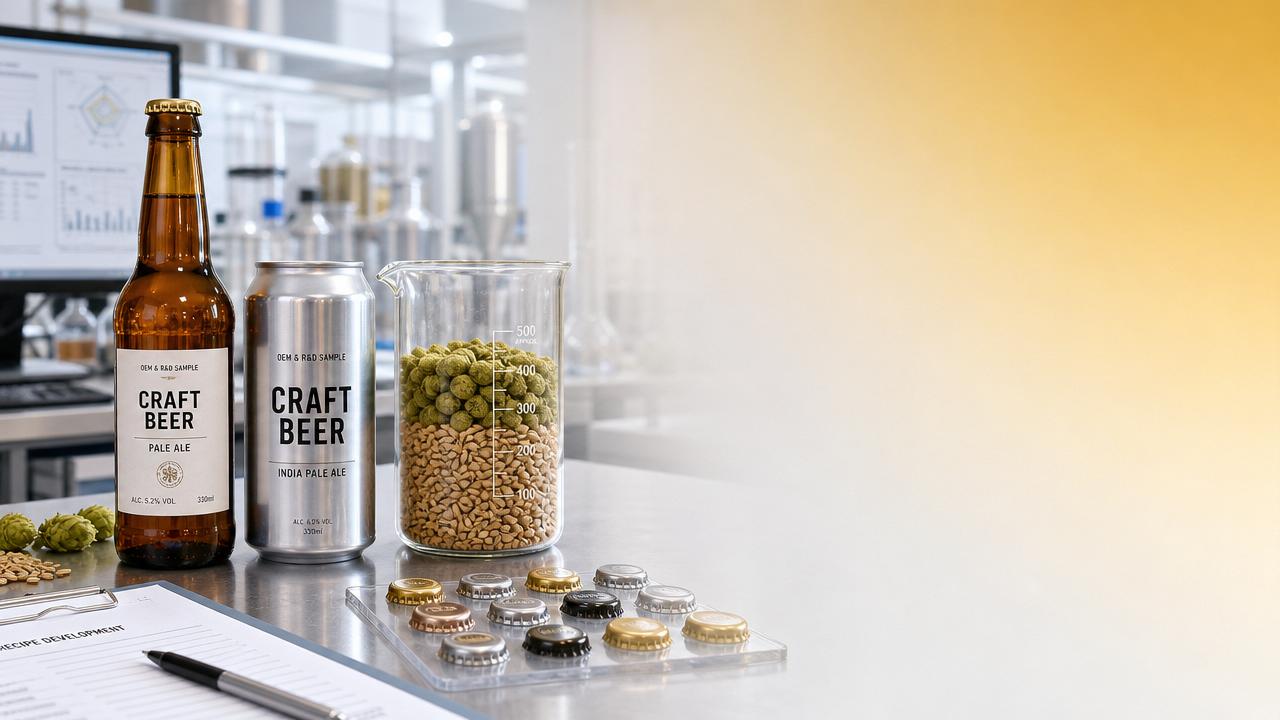
For procurement teams evaluating private-label brewing partners, a key question is: Do China beer OEM factories offer R&D support before mass production? The answer can directly affect product quality, launch speed and market fit. From recipe development and flavor testing to packaging optimization and compliance support, experienced manufacturers like Jinpai Beer can help buyers reduce risk and turn ideas into market-ready craft beer products more efficiently.
When Does Pre-Production R&D Support Matter Most?
The short answer is yes: Do China beer OEM factories offer R&D support? Many capable suppliers do, but the depth of support varies greatly. Some factories only execute an existing formula, while others provide full-stage development covering style selection, ingredient matching, pilot brewing, shelf-life evaluation, and packaging validation. In beer and beverage projects, this difference often determines whether a concept reaches shelves smoothly or faces costly revisions.
Pre-production R&D is especially valuable when a product is new to the target market, when flavor expectations are highly localized, or when the brief includes functional claims such as sugar-free, low-calorie, or fruit-infused positioning. In these cases, asking Do China beer OEM factories offer R&D support is not just a technical question. It is a practical way to assess whether the supplier can adapt recipes to market demand, regulatory requirements, and commercial production conditions.
Jinpai Beer, for example, works across classic lager, German wheat, sugar-free low-calorie beer, fruit-flavored beer and functional specialty beer. That product breadth matters because different styles require different development logic. A fruit beer may need aroma retention testing, while a low-calorie beer may need balance correction to avoid a thin mouthfeel after sugar reduction.
Scenario 1: Launching a New Private-Label Craft Beer From Scratch
When a project starts with only a concept—such as “a refreshing wheat beer for chain retail” or “a modern fruit beer for younger consumers”—R&D support becomes the foundation of the OEM relationship. In this scenario, Do China beer OEM factories offer R&D support should be evaluated through concrete capabilities: recipe ideation, sample iteration speed, sensory testing, and pilot-batch consistency.
A reliable OEM partner should be able to translate a broad brief into technical options. That includes selecting malt profiles, bitterness levels, yeast strains, carbonation range, alcohol content, color targets, and possible adjuncts. It should also include recommendations on whether the final profile is better suited to cans, bottles, or keg supply, since packaging influences oxygen management and flavor stability.
Key judgment points in this scenario
- Can the factory develop samples based on taste direction rather than a finished formula?
- Does it provide multiple sample rounds with documented adjustments?
- Can it explain how pilot results scale into mass production?
- Does it support packaging and label compatibility during development?
Scenario 2: Reformulating for Sugar-Free, Low-Calorie or Functional Beer
This is where the question Do China beer OEM factories offer R&D support becomes more specialized. Reformulation projects are not simple flavor variations. Removing sugar, lowering calories, or adding functional characteristics can alter fermentation behavior, body, aroma release, and perceived sweetness. Without pre-mass-production R&D, the final product may pass basic specifications but fail consumer acceptance.
An experienced beer OEM should support feasibility analysis before scaling. That may involve testing enzyme strategies, adjusting grain bills, balancing bitterness, refining mouthfeel, and checking whether the finished product remains stable across storage conditions. For functional specialty beers, additional checks on ingredient interaction, clarity, sediment behavior, and claim-related documentation may also be necessary.
In this scenario, strong R&D support reduces the risk of launching a product that sounds attractive on paper but performs poorly in real consumption settings.
Scenario 3: Adapting an Existing Beer Formula for a New Market
Sometimes the formula already exists, but it was developed for a different region, climate, or channel. Here, asking Do China beer OEM factories offer R&D support helps determine whether the supplier can localize rather than simply replicate. A beer that sells well in one market may need bitterness reduction, carbonation adjustment, lower ABV, or revised fruit intensity in another.
R&D support in this scenario should include benchmark tasting, sample comparison, ingredient substitution if local sourcing differs, and shelf-life checks based on shipping distance and storage conditions. For export projects, packaging durability and labeling compliance can be as important as the liquid itself. A capable OEM partner will flag these issues before mass production instead of treating them as downstream problems.
How R&D Needs Change Across Beer OEM Project Types
Not every project requires the same development depth. The real value of asking Do China beer OEM factories offer R&D support lies in matching support level to project complexity.
What to Ask Before Choosing a China Beer OEM Partner
If the decision depends on whether Do China beer OEM factories offer R&D support, the evaluation should focus on evidence rather than promises. A meaningful discussion should reveal how the factory develops, tests, records, and refines products before mass production.
Useful checkpoints
- Ask whether sample development is included for OEM or ODM projects.
- Request a clear sample workflow, including timing and revision stages.
- Check whether the factory handles sensory evaluation and shelf-life testing.
- Confirm support for label, can, bottle, carton, and closure compatibility.
- Review whether export compliance and documentation are addressed early.
- Ask how pilot brewing results are translated into full production parameters.
These questions help distinguish basic contract brewing from a true development-oriented OEM relationship. In beverage categories with fast-changing consumer taste, that distinction can be decisive.
Common Misjudgments When Assessing R&D Support
One common mistake is assuming that a broad product catalog automatically means strong R&D capability. A factory may list lager, wheat beer, fruit beer, and specialty beer, but still offer limited formulation support. Another mistake is treating sample approval as the end of development. In reality, the critical question is whether the approved sample can be reproduced consistently at commercial scale.
A further oversight is ignoring packaging during R&D. Beer flavor stability depends on filling method, dissolved oxygen control, container choice, and transport conditions. When asking Do China beer OEM factories offer R&D support, packaging should be part of the answer, not a separate issue handled after the liquid is finalized.
It is also risky to focus only on price in early-stage comparison. Lower upfront cost may disappear quickly if reformulation, delayed launch, or quality inconsistency forces repeated sampling and smaller correction batches later.
How Jinpai Beer Supports Pre-Mass-Production Development
For brands seeking a practical answer to Do China beer OEM factories offer R&D support, Jinpai Beer represents the type of partner that combines product variety with development flexibility. Its experience in craft beer R&D, production and global distribution supports multiple project paths, from standard private-label lager to customized German wheat, sugar-free low-calorie beer, fruit-flavored beer and functional specialty beer.
Support can include concept discussion, sample customization, flavor adjustment, packaging coordination, and production planning aligned with OEM/ODM requirements. Because the company serves online and offline sales channels worldwide, development can be shaped around different retail and consumption contexts, including restaurants, supermarkets, bars, and broader retail distribution.
This kind of integrated support is particularly useful when the goal is to shorten time to market without sacrificing taste precision or commercial stability.
Practical Next Steps for a Better OEM Decision
So, Do China beer OEM factories offer R&D support? Yes, many do—but the quality and scope of that support vary widely. The best approach is to evaluate the supplier based on the project scenario: new recipe creation, health-oriented reformulation, flavor localization, or packaging adaptation. Each case requires different levels of technical input before mass production begins.
A practical next step is to prepare a concise development brief covering target beer style, flavor direction, ABV range, packaging preference, market destination, expected claims, and launch timing. Then ask the OEM partner to respond with a sample plan, R&D process, timeline, and quality checkpoints. This makes it easier to compare not only capacity, but also development readiness.
If the goal is to build a market-ready beer product with lower trial-and-error cost, choosing a partner with proven pre-production R&D support is often the smarter route. Jinpai Beer welcomes global distributors, agents and partners seeking OEM/ODM beer solutions backed by practical product development, stable production and channel-oriented customization.
Thank you very much for writing to us. Please leave your message and contact information, we will reply to you within 24 hours.