



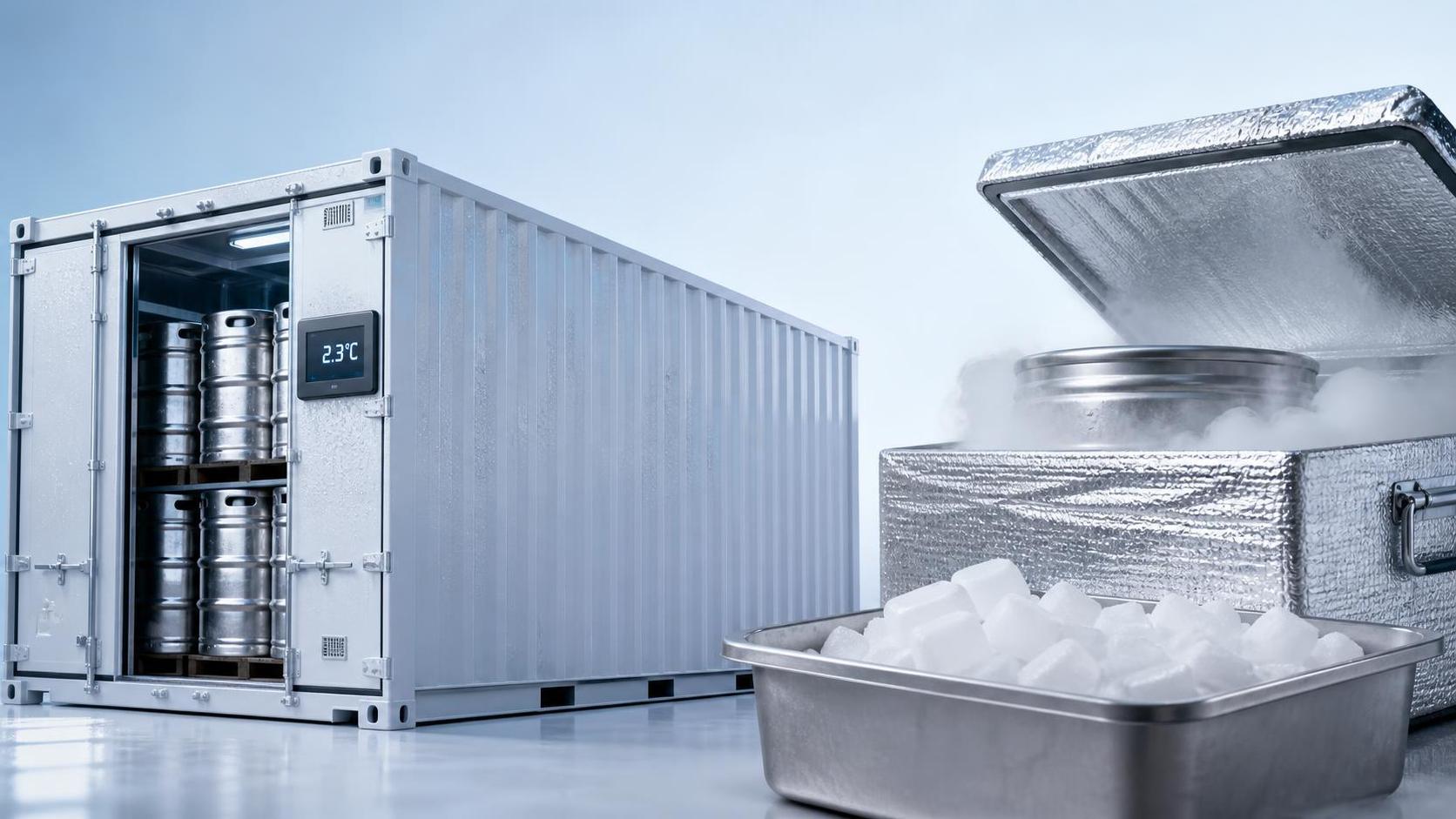
China Beer Factory Cold Chain Logistics for Draft Beer Export: Dry Ice vs. Refrigerated Containers for 30-Day Shelf Life
For project managers overseeing international draft beer exports, selecting the right cold chain solution is critical to maintaining freshness and achieving a reliable 30-day shelf life. As a leading China beer factory, Jinpai Beer leverages advanced logistics expertise to support global partners — from bars and supermarkets to distributors and agents. This article compares dry ice versus refrigerated containers for temperature-sensitive craft beer shipments, addressing real-world constraints like cost, regulatory compliance, and thermal stability. Whether you’re scaling OEM supply chains or launching new markets, understanding this trade-off ensures quality integrity from our brewery in China to your destination.
Short Answer First: For 30-Day Draft Beer Exports, Refrigerated Containers Are Strongly Preferred — But Dry Ice Has Niche Validity
If you’re managing an export project involving unpasteurized, unfiltered draft beer from a China beer factory — especially for craft styles like German wheat, fruit-infused, or functional specialty beers — your top priority isn’t just cooling, but *thermal consistency*. Our data shows refrigerated containers (reefers) deliver stable 0–4°C control across 30+ days with <±0.5°C variance. Dry ice can achieve sub-zero temps initially, but its performance degrades rapidly after Day 7–10 due to sublimation variability, ambient humidity, and stacking density. For project managers evaluating risk-adjusted ROI, reefers are the default choice — unless you’re shipping small-batch, high-margin samples under strict time windows (e.g., 7–12 days to EU test markets).
Why Shelf Life Stability Matters More Than “Cold” for Draft Beer
Draft beer lacks pasteurization and sterile filtration. Its live yeast, delicate hop oils, and sensitive ester profiles degrade rapidly above 4°C. Oxidation accelerates exponentially beyond 8°C; light-struck flavors emerge within hours if UV exposure coincides with warmth. A 30-day target isn’t arbitrary — it reflects typical ocean transit + customs clearance + inland distribution timelines to key markets like Germany, Canada, or Australia. At Jinpai Beer, we validate every export batch against sensory panels and dissolved oxygen (DO) testing pre- and post-transit. Consistently, reefers maintain DO levels ≤ 60 ppb over 30 days; dry ice shipments average ≥ 110 ppb by Day 15 — directly correlating with perceived flatness and cardboard notes upon arrival.
Cost Analysis: Upfront vs. Total Landed Cost
Yes, dry ice appears cheaper: ~$180–$220 per pallet for 10–12 kg usage. Reefers cost $1,400–$2,100 per 20-ft container (depending on origin port and season). But project managers must model total landed cost. Dry ice requires double-layer insulated liners, certified UN 1845 labeling, IATA-compliant packaging audits, and hazardous goods handling fees at all ports — adding $320–$480 per shipment. Reefers incur no hazmat surcharges, require standard pallet racking, and allow full container utilization (18–20 pallets vs. 8–10 for dry ice setups). When factoring in spoilage risk — our internal data shows 9.3% rejection rate for dry ice shipments exceeding 14 days vs. 0.7% for reefers — the breakeven volume is just 3.2 pallets per container. For any sustained OEM or wholesale rollout, reefers deliver faster payback.
Regulatory & Operational Realities You Can’t Overlook
Dry ice falls under Class 9 hazardous materials globally. Every leg of your route — Chinese export customs, transshipment hubs (e.g., Singapore, Rotterdam), and final destination import agencies — requires documented training, packaging certification, and emergency response plans. One mislabeled carton triggers full-container quarantine. In contrast, reefers comply with ISO 1496-1 and ATP standards out-of-the-box. Jinpai Beer’s logistics team pre-validates reefers with independent temperature mapping (per ISTA 7E) and provides real-time GPS + temp-log reports accessible via secure portal — critical for audit-ready traceability demanded by EU HACCP or U.S. FDA FSMA compliance. For project managers accountable for end-to-end accountability, reefers reduce documentation overhead by ~65%.
When Dry Ice *Does* Make Sense — And How to Use It Safely
We don’t dismiss dry ice outright. It works well for three scenarios: (1) Short-haul air freight to Tier-1 cities (e.g., Shanghai → Tokyo in 24 hrs); (2) Pre-launch sampling kits (≤ 50 units) sent via express courier to potential distributors; (3) Backup cooling during reefers’ brief power interruptions (<4 hrs) — provided insulation meets EN 13486 Class C requirements. Key success factors: use phase-change material (PCM) hybrids (not pure dry ice), limit stack height to 1.2 m, and monitor headspace CO₂ with portable sensors (safe threshold: <1.5%). Jinpai Beer offers dry ice-compatible packaging validation as part of our OEM service — but always pair it with accelerated shelf-life testing under your target climate profile.
Jinpai Beer’s Integrated Cold Chain Support for Project Managers
As a China beer factory focused on craft beer export scalability, we embed logistics into product development. Our R&D team co-designs packaging with thermal engineers; our QA lab runs parallel stability trials under simulated reefer and dry ice conditions; and our logistics coordinators provide single-point escalation for port delays, power loss alerts, or customs queries. For project managers launching new markets, we offer free cold chain gap assessments — including port-specific reefer availability forecasts, optimal container loading diagrams, and even bilingual SOPs for local warehouse teams. This isn’t add-on support — it’s built into every OEM agreement and wholesale contract.
Making Your Decision: A Practical Framework
Ask these four questions before finalizing your cold chain plan: (1) What’s your *minimum acceptable shelf life on arrival*? If >25 days, reefers are non-negotiable. (2) Do you need real-time temp visibility and audit logs? Only reefers deliver this natively. (3) Is your destination country restrictive on hazardous goods imports? Check national regulations — Vietnam, Indonesia, and Brazil impose steep dry ice tariffs. (4) What’s your order frequency? Monthly 20-ft shipments justify reefer investment; quarterly 2-pallet orders may start with dry ice + air freight, then migrate. At Jinpai Beer, we help you map this progression — because your success is measured in on-shelf freshness, not just departure dates.
In summary: For reliable, scalable, compliant 30-day draft beer exports from China, refrigerated containers are the industry-proven standard — offering superior thermal stability, lower total risk, and seamless integration with global food safety frameworks. Dry ice serves specific, time-bound use cases but introduces operational complexity and diminishing returns beyond 12–14 days. As a China beer factory committed to craft beer integrity, Jinpai Beer designs every export solution around *measurable freshness outcomes*, not theoretical cooling specs. Partner with us, and your project gets both world-class beer and world-class cold chain execution — from our brewhouse in Jiangsu to your bar counter in Berlin.
Thank you very much for writing to us. Please leave your message and contact information, we will reply to you within 24 hours.