



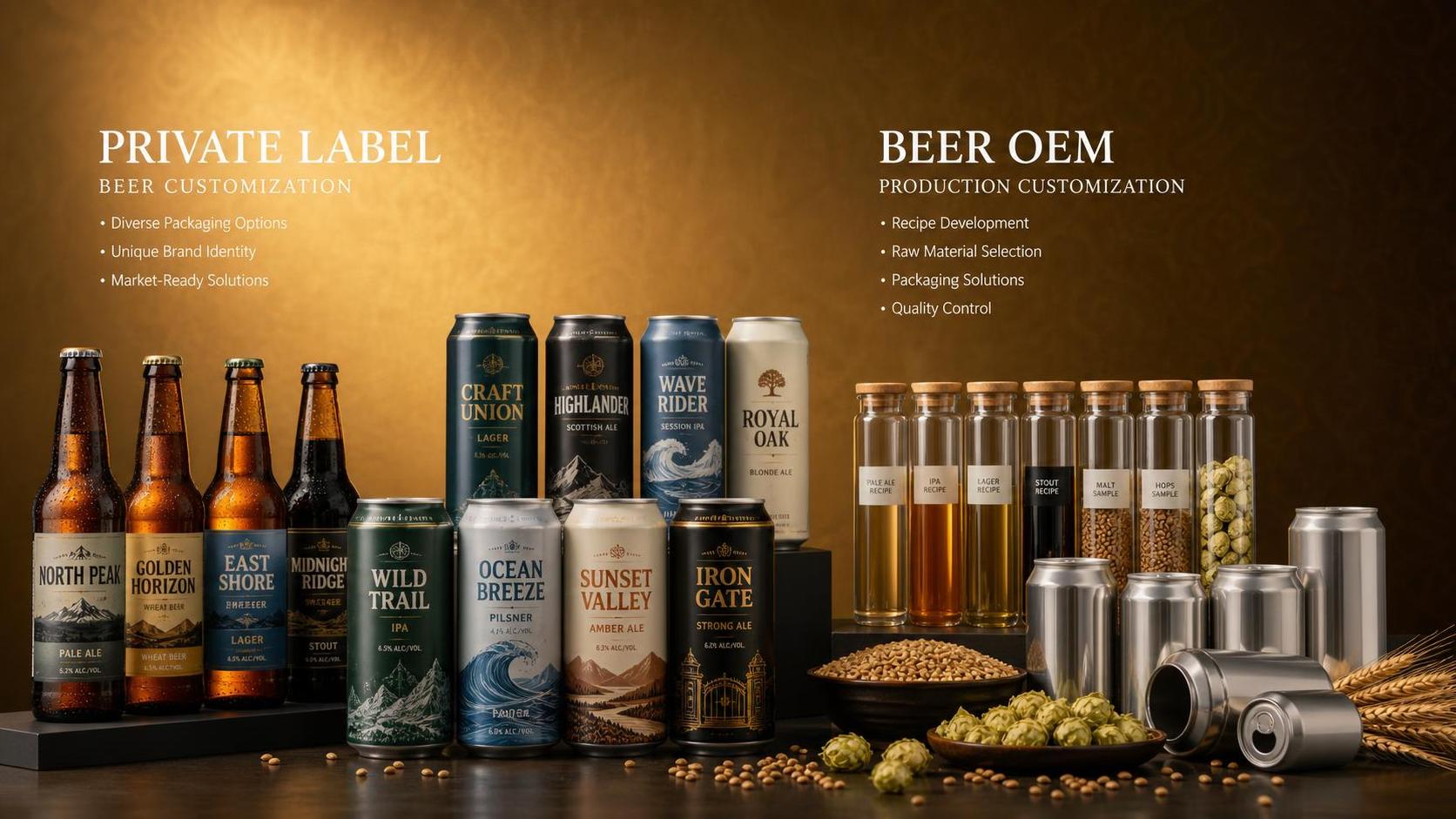
Beer OEM vs Private Label: What’s the Real Difference?
Choosing between Beer OEM and private label sounds simple until you start pricing recipes, checking label compliance, and trying to figure out how much of the beer is actually yours. That is usually where the confusion starts. People use the two terms interchangeably, but in practice they often point to different levels of control, cost, and development work.
If you are a distributor, retailer, bar group, or new brand exploring custom beer, the real question is not which term sounds better. It is this: do you want a ready product with your branding, or do you want a manufacturing partner to help build something closer to your own specification? That distinction affects lead time, minimum order quantity, tasting rounds, paperwork, and what you can honestly claim in the market.
A practical way to think about it: private label usually means you select an existing beer from a brewery’s lineup and sell it under your own brand. Beer OEM usually goes further. It may include recipe adjustment, packaging customization, format choices, alcohol level targets, flavor profile changes, or market-specific production requirements. In some factories, OEM and ODM are offered together, with ODM covering more formulation input from the manufacturer’s side.
Start with this basic check: what exactly are you buying?
Before comparing price lists, ask for a plain-language breakdown of the service model.
- If the brewery offers an existing lager, wheat beer, fruit beer, or low-calorie beer and only changes the label or outer carton, that is usually private label.
- If the brewery is willing to adjust bitterness, aroma, sweetness, alcohol content, color, ingredients, or can size based on your target market, that falls more clearly into Beer OEM.
- If they say “custom” but can only let you choose between two stock recipes, treat it as private label with limited options.
This matters because many first-time buyers assume they are getting a unique product when they are really buying a standard liquid in custom packaging. There is nothing wrong with that, but it should be priced and positioned accordingly.
The fastest rule of thumb
That table is the short version. The harder part is judging what level of customization is worth paying for.
A buyer’s checklist before choosing either model
Check how unique your market position really needs to be. If you are selling into supermarkets under a value brand, private label may be enough. Consumers in that channel often care more about price point, packaging, and basic taste consistency than about a highly original recipe story. But if you are targeting craft-focused bars, boutique retail, or a regional concept built around local flavor preferences, a stock beer with a new label can feel thin very quickly.
Be honest about volume. True Beer OEM usually makes more sense when your volume can support development, testing, and separate production planning. Small buyers often ask for a fully custom beer but do not have the forecast to justify it. In that case, a smart supplier may recommend starting with a close existing product and customizing packaging first. That is not a downgrade. It is often the more commercial decision.
Ask what “custom recipe” actually includes. Some breweries can tweak malt and hop balance. Some can develop sugar-free low-calorie beer, fruit-flavored beer, or functional specialty beer concepts. Others are only set up for standard lagers and wheat beers with minor changes. If your concept depends on specific ingredients, sensory targets, or nutritional positioning, get that confirmed early. Claims around reduced sugar, calories, or functional ingredients should always be checked against actual formulation, testing, and destination-market rules. If the supplier speaks vaguely here, slow down.
Look at lead time beyond brewing. People tend to focus on production days, but custom beer projects often get delayed by can sourcing, carton proofing, translation, barcode setup, and label approval. Private label usually moves faster because much of the technical work is already locked. Beer OEM can add tasting rounds and formula confirmation, especially when the buyer wants several revisions. If you need beer on shelf by a fixed seasonal date, work backward from packaging and compliance, not just from brew day.
Do not skip shelf-life and stability questions. This is where attractive concepts sometimes break. A fruit-style beer that tastes good in a pilot sample may behave differently over time. A low-calorie or sugar-reduced concept may need careful process control to keep the flavor clean. If you are buying for export, transit and storage conditions matter too. Ask what shelf-life is offered, what packaging formats are recommended, and whether the supplier has done stability-related checks for similar products. If there is no clear answer, treat that as a risk flag rather than a minor detail.
Clarify ownership of formula and packaging files. In private label, this usually matters less because the liquid is already the brewery’s. In Beer OEM, it matters more. If you co-develop a recipe, can the manufacturer sell the same or a very similar beer to another buyer? Who owns the final artwork files? Can you move the product to another plant later? These are contract questions, not afterthoughts.
Where buyers usually make the wrong call
One common mistake is assuming private label is “too basic.” It is basic only if the commercial plan is weak. For a chain store, a house brand, or a quick market test, private label can be exactly the right tool. It lets you test price elasticity, packaging appeal, and channel response without spending months refining a beer profile customers may never notice.
The opposite mistake is assuming Beer OEM automatically creates brand value. It does not. A custom recipe only helps if the market can feel the difference and your sales channel can explain it. A distributor selling mostly on wholesale pricing may not recover the extra development cost. A premium retail concept with strong visual branding and tasting events might.
Another practical issue: some buyers focus heavily on unit price while ignoring minimum order structure. A lower quoted can price is not automatically better if the packaging MOQ is too high, or if you need separate print runs for several SKUs. With Beer OEM, the hidden cost is often complexity rather than the beer itself.
What to ask a brewery before moving forward
- Which products are stock formulas and which can be customized?
- What is the MOQ for private label versus Beer OEM?
- How many sample rounds are included before mass production?
- Which packaging formats are available: cans, bottles, draft, gift packs, mixed cartons?
- What technical documents can be provided for export or import review? Exact requirements depend on destination market and should be verified case by case.
- Who checks label language, allergen statements, alcohol declaration, recycling marks, and local compliance points【待核实 by market】?
- Can the product profile be matched to local tastes, such as lighter lager preference, wheat beer demand, fruit-led drinking occasions, or reduced-sugar positioning?
Good suppliers answer these questions directly. Weak suppliers tend to blur service boundaries and promise everything at once. That usually becomes expensive later.
How this plays out in real sourcing situations
A supermarket own-brand project often starts with private label because timing and cost control matter more than recipe originality. The buyer may choose a clean classic lager in cans, focus on carton efficiency, and push for a stable landed cost.
A bar chain, on the other hand, may want a house wheat beer or fruit-flavored seasonal SKU that fits its menu. That usually leans toward Beer OEM, because the product needs to feel linked to the venue experience rather than borrowed from a general lineup.
For importers entering a new country, there is also a hybrid path: start with private label to validate demand, then move into OEM once reorder patterns are clear. In actual business, that phased model is often more sensible than trying to launch with a perfect custom product on day one.
A useful way to decide
Choose private label if you need speed, lower complexity, and a manageable way to test your brand in market. Choose Beer OEM if your product concept is central to your positioning and you are prepared for extra development work.
And if you are still unsure, use this simple filter:
- Will customers notice the difference between a standard beer and a custom one?
- Can your sales channel explain that difference well enough to justify the cost?
- Do you have the volume and timeline to support custom development?
If the answer is mostly no, private label is probably the better starting point. If the answer is yes across the board, Beer OEM deserves a serious look.
For companies working with a brewery that already handles a broad range of styles such as classic lager, German wheat, sugar-free low-calorie beer, fruit-flavored beer, and specialty concepts, the decision becomes less about terminology and more about fit. The right model is the one that matches your market, your budget, and the amount of product control you actually need. That is the real difference, and it is the part worth getting clear before you place an order.
Thank you very much for writing to us. Please leave your message and contact information, we will reply to you within 24 hours.