



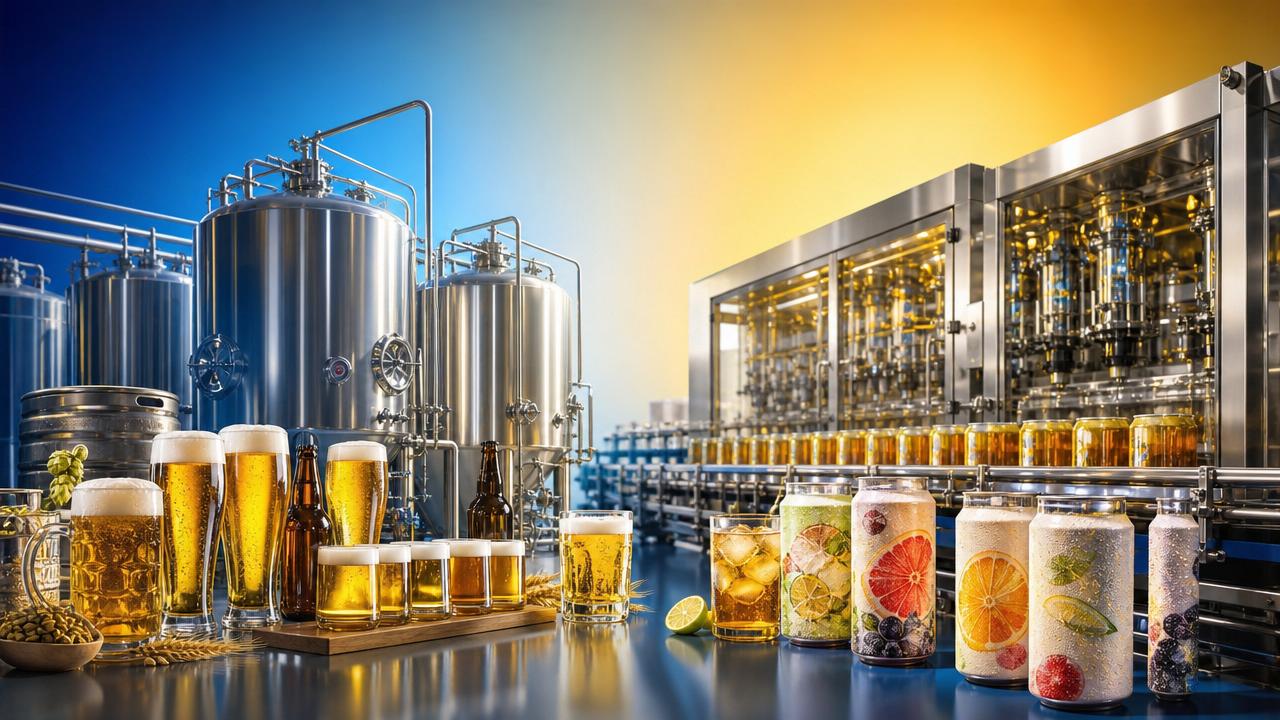
Choosing between a Beer factory and a Malt drink factory is not only a technical decision. It shapes product identity, regulatory positioning, channel fit and long-term margin structure.
For a new beverage line, the production model affects how a drink tastes, how it is labeled and how easily it can scale across markets. That is why the Beer factory versus Malt drink factory question matters early, not after launch.
The distinction is especially relevant in today’s beverage market, where classic beer, low-calorie formulas, fruit profiles and functional concepts are all competing for shelf space and consumer attention.
A company with broad R&D and OEM/ODM capability, such as Jinpai Beer, can often support both conventional brewing logic and more flexible product development paths. That creates useful options, but it also requires sharper judgment.
What the two production models really mean
A Beer factory is built around beer brewing standards. It typically uses water, malt, hops and yeast, with fermentation as the core production step.
That sounds simple, but in business terms it means stronger links to beer authenticity, traditional flavor structure and beer-category compliance in many markets.
A Malt drink factory usually has more formula flexibility. It may produce malt-based beverages with lower alcohol, no alcohol or blended ingredients that sit outside strict beer definitions.
In practice, a Malt drink factory can be better suited for sweetened profiles, fruit extensions, functional positioning and faster concept adaptation for regional demand.
The key point is this: beer production protects category credibility, while malt drink production can widen commercial possibilities.
Why the market is paying closer attention
The beer and beverage sector is becoming more segmented. Restaurants, bars, supermarkets and online retail all reward different product signals.
A classic lager for on-trade channels usually benefits from Beer factory credentials. Buyers often expect a clear brewing story, stable taste and familiar category language.
A fruit-led, low-calorie or functional beverage may need wider room for ingredient design. In that case, a Malt drink factory can reduce formulation constraints.
Another reason this topic matters is international expansion. Labeling rules, alcohol definitions and permitted claims vary across countries. The wrong production model can create avoidable friction.
This is where experienced OEM/ODM support becomes valuable. When production, formulation and export understanding sit under one roof, product planning becomes more realistic.
Core differences that affect product planning
The most practical way to compare a Beer factory and a Malt drink factory is to look at the business decisions they influence.
The table simplifies the issue, but it captures a useful truth. The production model influences not only manufacturing, but also market language and portfolio logic.
Flavor, formulation and brand positioning
Taste is often where strategy becomes visible. A Beer factory usually delivers stronger fermentation character, bitterness balance and beer aroma authenticity.
That matters for classic lager, German wheat and other styles where the brewing profile is part of the value proposition.
A Malt drink factory may be the better route when flavor goals include sweetness control, fruit-forward appeal or functional extensions that would feel less natural in standard beer logic.
This is especially relevant for sugar-free low-calorie beer alternatives, fruit-flavored beverages or specialty concepts with modern lifestyle positioning.
Not every fruit or low-calorie idea belongs in a Malt drink factory, though. Some brands win by keeping beer authenticity while introducing lighter or more expressive variants.
The better question is whether the brand wants to extend beer, or move beyond it.
When Beer factory logic is stronger
- The product story depends on brewing craftsmanship.
- On-trade channels expect credible beer language.
- The flavor target is dry, layered or hop-driven.
- The label must clearly support beer-category recognition.
When Malt drink factory logic is stronger
- The concept relies on flavor blending or softer drinking texture.
- The portfolio includes functional or crossover beverages.
- The target market responds to novelty more than tradition.
- Regulatory flexibility is needed across multiple export destinations.
OEM and ODM considerations behind the factory choice
Many beverage projects do not start with a factory build. They start with a partner search, and that changes how the Beer factory versus Malt drink factory decision should be evaluated.
An experienced partner should not only produce liquids. It should help translate a market idea into formula, packaging, labeling and channel logic.
For example, Jinpai Beer works across craft beer R&D, production and global distribution. That kind of range matters because product planning rarely stays inside one narrow category.
A lineup may begin with classic lager, then expand into German wheat, fruit-flavored SKUs or functional specialty beverages. A rigid production model can limit that roadmap.
The right OEM/ODM setup should answer three questions clearly.
- Can the partner support your current formula without compromising category expectations?
- Can it adapt future SKUs without rebuilding the entire supply structure?
- Can it align product design with the rules of your target markets?
Typical channel scenarios
Different sales channels often signal which model is more practical.
In bars and restaurants, a Beer factory usually has an advantage. Beer menus rely on recognizable styles, draft credibility and familiar expectations around mouthfeel and aroma.
In supermarkets, the answer depends on shelf strategy. If the product competes in mainstream beer, Beer factory credentials can strengthen trust.
If the shelf plan targets flavored refreshment, low-burden drinking or younger trend segments, a Malt drink factory may support better product-market fit.
Online channels add another layer. Digital shoppers respond quickly to niche flavor stories, limited editions and concept-led launches. That often favors more flexible development cycles.
Wholesale programs also need attention. Large-volume supply tends to reward stable production, consistent taste and packaging reliability, regardless of whether the base model is Beer factory or Malt drink factory.
A practical way to decide
A useful decision framework starts with the intended product claim, not the equipment list.
Ask what must remain true when the product reaches the shelf. Should it be understood as beer first, or as a broader malt-based beverage?
Then test the formula against five filters.
- Category fit: does the concept need beer authenticity or beverage flexibility?
- Compliance fit: what definitions apply in each target market?
- Flavor fit: is fermentation character central or secondary?
- Channel fit: where will the product win first?
- Portfolio fit: can future line extensions stay efficient?
This approach prevents a common mistake: selecting a Beer factory or Malt drink factory only because of short-term cost or trend pressure.
In beverage development, the cheapest early decision can become the most expensive correction later.
Where to focus next
The best production model is the one that protects your brand story while keeping room for commercial adaptation.
If the plan centers on brewed credibility, style integrity and beer-led channels, a Beer factory is often the stronger foundation.
If the goal is broader formulation freedom, flavored innovation or more flexible positioning, a Malt drink factory may offer better strategic alignment.
Before moving forward, compare target markets, label requirements, expected flavor profile and channel priorities in one review sheet. That usually makes the right path clearer.
When a production partner can support R&D, OEM/ODM customization and multi-channel supply, the decision becomes less about abstract theory and more about building a beverage line that can hold its position over time.
Thank you very much for writing to us. Please leave your message and contact information, we will reply to you within 24 hours.