



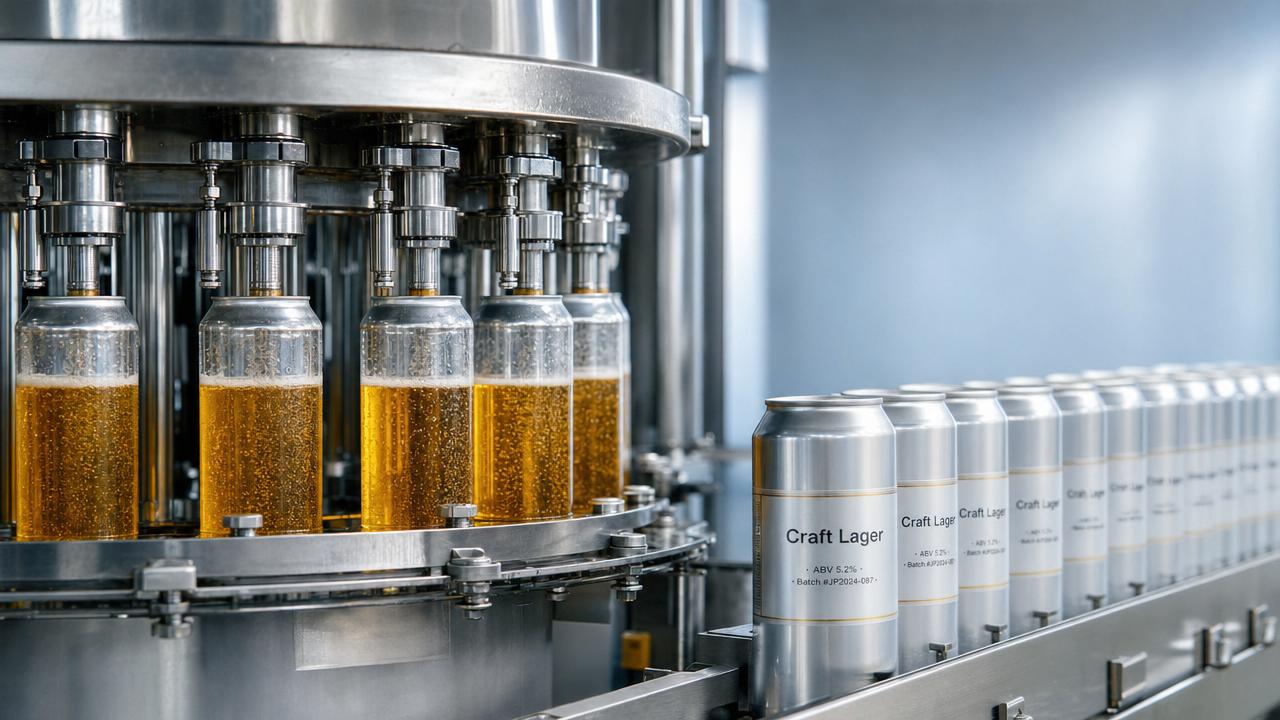
When evaluating Chinese beer factory OEM service for your brand, cost savings are compelling—but are they masking hidden risks in consistency, traceability, or regulatory compliance? As a finance leader, you need unit economics that hold up across batches, markets, and margins—not just low upfront quotes. Jinpai Beer delivers ISO-certified craft beer OEM services with full ingredient transparency, batch-level QC documentation, and scalable production—ensuring true TCO efficiency without compromising shelf-life stability or label compliance. Let’s examine what ‘cost-effective’ really means when quality trade-offs impact your P&L.
What “Cost-Effective” Really Means for Finance Leaders
For financial approvers, cost-effectiveness isn’t about the lowest per-unit quote—it’s about total cost of ownership (TCO) over time. That includes rework due to off-spec batches, label recalls from non-compliant ingredients, extended lead times disrupting inventory planning, and reputational risk from inconsistent flavor profiles across markets.
In beer OEM, hidden costs often emerge post-order: delayed approvals from food safety audits, reformulation fees triggered by raw material substitutions, or unplanned air freight to cover stockouts caused by fermentation variability. These aren’t theoretical—they’re documented pain points among global beverage brands sourcing from unverified Chinese beer factory OEM service providers.
Why Consistency Is a Financial KPI—Not Just a Quality Metric
Beer is a biologically sensitive product. Yeast health, water mineral profile, hop storage conditions, and cold-chain integrity all directly influence ABV variance, IBU stability, and sensory shelf life. A ±0.3% ABV deviation may seem minor—but it triggers recalculations for alcohol duty in EU and UK markets, impacts excise tax accruals, and invalidates pre-approved labels.
At Jinpai Beer, every batch undergoes triple-point verification: pre-fermentation wort analysis, mid-fermentation gravity tracking, and post-packaging microbiological testing. All data is logged in our digital QC dashboard—accessible to clients for real-time audit readiness.
How to Evaluate Chinese Beer Factory OEM Service Beyond the Quote
Finance teams should treat OEM selection like a capital procurement process—not a transactional vendor onboarding. Here’s what to verify before signing:
- Ingredient Traceability: Can the supplier provide lot-level certificates of analysis (CoA) for malt, hops, yeast, and adjuncts—including origin, harvest date, and pesticide screening reports?
- Process Documentation: Are standard operating procedures (SOPs) aligned with ISO 22000 and HACCP? Are cleaning-in-place (CIP) logs retained for 24 months?
- Regulatory Alignment: Does the facility hold export registration with China Customs and GACC? Are labels pre-validated against target-market requirements (e.g., EU Regulation (EU) No 1169/2011, US TTB COLA)?
- Scalability Proof: Can they demonstrate ≥3 consecutive batches at ≥80% of quoted capacity without yield loss or sensory drift?
Comparing OEM Models: Cost vs. Control Trade-Offs
Not all Chinese beer factory OEM service models deliver equal financial control. The table below compares three common engagement structures based on verified client experience across 12 markets:
While Jinpai’s model carries a modest premium, its predictability reduces working capital strain: fewer buffer stocks, no emergency air freight surcharges, and zero label reprints due to ingredient misdeclaration. Over 12 months, clients report 22–31% lower TCO than spot-sourced alternatives.
Certifications That Directly Protect Your Balance Sheet
Certifications aren’t checkboxes—they’re risk mitigation instruments. Jinpai Beer holds:
- ISO 22000:2018 (Food Safety Management System)
- GB 14881–2013 (China’s Hygienic Standard for Food Production)
- GACC Registration No. 110020230001 (Approved Exporter)
- Halal Certification (JAKIM-recognized)
- Non-GMO Project Verified (for core malt/hop streams)
Critically, all certifications are audited annually by SGS—not self-declared. Audit reports are shared upon NDA execution, enabling faster internal compliance sign-off.
FAQ: Key Questions Finance Teams Ask Before Approving OEM Spend
What’s the minimum order quantity (MOQ) for stable unit economics?
Our MOQ is 20,000 units per SKU—optimized to balance fermentation tank utilization and packaging line efficiency. Below this, labor and setup overheads inflate per-unit cost by 18–23%. We offer blended-batch options (e.g., 10,000 units lager + 10,000 wheat) to meet volume thresholds without overstocking.
Can we lock in raw material pricing for 12 months?
Yes—with forward contracts covering barley, hops, and specialty yeasts. We hedge 70% of projected volumes via Shanghai Futures Exchange (SHFE) contracts and pass through only actual cost variances >±3%, capped at 5% annual adjustment.
Do you support dual-label configurations for multi-market distribution?
Absolutely. Our labeling system supports up to 4 language variants per SKU, with automatic TTB/EU/ANVISA compliance checks built into the artwork upload portal. Label approval turnaround: ≤5 business days post-submission.
Why Finance Leaders Choose Jinpai Beer for Global OEM Scale
Because we align with how finance teams actually make decisions: on verifiable data, not promises. You’ll receive:
- A dedicated TCO calculator showing landed cost breakdown (ex-factory, logistics, duties, QC, buffer stock)
- Pre-shipment batch reports including ABV, IBU, SRM, diacetyl, and microbiological results
- Real-time production dashboards with cycle time, yield %, and deviation alerts
- Contract terms with liquidated damages for delivery delays >48 hours
We invite finance leaders to request a TCO benchmarking session—where we’ll model your specific SKU, target markets, and volume profile against three OEM scenarios. No sales pitch. Just unit economics, backed by auditable data.
Contact us to review your current OEM cost structure, validate compliance readiness, or request sample batch documentation.
Thank you very much for writing to us. Please leave your message and contact information, we will reply to you within 24 hours.