



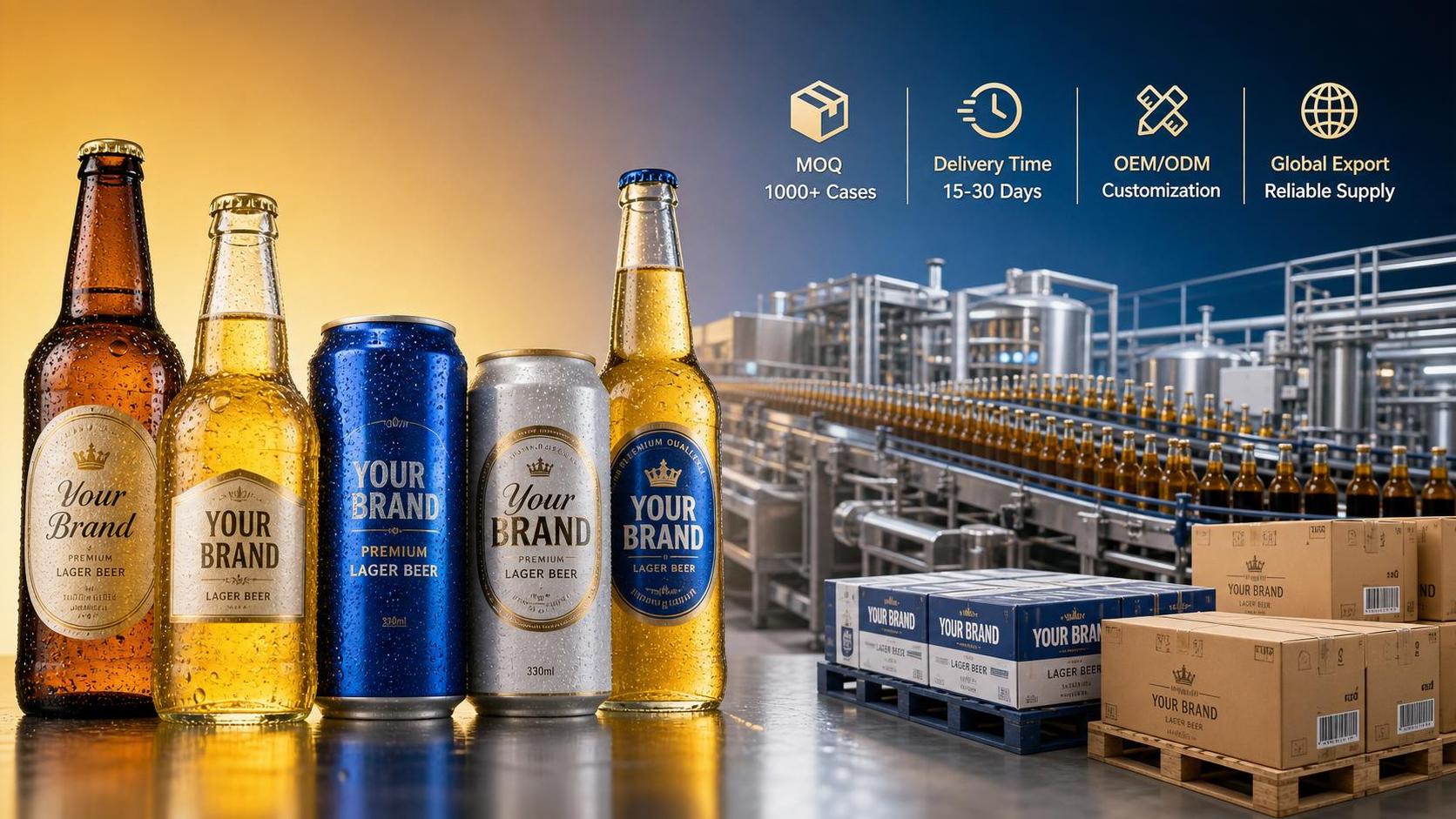
Strong Lager Beer Contract Manufacturer: MOQ and Lead Time Guide
Choosing a strong lager beer contract manufacturer involves more than comparing prices.
MOQ and lead time shape launch timing, stock pressure, and room for market adjustment.
That matters even more when a brand plans multiple SKUs, custom packaging, or regional rollouts.
A reliable strong lager beer contract manufacturer should help balance speed, consistency, and cost.
Jinpai Beer supports OEM and ODM projects with broad production capability and practical planning support.
Its portfolio covers classic lager, German wheat, sugar-free low-calorie beer, fruit beer, and functional specialty beer.
For beverage brands, distributors, supermarkets, bars, and restaurant channels, that range creates useful flexibility.
This guide explains how to evaluate MOQ, lead time, and supply planning with fewer surprises.
Why MOQ Matters in Strong Lager Beer Manufacturing
MOQ is not just a purchasing number.
It influences recipe choice, packaging setup, production efficiency, and warehouse planning.
In actual projects, MOQ often decides whether a product launch stays controlled or becomes overcommitted.
A strong lager beer contract manufacturer usually sets MOQ around production realities, not guesswork.
These realities include brewing batch size, can or bottle supply, label runs, carton printing, and filling schedules.
Smaller MOQs can improve market entry, but they may raise per-unit cost.
Larger MOQs lower production cost, yet they increase inventory risk and slow product rotation.
The better approach is to match MOQ with channel demand and launch confidence.
Key factors behind MOQ
- Beer style complexity and fermentation cycle
- Packaging format such as cans, bottles, or kegs
- Custom can design, label printing, and carton requirements
- Ingredient sourcing, including malt, hops, and flavor additions
- Regional compliance and export documentation
When reviewing suppliers, ask what part of the MOQ is technical and what part is negotiable.
That question often reveals how flexible the manufacturing partner really is.
What Lead Time Really Includes
Lead time is often misunderstood as only production days.
In reality, it covers development, material preparation, brewing, filling, packing, inspection, and shipment release.
For a strong lager beer contract manufacturer, lead time can also change with seasonality and order mix.
Peak demand before holidays usually tightens production windows and packaging availability.
A realistic schedule should separate each stage clearly.
Typical lead time stages
- Formula confirmation and sample approval
- Packaging artwork finalization and material ordering
- Brewing and fermentation scheduling
- Filtration, filling, and packing
- Quality checks and export document preparation
- Warehouse release and shipping arrangement
This is why a short quote without stage detail is not enough.
A dependable strong lager beer contract manufacturer should explain which steps are fixed and which depend on approvals.
That clarity helps avoid launch delays caused by artwork changes or late packaging decisions.
How Jinpai Beer Supports Flexible OEM and ODM Projects
Jinpai Beer approaches contract brewing as a planning partnership, not only a factory transaction.
That becomes useful when timelines are tight and channel targets are changing.
As a strong lager beer contract manufacturer, Jinpai Beer supports both standard and customized product paths.
Clients can choose from existing beer styles or develop tailored recipes for specific retail or on-trade needs.
That includes classic lager, stronger alcohol profiles, low-calorie options, fruit variants, and functional specialty concepts.
Practical advantages for supply planning
- OEM and ODM service options for different brand strategies
- Support for wholesale supply and private label development
- Product range suited to supermarkets, bars, restaurants, and retail chains
- Global channel experience across online and offline distribution
- Customized solutions based on target market and packaging needs
From a project execution angle, this flexibility reduces handoff friction.
It also means a brand can start with a manageable SKU plan, then expand after first-market feedback.
For many buyers, that is more valuable than chasing the lowest unit price.
Balancing MOQ, Lead Time, and Market Risk
The real decision is not MOQ alone or lead time alone.
It is how both numbers work together under your sales assumptions.
A strong lager beer contract manufacturer should help frame that tradeoff with realistic scenarios.
For example, a lower MOQ with a slightly higher unit cost may protect cash flow during a new launch.
On the other hand, a larger first run may fit better when retail listings are already confirmed.
Questions worth asking before approval
- What sales volume supports the first MOQ within a safe turnover period?
- How much buffer time is needed before the planned shelf date?
- Which materials have the longest procurement cycle?
- Can repeat orders move faster than first orders?
- What happens if packaging artwork changes late?
These questions improve decision quality because they connect factory planning with actual market exposure.
They also help compare suppliers on execution strength, not just quotation sheets.
A Simple Evaluation Framework for Supplier Selection
When selecting a strong lager beer contract manufacturer, a clear evaluation framework saves time.
It also keeps discussions focused on operational fit.
This framework works especially well when several suppliers appear similar on price.
The differences usually appear in execution detail, not brochure language.
How to Move Forward with Fewer Delays
The fastest way to improve outcomes is to prepare a clearer inquiry package.
That gives the strong lager beer contract manufacturer the detail needed for an accurate response.
Include these items in your first discussion
- Target alcohol strength, flavor profile, and positioning
- Expected first order volume and repeat order forecast
- Preferred can, bottle, or keg specification
- Target launch date and market destination
- Required certifications, labeling rules, and shipping terms
With this information, discussions become more precise and timelines become more believable.
Jinpai Beer can then align product development, MOQ planning, and delivery scheduling around your market goal.
For brands expanding into strong lager segments, the right manufacturing partner is the one that keeps momentum practical.
A strong lager beer contract manufacturer should help you launch with confidence, not with hidden timing risk.
Start with MOQ clarity, confirm each lead time stage, and build the project around realistic demand.
Thank you very much for writing to us. Please leave your message and contact information, we will reply to you within 24 hours.