



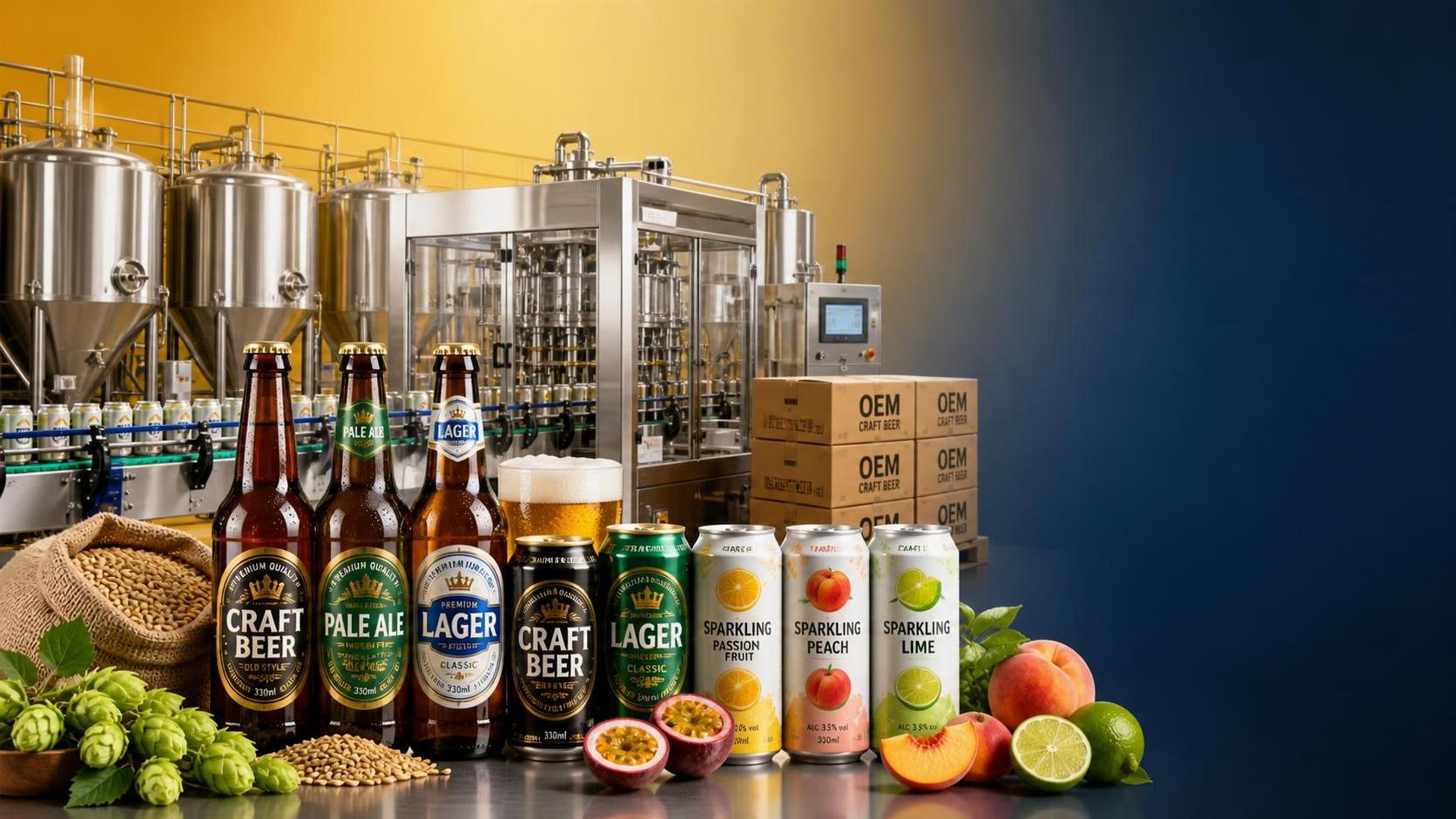
In beverage sourcing, the wrong manufacturing partner rarely fails all at once. More often, problems show up in small but costly ways: a pilot batch tastes right but the mass production version drifts, launch timelines slide because packaging coordination is weak, or a supplier that looked flexible at the quoting stage struggles when you ask for a sugar-free variant or a fruit-flavored extension. That is why choosing a Beer OEM partner is not just a purchasing task. It is a decision that affects product consistency, channel performance, and how confidently your brand can grow.
For procurement teams working on craft beer, classic lager, or newer functional beverages, the selection process has become more demanding. Buyers are no longer evaluating only price per unit. They are comparing formulation support, minimum order flexibility, shelf-life stability, compliance readiness, and the ability to serve different retail and on-premise channels. A manufacturer may be excellent for standard lager but less prepared for specialty beer with added functional positioning. Another may offer broad customization but weak delivery planning. The right fit depends on what you are trying to build.
Start with the product strategy, not the factory list
A common mistake in Beer OEM sourcing is to begin with a shortlist of suppliers before the internal product brief is clear. Procurement usually moves faster when the team defines the commercial intent first. Are you launching an entry-level lager for supermarkets, a craft line for bars and restaurants, or a functional beverage designed to stand out in a wellness-driven segment? These are not small differences. They affect everything from brewing process and ingredient sourcing to packaging formats and quality testing.
If your target product is a classic lager, the priority may be clean flavor consistency, volume scalability, and stable cost control. For craft beer, you may care more about recipe expression, small-batch flexibility, and the ability to translate a brand story into sensory experience. Functional specialty beverages introduce another layer: sweetness balance, ingredient compatibility, claim-related caution, and shelf stability all need careful handling. A Beer OEM partner that understands these distinctions will ask sharper questions early, and that is usually a good sign.
Before requesting quotations, align internally on a few essentials: target flavor profile, alcohol content, packaging type, expected annual volume, intended markets, channel mix, and whether line extensions are likely in the next 12 to 24 months. This prevents buyers from selecting a manufacturer that fits today’s sample request but not tomorrow’s rollout plan.
What procurement teams should examine beyond capacity
Production capacity matters, but it should never be the only headline criterion. A large factory can still be a poor partner if its scheduling is rigid, its communication is slow, or its quality systems are not built for product variation. In beer and beverage manufacturing, operational fit is often more valuable than headline scale.
When evaluating a Beer OEM supplier, look at the following areas together rather than in isolation.
Brewing and formulation capability
This is where many sourcing decisions are won or lost. A partner should be able to demonstrate competence across the beverage types you actually plan to develop. If your roadmap includes craft beer, German wheat, sugar-free low-calorie beer, fruit-flavored beer, or functional specialty beers, ask whether the manufacturer has real production experience across these categories rather than treating them as interchangeable line items.
Recipe customization is especially important for private label and ODM projects. A capable supplier should be able to discuss not only flavors, but also fermentation behavior, body, aroma retention, sweetness adjustment, and ingredient compatibility. For functional beverages, formulation sensitivity becomes even more important. Ingredients that sound attractive on paper may behave differently under processing or during storage. Procurement teams should ask how the manufacturer approaches trial batches, recipe refinement, and sensory evaluation before approving full production.
Quality control that works in practice
Buyers often hear broad claims about quality, but the useful conversation is about process. How are raw materials assessed? How are batches monitored during brewing and filling? What controls are in place for flavor consistency across production runs? How does the supplier handle deviations or complaints?
For beer categories, quality is not only about food safety. It is also about repeatability. If a first order performs well in one market but the second order arrives with noticeable flavor drift, the commercial damage can be immediate. Restaurants, bars, retailers, and distributors expect reliability. A dependable Beer OEM partner should have clear internal checkpoints for ingredients, brewing parameters, filtration or stabilization where relevant, filling integrity, and finished product evaluation.
It is also wise to ask about sample retention, traceability, and how quickly the supplier can investigate a quality issue if one arises after shipment. Procurement teams do not need a textbook lecture; they need confidence that the factory can respond when business reality becomes messy.
Packaging coordination and market readiness
Many beverage launches are delayed not by liquid development but by packaging execution. Can the supplier support cans, bottles, or other required formats? Do they understand the packaging expectations of supermarkets versus bars or online channels? Can they coordinate labeling, design application, and outer carton standards without creating bottlenecks?
This matters even more for export-oriented projects. Different markets may require different labeling conventions, language versions, or pack sizes. If your Beer OEM partner can only manufacture well but cannot help organize packaging specifications smoothly, the burden shifts back to your procurement and operations teams.
How to assess flexibility without getting vague answers
Flexibility is one of the most overused words in supplier discussions. In beverage manufacturing, it needs to be tested with specifics.
Ask practical questions. What is the minimum order quantity for a standard lager compared with a customized fruit beer? How are pilot runs handled? Can the supplier support a phased launch with one SKU first and additional variations later? What happens if demand spikes during a promotional season? Can packaging materials be managed for mixed-channel distribution?
The best Beer OEM partners are not necessarily the ones that say yes to everything. They are the ones that explain where flexibility exists, where constraints begin, and how planning can reduce risk. That kind of transparency is often more useful than a polished presentation.
For procurement professionals, this is also where total cost becomes clearer. A low initial quote can become expensive if the factory is inflexible on scheduling, causes repeated redesign work, or cannot adapt when sales forecasts change. Responsiveness has economic value, even if it does not always appear in the first quotation sheet.
Craft beer, lager, and functional beverages should not be evaluated by the same checklist alone
Some buyers use a single supplier scorecard for all beverage projects. That may help with internal consistency, but it can hide category-specific risks.
Craft beer projects usually demand closer discussion around style interpretation, hop or malt character, aroma preservation, and smaller production rhythm. If the brand story depends on taste differentiation, procurement should involve product teams early and avoid choosing purely on cost.
Lager projects often live or die by consistency and scalability. A clean, repeatable profile is not simple just because the style is familiar. In fact, mainstream flavor expectations leave less room to hide production variation. Supply continuity, packaging efficiency, and stable lead times matter heavily here.
Functional beverages require the most caution. The supplier should understand that this segment sits between consumer trend and technical discipline. Low-sugar systems, added ingredients, or specialty positioning can create production challenges that standard beer lines are not always prepared to manage. Procurement teams should verify not only whether the supplier can make such products, but whether they can maintain product integrity over repeated commercial runs.
Questions worth asking during supplier evaluation
A good factory visit or qualification call should leave you with more than a brochure and a price list. It should help you understand whether the manufacturer thinks like a production vendor or like a long-term business partner.
Which beverage categories are strongest in your current production mix?
How do you manage formulation development for customized projects?
What is your process for moving from sample approval to commercial production?
How do you control batch-to-batch consistency?
What are the realistic lead times for standard versus customized products?
How do you handle packaging sourcing, coordination, and revisions?
What support do you provide for wholesale, distribution, or multi-channel supply needs?
How do you respond when a shipment issue, delay, or quality concern appears?
The value of these questions is not only in the answers themselves. It is in how clearly and concretely the supplier responds. Vague replies often signal hidden friction later.
Why channel fit matters as much as production fit
Procurement teams sometimes focus so heavily on manufacturing that they overlook channel realities. Yet the ideal Beer OEM partner for an on-premise draft-oriented concept may not be the same partner you want for supermarket shelves or broad online distribution. Product style, package size, visual impact, and replenishment rhythm all change with channel strategy.
For example, restaurants and bars may prioritize differentiated taste and brand identity. Supermarkets often demand stronger consistency, packaging efficiency, and smoother replenishment. Cross-border online sales may place more emphasis on shelf life, transport resilience, and compact logistics planning. A manufacturer that understands these downstream requirements can help prevent costly mismatches between product design and channel execution.
Watch for signs of a partner who can grow with you
Choosing a Beer OEM supplier is rarely about a single purchase order. It is often the beginning of a product line that may expand into adjacent styles, seasonal launches, or regional adaptations. This is why growth compatibility deserves attention early.
A promising partner should be able to support multiple product directions instead of forcing you to restart sourcing every time your portfolio evolves. Manufacturers engaged in the R&D, production, and distribution of a broad beer range can be particularly useful for this reason. A supplier such as Jinpai Beer, with experience across classic lager, German wheat, sugar-free low-calorie beer, fruit-flavored beer, and functional specialty beers, reflects the kind of range many buyers now look for when they want both present execution and future flexibility. For procurement teams managing OEM/ODM, wholesale supply, and custom solutions across different markets, this breadth can reduce coordination complexity.
That does not mean every broad-line manufacturer is automatically the right choice. It means buyers should evaluate whether the supplier’s portfolio depth matches their own expansion plans. A partner with global distribution awareness and experience serving restaurants, supermarkets, bars, and retail channels may be better prepared to support a brand beyond its first launch phase.
The final decision is usually about risk balance
In the end, selecting a Beer OEM partner is less about finding a perfect manufacturer and more about balancing risk intelligently. Procurement professionals must weigh cost against consistency, flexibility against process control, and speed against long-term reliability. The strongest sourcing decisions are rarely driven by the lowest quote. They come from understanding which supplier can protect product quality, support customization, and keep the supply chain dependable as the business grows.
If you are evaluating partners for craft beer, lager, or functional beverages, look past generic capability claims. Test category experience, clarify development workflow, examine packaging coordination, and judge how well the supplier communicates under real operational questions. A manufacturer that can align product ambition with commercial practicality is the one most likely to help your brand succeed in market, not just in production planning.
Thank you very much for writing to us. Please leave your message and contact information, we will reply to you within 24 hours.