



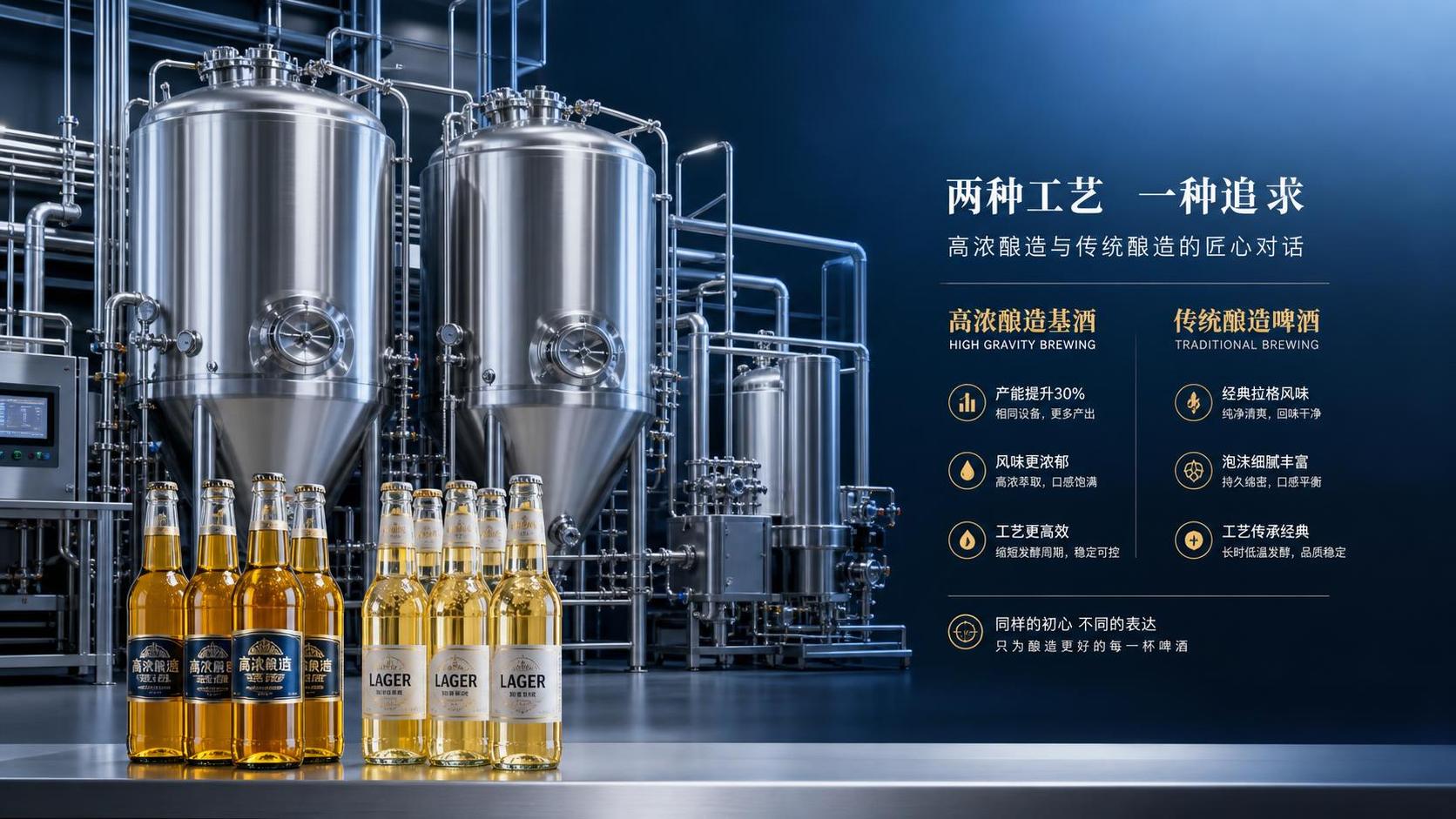
What should a buyer focus on first when comparing high-gravity lager with traditional brewing?
Start with the cost per saleable liter, not the brewhouse headline. That sounds obvious, but it is where many purchasing discussions go off track. A high-gravity lager program can lower packaging, storage, and fermentation tank pressure by producing a stronger base beer and diluting it later to the target alcohol level. Traditional brewing skips that dilution step and usually feels simpler from a process-control standpoint, but it often needs more tank time and more volume moving through the system to reach the same packaged output.
For procurement teams, the real question is not which method is “better” in theory. It is which method fits your plant, your quality target, and your route to market. If your brewery is capacity-constrained and selling a high-volume lager line, high-gravity lager may improve throughput. If your product mix is smaller, more premium, or less forgiving on flavor differences, traditional brewing may create fewer operational complications.
Where does high-gravity lager usually save money?
The savings usually come from asset utilization rather than from one dramatic raw material reduction. Brewing stronger wort means you can produce more finished beer from the same fermentation and cellar footprint once dilution is applied under controlled conditions. That can reduce the cost burden tied to tanks, utilities, labor hours per packaged unit, and warehouse movement.
In practical buying terms, high-gravity lager tends to make more sense when these conditions are true:
- Your lager volume is stable and large enough to justify process tuning.
- You are trying to expand output without adding fermentation capacity immediately.
- You already have, or are willing to invest in, reliable blending and quality-control capability.
- Your target market values consistency and price discipline more than a highly distinctive brewing story.
The mistake is assuming the cost advantage appears automatically. If dilution water treatment, dissolved oxygen control, or blending accuracy are weak, the savings can disappear into rework, flavor complaints, or shelf-life loss.
Does traditional brewing still make more sense for some breweries?
Yes, and more often than some equipment sellers admit. Traditional brewing is usually the better fit when the brewery values process simplicity, lower technical risk, and a more direct flavor path over maximum output per tank. For small to mid-sized operations, especially those with mixed portfolios, it can be easier to manage because there is no post-fermentation dilution stage to control.
That matters for buyers because complexity has a cost. A technically efficient system is not automatically the most economical one if the site lacks trained operators, stable water treatment, or strong in-line monitoring. Traditional brewing can also be the safer choice when the beer is positioned as premium craft lager, where even subtle changes in body, aroma, or finish may affect repeat purchase.
What are the main quality risks with high-gravity lager?
The biggest risks are usually mouthfeel thinning, flavor imbalance, and oxygen pickup during dilution or transfer. Buyers evaluating a high-gravity lager supplier or production partner should not stop at brewhouse capacity claims. They should check whether the system can protect flavor stability after dilution.
Ask for process details around these points:
- How dilution water is treated and stored before use.
- Whether blending is done in-line or in tank, and how consistency is controlled batch to batch.
- How dissolved oxygen is monitored after filtration, blending, and packaging.
- Whether the recipe was developed specifically for high-gravity production rather than simply diluted from a standard brew.
A common purchasing error is comparing samples without asking how they were produced at commercial scale. A pilot sample may taste fine, while the packaged product behaves differently once blending, transit, and shelf time are involved.
Which option is better if the goal is fast volume growth?
If your demand forecast is strong and centered on mainstream lager, high-gravity lager often gives the faster path to volume growth. It helps breweries stretch existing assets before making major expansion moves. That is especially relevant for buyers supplying supermarkets, chain restaurants, convenience retail, or private-label programs where consistent supply matters as much as flavor acceptance.
Still, growth only helps if the commercial model supports it. If your forecast is uncertain or heavily seasonal, a traditional setup may protect cash better because it avoids buying into extra blending, water handling, or control systems before demand is proven. Procurement should evaluate not just expected growth, but how painful underutilized equipment would be if sales miss plan.
How should buyers compare total cost instead of just production cost?
Use a wider lens. The right comparison includes the process cost, the quality cost, and the commercial cost of failure. A lower brewing cost does not help if the beer requires higher discounting, sees more customer complaints, or creates inconsistency across batches.
When reviewing supplier proposals, ask them to break the economics into raw materials, utility load, labor input, quality-control requirements, expected yield, and packaging loss. Without that breakdown, “lower cost” is too vague to support a purchasing decision.
What documents or technical details should procurement request before approving a high-gravity lager program?
You do not need a thick file of generic marketing material. You need the operating information that affects reproducibility, product acceptance, and contract clarity.
- Product specification sheet covering target ABV, extract, bitterness, color, and packaging format.
- Process description showing where dilution happens and how the final beer is standardized.
- Water management details relevant to blending quality.
- Shelf-life and storage guidance tied to the finished packaged product.
- Batch consistency records or retained sample policy if the product will be supplied repeatedly.
- OEM or ODM scope definition if the beer is being produced under a private-label or custom program.
For a custom supply arrangement, it also helps to define who owns recipe adjustment decisions if the product needs tuning after the first production runs. That point causes friction surprisingly often.
Is high-gravity lager a good choice for private label or customized beer projects?
It can be, especially when the project is aimed at broad retail, price-sensitive distribution, or a house-brand lager with reliable repeatability. For buyers working with OEM or ODM partners, high-gravity lager may offer useful flexibility because the base production can support efficient scaling once the target profile is locked.
That said, custom projects fail when the brief is too loose. If you are sourcing a private-label lager, define the commercial target clearly: entry-level value, standard mainstream, low-calorie extension, or something more flavor-led. The more precise the brief, the easier it is to judge whether high-gravity production supports the intended drinking experience or pushes the product too far toward neutrality.
When does traditional brewing win on brand positioning?
Traditional brewing usually has the advantage when the beer story matters almost as much as the liquid itself. That includes brewpub-led brands, specialty lagers, premium on-trade placements, and portfolios where consumers expect more texture or brewing authenticity cues. Buyers serving bars, restaurants, or curated retail shelves should pay attention to this, because those channels often reward character and narrative as much as price efficiency.
This does not mean high-gravity lager cannot deliver a good mainstream beer. It means the margin earned from a premium-positioned lager can disappear if the sensory profile becomes too thin or too interchangeable. Procurement decisions shape that outcome long before launch.
What mistakes do buyers make when choosing between these two approaches?
Three mistakes show up again and again.
- They compare unit price without checking whether the same quality controls are built into both options.
- They assume capacity efficiency matters more than channel fit.
- They approve a sample before confirming that the same flavor can be held at production scale and through shelf life.
Another one is treating all lagers as interchangeable. A classic easy-drinking retail lager, a low-calorie extension, and a premium food-service pour do not have the same tolerance for process tradeoffs. The procurement brief should reflect the selling environment, not just the style name on paper.
So which option fits better?
Choose high-gravity lager when your main pressure point is scalable output, your market expects consistent mainstream lager, and your production partner can control dilution and packaging quality with discipline. Choose traditional brewing when your commercial edge depends on a more direct flavor profile, simpler operations, or stronger premium positioning.
If you are making the call as a buyer, use one sequence: define the target channel, map the acceptable flavor range, review the real production workflow, and then compare total delivered cost. That order usually leads to a sound decision faster than starting with price alone.
Thank you very much for writing to us. Please leave your message and contact information, we will reply to you within 24 hours.