



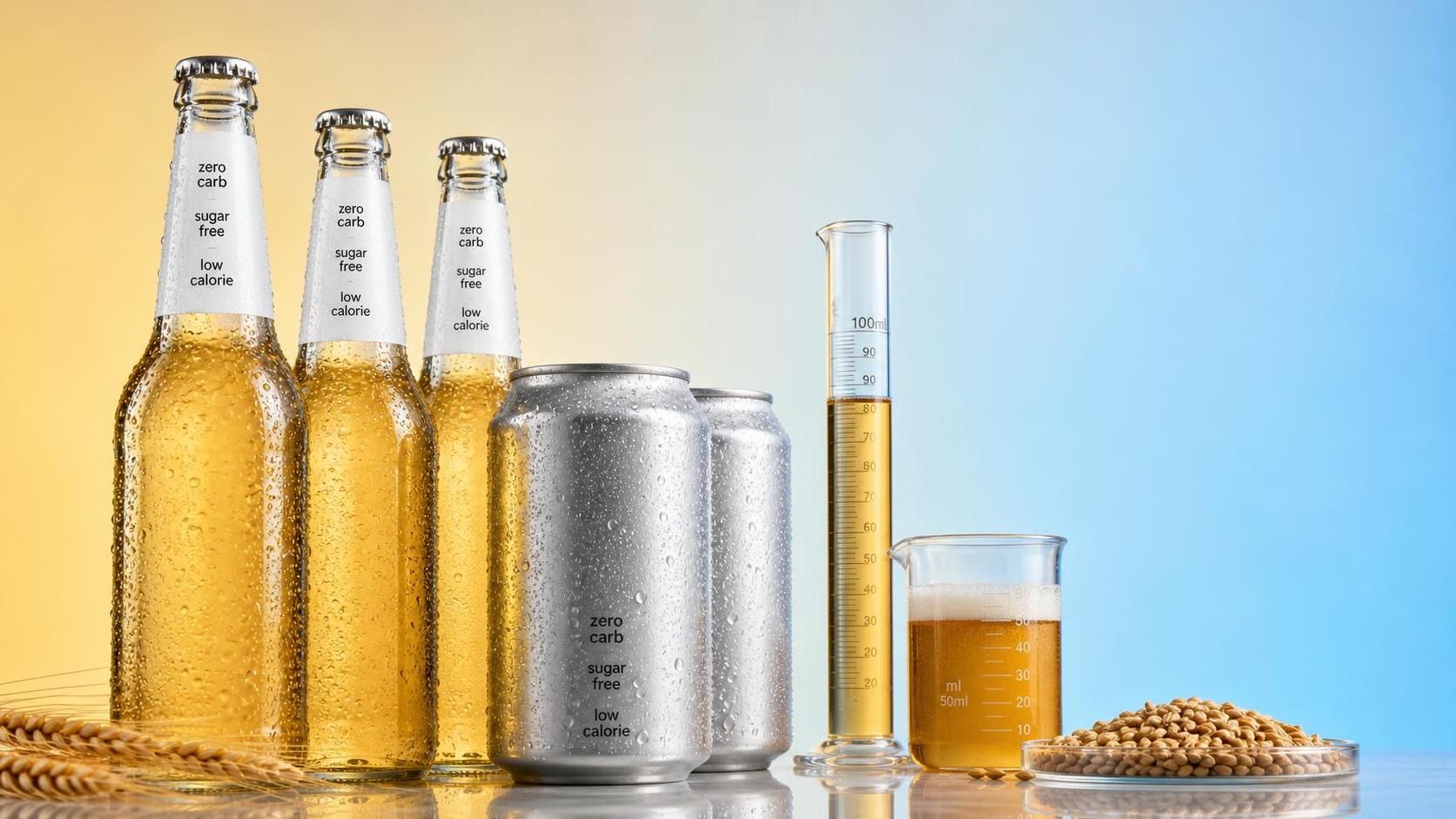
Common Zero-Carb Beer Label Claims and What They Really Mean
The most common mistake with zero-carb beer is to treat every front-label claim as if it describes the same technical reality. It does not. “Zero carb,” “carb-free,” “sugar-free,” “no added sugar,” and “low calorie” may appear close in consumer language, but for production, testing, quality control and compliance review, they point to different questions. Some relate to residual carbohydrate content. Some relate only to sugar. Some describe an energy result rather than a carbohydrate result. A label can sound stricter than the underlying formulation, or stricter than the analytical method can confidently support.
That distinction matters because beer is not a simple beverage matrix. Residual extract can include fermentable sugars, unfermentable dextrins, alcohol-related contributions to energy value, flavor adjuncts and process-derived variability. A zero-carb beer claim is therefore never just a marketing sentence. It is a statement that has to survive three separate checks: formulation logic, laboratory verification and jurisdiction-specific labeling rules.
In practice, quality and safety teams are usually not asking whether a claim sounds attractive. They are asking whether the claim is technically supportable batch after batch, whether the claim matches the certificate or test report, and whether the wording creates avoidable regulatory exposure in export channels. That is where most misunderstandings begin.
Why “Zero-Carb Beer” Is Harder Than It Sounds
Beer starts with carbohydrates. Malt contributes starches that are converted during mashing, and fermentation removes part of that carbohydrate load by turning fermentable sugars into alcohol and carbon dioxide. What remains depends on recipe design, enzyme activity, yeast performance, filtration strategy and whether flavoring or functional ingredients are added later. So when a beer is described as zero-carb, the technical meaning is usually that residual carbohydrates are reduced to a level that the brand believes qualifies for the target market’s labeling framework, not that carbohydrates were never present in the process.
This is also why experienced brewers and compliance staff do not rely on shorthand. A product may be brewed for very low residual sugar yet still carry measurable carbohydrate from dextrins. Another may be formulated to reduce overall carbohydrates but still fail a “sugar-free” position if the sugar fraction is not low enough under the local rule. In a flavored or functional beer, post-fermentation additions can complicate the picture even more.
The Claims That Get Confused Most Often
A useful way to read the label is to separate consumer-facing language from technical intent.
The table looks simple, but it captures a real operational problem. Teams often inherit a commercial brief that says “develop a zero-carb beer” when what the market actually wants is lower calories, cleaner finish, sugar-free positioning, or diabetic-friendly consumer signaling. Those are not interchangeable targets.
Sugar-Free Does Not Automatically Mean Zero-Carb
This is probably the most persistent confusion. In beer, sugar is only one part of the carbohydrate story. If fermentation removes simple sugars effectively, the finished beer may test very low for sugar while still containing other carbohydrate fractions. That can happen in products designed for a dry finish, especially when the process leaves non-sugar extract behind.
For QC review, that means the certificate showing compliant sugar values is not enough to justify a zero-carb statement. You need to know what was measured, how it was measured and what carbohydrate definition is being used on the nutrition panel or product dossier. A supplier saying “sugar-free low-calorie beer” may be entirely accurate and still not be making a defendable zero-carb claim.
Low-Calorie Does Not Solve the Compliance Question Either
Energy reduction in beer can come from lower residual carbohydrates, lower alcohol, smaller serving basis, or a combination of these factors. Since alcohol itself contributes calories, a beer can be lower in carbs without being especially low in calories, and a beer can be lower in calories without reaching a carb-free threshold. This matters when product development, export sales and label approval are handled by different teams and the language starts drifting.
If a product is positioned as both zero-carb and low-calorie, the two claims should be checked independently. One set of lab results does not automatically validate both. The discipline here is straightforward: do not let a favorable nutrition profile in one dimension stand in for another dimension that is regulated or declared separately.
What Quality Teams Should Look At Before Approving the Claim
The first question is not the wording. It is the claim basis. Is the declared value per 100 mL, per serving, per container or per another defined unit? Small numerical differences can change whether a product qualifies in one market and fails in another. A front label saying “0 carb” may be commercially common, but substantiation still depends on the declared reference basis used by the applicable regulation.
The second question is the analytical framework. Carbohydrate testing in beer is not just a number coming out of a machine. The method has to fit the matrix and the claim. Detection limits matter. Reporting conventions matter. Rounding rules matter. If the claim sits close to the threshold, method selection and result interpretation become part of the compliance file, not just the lab file.
The third question is process capability. A claim that can be met in pilot production but not held across commercial batches is not a robust claim. In low-carb or sugar-free brewing, small shifts in mash profile, enzyme dosing, fermentation completeness, filtration performance or flavor addition can move the final value enough to create inconsistency. This is especially relevant for manufacturers running multiple beer types, including classic lager, wheat beer, fruit-flavored beer and functional specialty lines, because changeover controls and cross-product formulation discipline start to matter.
A practical internal review usually needs at least these documents aligned: formulation sheet, batch record, nutrition calculation logic, test report, label copy and target-market regulatory check. When one of those sits outside the approval loop, claim risk increases quickly.
Where Label Claims Become Risky in OEM and Export Business
The risk increases when a product is made under OEM or ODM arrangements. The brand owner may request a term such as “zero-carb beer” because it performs well in a retail brief, while the manufacturing side is working from a formulation that was originally optimized for sugar-free or low-calorie positioning. If the technical dossier is not updated to match the final commercial claim, everyone assumes someone else checked the boundary conditions.
Export adds another layer. Different jurisdictions may define nutrient content claims differently, or place conditions on comparative language, font prominence, nutrition declarations and supporting evidence. A statement acceptable in one online channel may need different wording for supermarket shelves or bar menu distribution in another market. For global supply businesses, this is less about legal theory and more about label architecture: one formula does not always support one universal claim set.
A Better Way to Read the Claim
When you see zero-carb beer on a specification, read it as a starting point, not a finished conclusion. Ask what carbohydrate fraction is being discussed. Ask which market standard is being applied. Ask whether the laboratory result comfortably clears the threshold or only clears it after rounding. Ask whether later additions, especially in fruit-flavored or functional variants, change the nutritional profile. These are not bureaucratic questions. They are the difference between a claim that survives audit and one that only survives a sales meeting.
It also helps to separate sensory expectation from compositional reality. Some very dry beers are assumed to be carb-free because they do not taste sweet. That is not a reliable indicator. The reverse can also happen in flavored products where aroma suggests sweetness but the sugar profile remains low. Sensory perception should never be used as evidence for a nutrient claim.
What the Claim Should Mean in Daily Decision-Making
For technical teams, the right approach is disciplined and unspectacular. Treat “zero-carb beer” as a claim that requires a defined regulatory target, a stable formulation strategy, an appropriate test method and conservative label wording. Treat “sugar-free” and “low-calorie” as adjacent but separate positions. In supplier review or new product approval, ask for the evidence chain rather than the headline claim.
That mindset is especially useful in a category where breweries now produce across very different product styles, from standard lager to sugar-free low-calorie beer, fruit beer and specialty functional formulations. The broader the portfolio, the easier it is for claim language to drift away from technical meaning. The teams that avoid trouble are usually the ones that keep one habit: they do not approve label language until formulation, analytics and market rules are speaking the same language.
In other words, zero-carb beer is not a vague wellness label. It is a precise claim that only becomes useful when the numbers, the process and the wording line up.
Thank you very much for writing to us. Please leave your message and contact information, we will reply to you within 24 hours.