



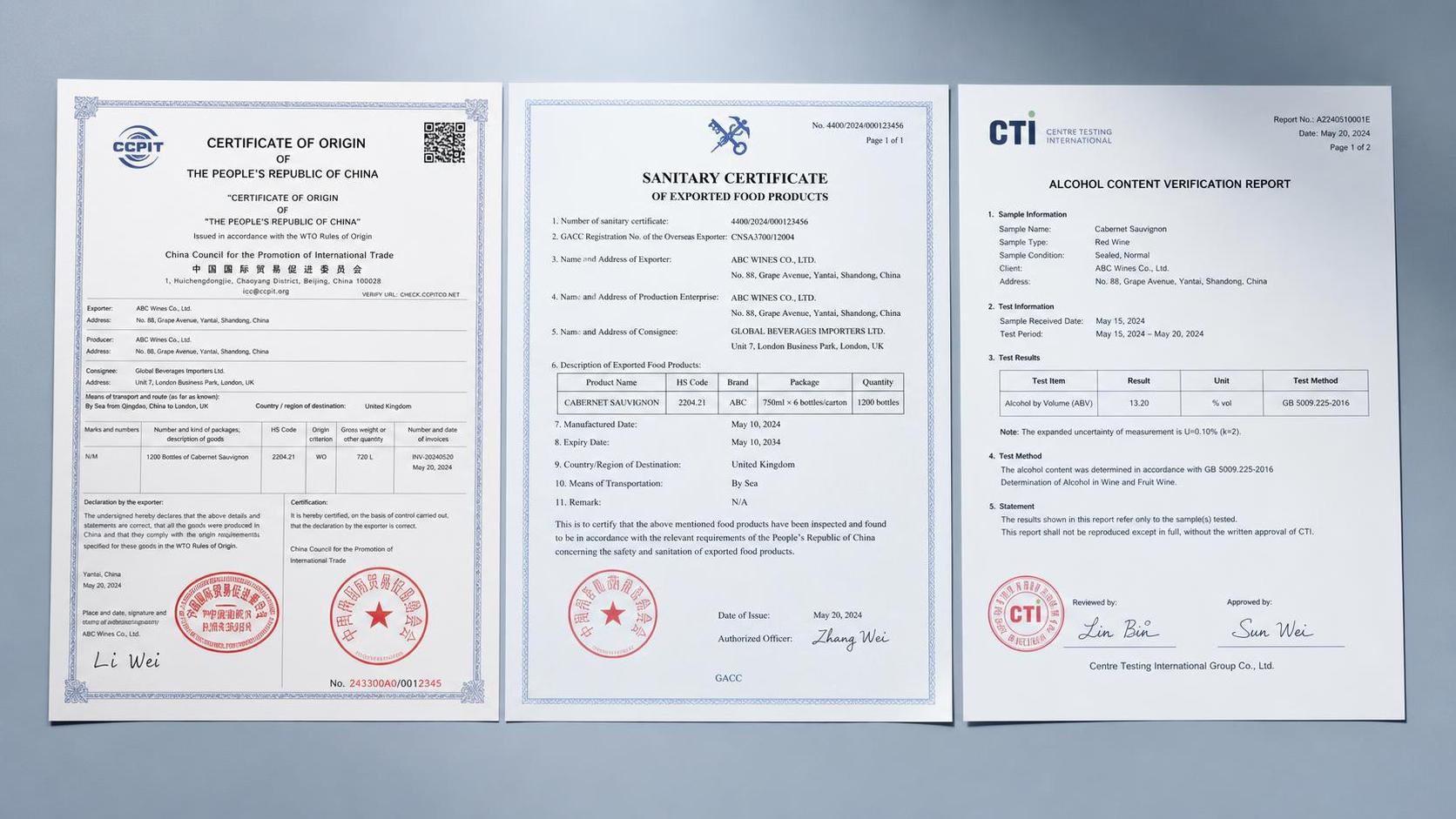
Navigating export compliance is critical for any China beer factory entering global markets — especially when shipping craft beer across borders. You’ve finalized an order with a distributor in Germany, confirmed the label design, and scheduled production. Then customs in Hamburg holds the shipment — not for labeling or packaging, but because the Certificate of Origin lacks the correct chamber of commerce stamp, the Sanitary Certificate references outdated inspection protocols, and the alcohol content on the commercial invoice doesn’t match the lab report submitted separately. No one flagged the mismatch during internal review. The delay stretches to 11 days. Storage fees accrue. The distributor pushes back the launch date. And your team scrambles to reissue documents while questioning whether the same error might repeat on the next container bound for Canada or Chile.
This isn’t hypothetical. It’s a recurring friction point for procurement managers and import compliance officers evaluating suppliers — particularly when working with a China beer factory that produces diverse styles: German wheat beers with suspended yeast, sugar-free lagers requiring precise ABV verification, fruit-infused variants where residual sugars affect alcohol measurement methodology, or functional beers containing botanical extracts subject to additional health authority scrutiny. Each style introduces subtle but consequential documentation variables. A generic checklist won’t suffice. What’s needed is a field-tested, style-aware verification sequence — one grounded in actual document submission patterns, not theoretical regulatory overviews.
Why These Three Documents Carry Disproportionate Weight
The Certificate of Origin, Sanitary Certificate, and Alcohol Content Verification aren’t standalone forms. They’re interlocking checkpoints. Customs authorities cross-reference them — not just for consistency, but to validate chain-of-custody logic. For example, if the Certificate of Origin states “produced in Jiangsu Province,” the Sanitary Certificate must list the exact facility address registered with China’s General Administration of Customs (GACC), and the alcohol content report must bear the seal of a CNAS-accredited lab operating at that same site. A mismatch in any element triggers manual review — and manual review means delays.
More critically, requirements shift by destination. The EU mandates that the Sanitary Certificate include a declaration on allergen handling for wheat-based beers. Japan requires alcohol content verified via distillation + hydrometer method — not digital densitometry alone — for beverages above 2.5% ABV. Saudi Arabia rejects Certificates of Origin issued by provincial chambers; only those from the China Council for the Promotion of International Trade (CCPIT) are accepted. Assuming uniformity across markets is the most common starting error.
Certificate of Origin: Beyond the Chamber Stamp
Start here — but don’t stop at signing. First, confirm whether your buyer needs a CCPIT-issued certificate (most common for EU, Middle East, Latin America) or a GACC-registered version (required for some ASEAN countries). Then verify the product description line-by-line against the commercial invoice: “unfiltered German-style wheat beer” is not equivalent to “wheat beer, cloudy.” Tariff codes matter — HS 2203.00 applies to beer without added spirits; HS 2206.00 covers flavored malt beverages, which may trigger different origin rules. Finally, check the signatory: it must be the legal representative named in the factory’s business license — not a sales manager or export coordinator, even if authorized internally.
Sanitary Certificate: Facility Alignment Is Non-Negotiable
This certificate ties production reality to paper. Before applying, ensure the facility listed is the *exact* one used for brewing, fermenting, and packaging that batch — down to the building number and production line. If your China beer factory uses separate tanks for low-calorie and fruit-infused batches, the certificate must reflect which line was used. Also note: the issuing authority (usually local CIQ or customs bureau) will only certify products covered under the factory’s current GACC registration scope. Adding a new variant — say, a functional beer with added B vitamins — requires prior amendment to that registration. No exceptions. Submitting a Sanitary Certificate for an unregistered product type invalidates the entire document.
Alcohol Content Verification: Method Matters More Than Number
The stated ABV seems straightforward — until you compare methods. Exporters often submit lab reports using refractometer readings calibrated for standard lagers. But for fruit-flavored beers with high dissolved solids, or hazy wheat beers with suspended proteins, refractometry overstates ABV. Distillation followed by hydrometry remains the internationally accepted baseline for dispute resolution. If your buyer’s market specifies a particular method (e.g., Japan’s MHLW Notification No. 178), use it — and ensure the lab report explicitly names the procedure, equipment model, and calibration date. Also, the report must cover the *same batch* referenced in the packing list and Certificate of Origin. Batch numbers must match exactly — no “approximate” or “similar to” phrasing.
Pre-Shipment Cross-Check Routine
Build this into your final 72-hour pre-shipment window:
- Print all three documents side-by-side. Highlight every instance of facility name, batch number, product description, and ABV value. Verify visual alignment — not just semantic equivalence.
- Confirm the Certificate of Origin’s issue date falls *after* the Sanitary Certificate’s inspection date and *before* the alcohol lab report’s issuance date. Chronology errors are frequent and fatal.
- Check signature authenticity requirements: Some countries require wet-ink signatures only; others accept digital seals if issued through the official CCPIT portal. Never assume.
- Validate translation accuracy. Even minor deviations — e.g., “non-alcoholic” vs. “alcohol-free” — carry distinct regulatory meanings in the EU and South Korea.
Jinpai Beer follows this sequence for every OEM/ODM and wholesale export shipment — regardless of volume or destination. Our internal process treats documentation as part of the production workflow, not a post-completion administrative step. That means ABV testing occurs during final filtration, facility details are locked into the Sanitary Certificate application before fermentation ends, and Certificate of Origin drafts are reviewed alongside label artwork. It eliminates last-minute corrections — and prevents the kind of delay that erodes trust before the first case hits the shelf.
When evaluating a China beer factory for long-term partnership, look beyond certifications displayed on a website. Ask how they sequence documentation generation relative to production milestones. Ask whether their lab partners are CNAS-accredited *and* method-verified for your target market’s requirements. Ask how they handle variant-specific adjustments — not just for classic lager, but for sugar-free, fruit-infused, or functional formulations. The rigor applied to paperwork is the clearest indicator of operational discipline — especially when the product itself is complex, perishable, and regulated at every border.
Thank you very much for writing to us. Please leave your message and contact information, we will reply to you within 24 hours.