



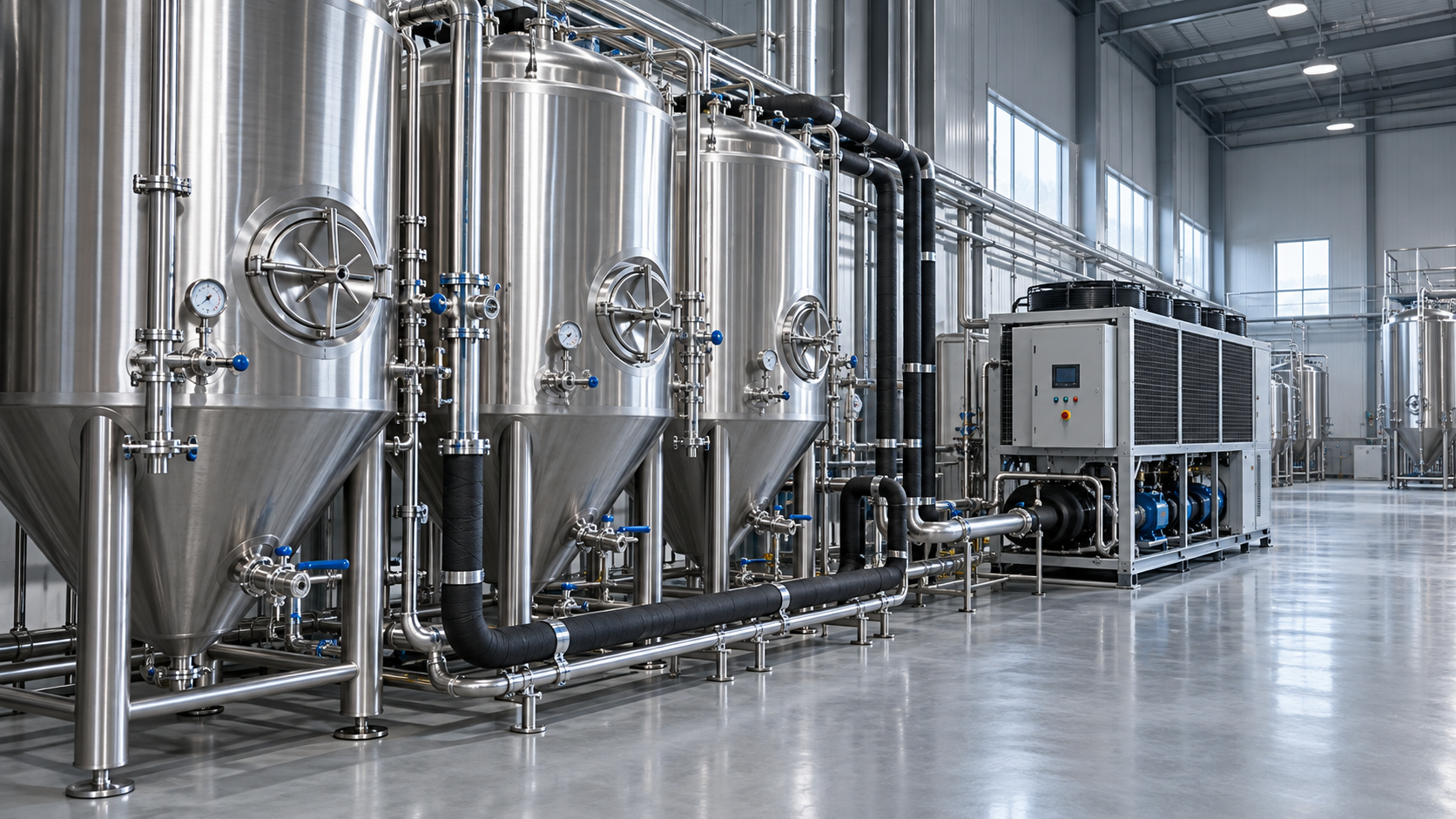
A brewery equipment quote can look competitive until the installation team identifies missing pipework, an undersized chiller or a power supply that needs upgrading. For procurement teams planning a Beer factory, the right comparison is the cost of achieving an agreed production output—not simply the price of the vessels. Normalize the scope, verify capacity against the planned beer mix, and compare installed costs, operating expenses and contractual responsibilities before selecting a supplier.
The cheapest package may still be the best choice when its exclusions are clear and manageable. The problem is an apparently complete offer that leaves essential work unpriced. A useful quotation should make those gaps visible early enough to budget for them, assign responsibility and avoid delaying production.
Start with one production brief for every bidder
Suppliers cannot provide comparable quotations if they are designing around different assumptions. One may quote a brewhouse based on a single daily brew, while another assumes multiple shifts. Both may describe the same nominal capacity, but the labor requirements, utility demand and cellar needs will differ.
Issue a common production brief covering saleable beer volume, product mix, brewing days, packaging formats, automation expectations and available site utilities. Ask each bidder to return an equipment schedule and a list of deviations from that brief. Unanswered requirements should remain open items, not become assumed inclusions.
Separate immediate demand from expansion plans. Buying oversized equipment can tie up capital and create inefficient operating conditions at low utilization. Conversely, a package with no allowance for additional fermentation tanks, cooling demand or packaging capacity may require expensive modifications later. Request a defined expansion route rather than a vague claim that the system is “scalable.”
Turn package descriptions into a scope comparison
Terms such as “complete brewery,” “turnkey” and “installation included” are not reliable scope definitions. Break each offer into equipment, delivery, site work, commissioning and handover. Record whether each item is included, excluded, optional or supplied by another contractor.
Delivery terms deserve particular attention for imported equipment. Establish where risk transfers, who arranges transport insurance, and who handles customs clearance and applicable import charges. A shipment delivered to a port is not equivalent to equipment positioned and connected inside the brewery.
Test capacity against the production schedule
A brewhouse batch rating does not establish annual saleable output. Actual throughput depends on brewing cycles, fermentation and conditioning time, cleaning, product changeovers, packaging availability and losses. Request a capacity calculation that shows these assumptions rather than accepting a headline volume.
Lager production can occupy cellar capacity differently from faster-turning beers. Wheat and fruit-flavored products may introduce additional transfer, cleaning or ingredient-handling requirements. The supplier should explain how the proposed tank arrangement supports the intended production mix without relying on every vessel being continuously available.
Clarify what the tank volume means
Ask whether quoted tank capacity is total geometric volume or usable working volume. Confirm the required headspace, operating pressure and temperature range. These details affect how much beer can actually be processed and whether the vessel is suitable for fermentation, conditioning or serving as a bright beer tank.
Then examine the rest of the line. A larger brewhouse has limited value if cooling cannot handle overlapping loads or packaging cannot clear finished beer on schedule. Require bidders to identify the expected bottleneck and explain what changes when another tank or brewing shift is added.
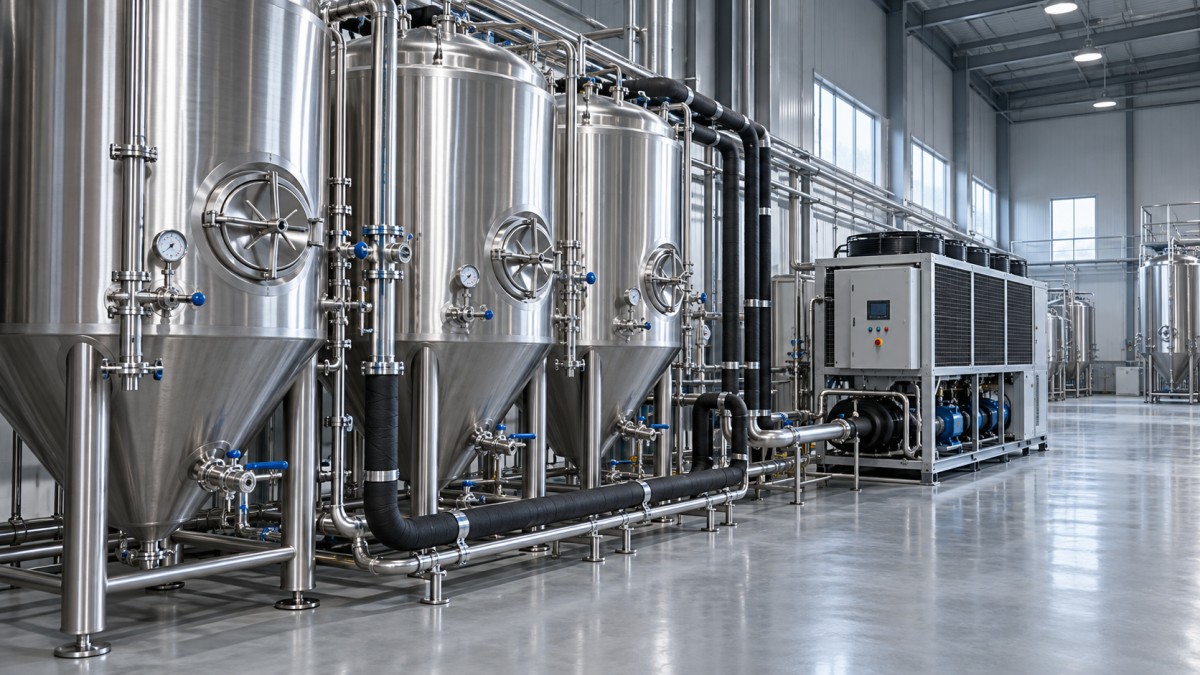
Make site and utility costs visible before ordering
Utility connections often account for major differences between the quoted equipment price and the installed project cost. Request a utility schedule showing connected loads, expected operating demand, peak simultaneous demand, supply conditions and connection points.
- Heating: Identify the proposed heat source and whether boilers, steam treatment, condensate return or electrical supply upgrades are included.
- Cooling: Check refrigeration capacity against wort cooling, fermentation, conditioning and other simultaneous loads. Confirm glycol pipework, insulation and controls.
- Water and drainage: Establish required water quality, pressure and flow, plus drainage and wastewater handling needs during cleaning and production.
- Power and gases: Verify voltage, frequency, phase, compressed-air quality and pressure, and carbon dioxide supply requirements.
Site access must also be checked against actual equipment dimensions. Door openings, ceiling clearance, lifting routes, floor loading and maintenance access can change the installation method. Have the proposed layout reviewed before manufacture, especially where equipment must enter an existing building.
Pressure systems, electrical installations and other regulated equipment may need location-specific documentation or approval. Ask qualified local engineers to confirm the applicable requirements before finalizing specifications. A supplier’s standard design should not be assumed suitable for every destination.
Compare running costs using shared assumptions
Energy-efficiency claims are difficult to compare unless their measurement boundaries match. One supplier may quote brewhouse consumption only; another may include refrigeration. Request estimated consumption at the same batch size, production schedule and incoming utility conditions, with the basis of calculation stated.
Review water, heating energy, electricity, cleaning chemicals, consumables and routine maintenance separately. Include labor where automation changes operator tasks. An automated system may reduce manual intervention, but it can also require specialist troubleshooting or software support. Ask what operators still need to do during brewing, transfers, cleaning and fault recovery.
A practical ownership-cost model is:
Total ownership cost = delivered equipment + site preparation and installation + commissioning and training + operating and maintenance costs over the comparison period + expected replacements and downtime costs − estimated residual value.
Use the same evaluation period and financial assumptions for every offer. Treat downtime and residual value as scenarios where evidence is weak, rather than presenting uncertain estimates as precise figures. Keep recoverable taxes separate from permanent costs while recognizing their cash-flow impact.
Run a sensitivity check on utilization, utility prices and labor needs. A system that appears economical at full production may compare differently during a gradual sales ramp-up. This is particularly relevant when the planned factory will initially operate well below its design capacity.
Inspect the specifications that determine cleaning and reliability
Material descriptions should identify grades by component and service conditions, not simply state “food-grade stainless steel.” Ask for product-contact material specifications, weld quality requirements, surface-finish criteria and compatibility with the intended cleaning chemicals. Material selection should reflect the process and cleaning conditions rather than the assumption that a higher grade is always necessary.
Cleanability depends on geometry as well as materials. Review drainability, valve arrangements, instrument connections, cleaning coverage and access for inspection. A quotation that includes a clean-in-place system should specify its working capacity, heating method, dosing arrangement and the circuits it is intended to clean.
For fruit-containing beers, confirm how solids will be introduced, transferred and removed. Product viscosity and particles can affect pumps, valves and cleaning. These requirements belong in the specification before purchase, not in a later discussion about why standard components are unsuitable.
Also request make and model information for critical pumps, sensors, valves and control components. Equivalent substitutions should require approval where they affect performance, maintenance or spare-parts availability.
Put commissioning and acceptance into the contract
“Commissioning included” may mean little more than checking that equipment switches on. Define the tests, utilities, ingredients, labor and supplier attendance needed to demonstrate the agreed performance. Distinguish factory checks from tests that can only be completed after installation.
- Before shipment: Agree inspection records, equipment identification, control checks and documentation to be reviewed before release.
- After installation: Verify connections, safety functions, instrument operation and leak testing using procedures appropriate to the equipment.
- During process trials: Assess agreed batch volumes, heating and cooling performance, transfers, cleaning functions and control sequences under defined conditions.
- At handover: Record outstanding defects, corrective deadlines, training completion and delivery of operating and maintenance documents.
Acceptance conditions should be measurable and within the supplier’s responsibility. Finished beer quality depends on ingredients, recipes, hygiene and operating practice as well as equipment, so an undefined promise to “produce good beer” is not a useful test. Tie payment milestones to documented deliverables and specify how unresolved deficiencies will be handled.
Read service terms as part of the equipment price
Check when the warranty begins: shipment, delivery, commissioning or acceptance. A shipment-based warranty can lose useful coverage while equipment is in transit or awaiting site completion. Establish which parts, labor, travel and freight costs are covered, and how defects must be reported.
Local service availability should be verified, not inferred from a sales presence. Ask who performs repairs, where technicians are based, what remote support includes and whether response commitments are contractual. Parts dispatch time and repair completion time are different promises.
Request a recommended spares list with prices, lead times and storage requirements. Identify components that can be sourced locally and those available only through the original supplier. For controls, confirm access credentials, software backups, license terms and the process for restoring operation after controller failure.
Resolve the exclusions before choosing the price
Build a final comparison with three separate views: committed project cost, expected recurring cost and unresolved exposure. Add required exclusions to each supplier’s quoted total using consistent estimates or firm third-party offers. Do not hide unpriced items inside a single contingency allowance.
Outstanding issues should have named owners and closure dates. Missing cooling-load calculations, unclear installation boundaries or undefined acceptance tests are reasons to seek clarification before award, even when the headline price is attractive.
Where sales demand remains uncertain, compare immediate ownership with a staged equipment purchase or contract production using the same volume and quality requirements. Where ownership is justified, award against a complete scope, an executable site plan and enforceable supplier commitments—not a discount on an incomplete package.
Thank you very much for writing to us. Please leave your message and contact information, we will reply to you within 24 hours.