



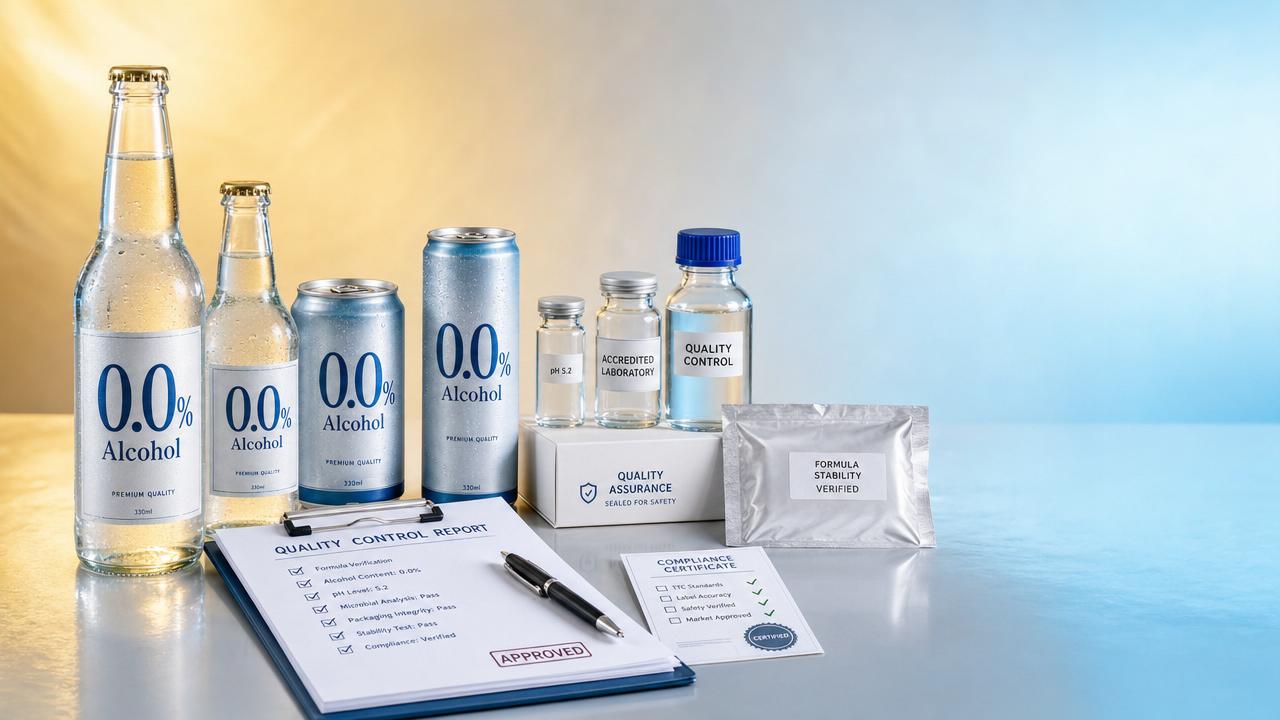
Launching 0.0% Alcohol drinks looks simple on the shelf, yet compliance work starts much earlier. Formula control, process validation, labeling accuracy and market-specific rules all affect whether a product can move smoothly from pilot batch to retail distribution.
In beverages, especially beer-adjacent products, the category is growing because consumers want moderation without giving up flavor, brand identity or convenience. That demand creates opportunity, but it also raises scrutiny from regulators, retailers and import partners.
For companies developing craft and functional beverage lines, including OEM and ODM projects, 0.0% Alcohol claims need solid technical support. A launch is not only about product appeal. It is also about proving the claim is reliable in real production and throughout the product lifecycle.
Why 0.0% Alcohol needs careful control
The term 0.0% Alcohol carries a stronger promise than low-alcohol positioning. Consumers often read it as completely alcohol-free, even when local regulations define the claim through specific analytical limits and tolerances.
That gap between consumer expectation and legal interpretation is where launch risk appears. If test data, labels or process records are weak, the problem can quickly move from a technical issue to a commercial and reputational one.
The pressure increases in cross-border trade. Different markets may accept different thresholds, naming rules, warning statements and ingredient disclosures. A compliant domestic launch does not automatically mean a compliant export launch.
What the claim means in practice
In practical terms, 0.0% Alcohol is not just a front-label phrase. It is a claim connected to formulation, fermentation management, dealcoholization performance, laboratory methods, packaging integrity and storage stability.
For malt-based drinks, wheat-style products, fruit-flavored beverages and specialty functional lines, the risk profile may differ. Residual fermentation potential, sugar content, flavor additions and microbial behavior can all influence final alcohol results.
This matters for producers with broad portfolios. A company like Jinpai Beer, which works across classic lager, German wheat, sugar-free low-calorie beer, fruit-flavored beer and specialty concepts, needs claim management that adapts to each recipe and channel.
A useful way to read the claim
The safest approach is to treat 0.0% Alcohol as a verified system claim, not a marketing phrase. That system should connect product design, in-process checks, release testing and post-market traceability.
Compliance starts with formula and process design
Many launch issues begin before packaging artwork is drafted. If the formula or process naturally creates variability, later label review cannot solve the root problem.
For 0.0% Alcohol drinks, the technical route usually falls into two paths. One is controlled production that minimizes alcohol generation. The other is producing flavor structure first, then removing alcohol through a validated process.
Each route creates different control points. Fermentation-restricted systems may face flavor limitations or microbiological pressure. Dealcoholized systems may face consistency, aroma recovery and batch-to-batch verification challenges.
- Confirm raw material specifications, especially fermentable sugars and flavor carriers.
- Define critical process parameters that influence alcohol formation or removal.
- Set validation limits for each production stage, not only the final batch.
- Check whether sweeteners, botanicals or functional ingredients affect stability.
In OEM and ODM projects, these points deserve extra attention. A customer may request a fast launch, but outsourced production does not reduce claim responsibility. It often increases the need for documented technical agreements.
Testing methods are as important as the result
A release certificate showing 0.0% Alcohol has little value if the method is not appropriate for the matrix. Carbonation, sugars, fruit components and low-level alcohol detection can affect analytical reliability.
Method selection should match the product type and the market requirement. Detection limit, repeatability, sample preparation and laboratory competence all matter, especially when the label claim leaves little room for ambiguity.
Routine verification should not rely only on one final sample. More useful control comes from trend data across pilot runs, commercial batches and shelf-life checkpoints.
Labeling and packaging often determine launch readiness
Many technically sound products get delayed because artwork review happens too late. The 0.0% Alcohol statement must align with local naming rules, nutrition declarations, ingredient lists and any required warnings.
That review should extend beyond the main label. Secondary packaging, e-commerce pages, brochures and distributor materials also shape the compliance picture. Inconsistency across channels can trigger questions even when the bottle label is correct.
Packaging also plays a technical role. If oxygen control, sealing performance or pasteurization are not stable, product change during storage may affect flavor integrity and, in some cases, claim reliability.
Points that deserve a final check
- The legal product name matches the target market category.
- The 0.0% Alcohol claim is supported by validated data.
- Nutrition, allergen and ingredient statements are complete.
- Shelf-life, storage and traceability coding are readable and durable.
- Online product descriptions do not overstate the claim.
Different channels create different compliance pressures
A restaurant listing, a supermarket rollout and an export wholesale program do not carry the same operational risks. The product may be identical, but the documentation burden changes with the channel.
Retail chains often want stable specifications, supplier audit records and packaging consistency. Cross-border distributors may ask for import registration support, translated documents and proof that 0.0% Alcohol claims fit local law.
This is especially relevant for suppliers serving global online and offline channels. When a business combines branded products, wholesale supply and customized development, launch control has to work across multiple commercial models.
That is why scalable documentation matters. A well-prepared dossier can reduce delays when the same 0.0% Alcohol beverage moves from domestic testing to private-label launch or export review.
How to judge launch readiness before scaling
A practical readiness review should combine regulatory, technical and commercial checkpoints. If one side is missing, the launch may look complete but still be fragile.
Usually, the most reliable sign is consistency. The product should not only pass one test. It should show repeatable alcohol control, stable sensory quality and complete supporting records.
A more durable approach to 0.0% Alcohol launches
The strongest 0.0% Alcohol launches are built on coordination, not speed alone. R&D, production, quality, regulatory review and packaging decisions need to move together from the beginning.
For beverage businesses expanding into craft alternatives, sugar-free lines, fruit-led concepts or customized supply, this coordination becomes a competitive advantage. It lowers correction costs and improves confidence with retail and distribution partners.
Before approving the next formula or market rollout, it helps to review three things closely: whether the 0.0% Alcohol claim is technically repeatable, whether the label is market-ready, and whether the product remains stable after release.
That review often gives a clearer answer than sales momentum alone. In this category, careful preparation is usually what turns a promising concept into a reliable product launch.
Thank you very much for writing to us. Please leave your message and contact information, we will reply to you within 24 hours.